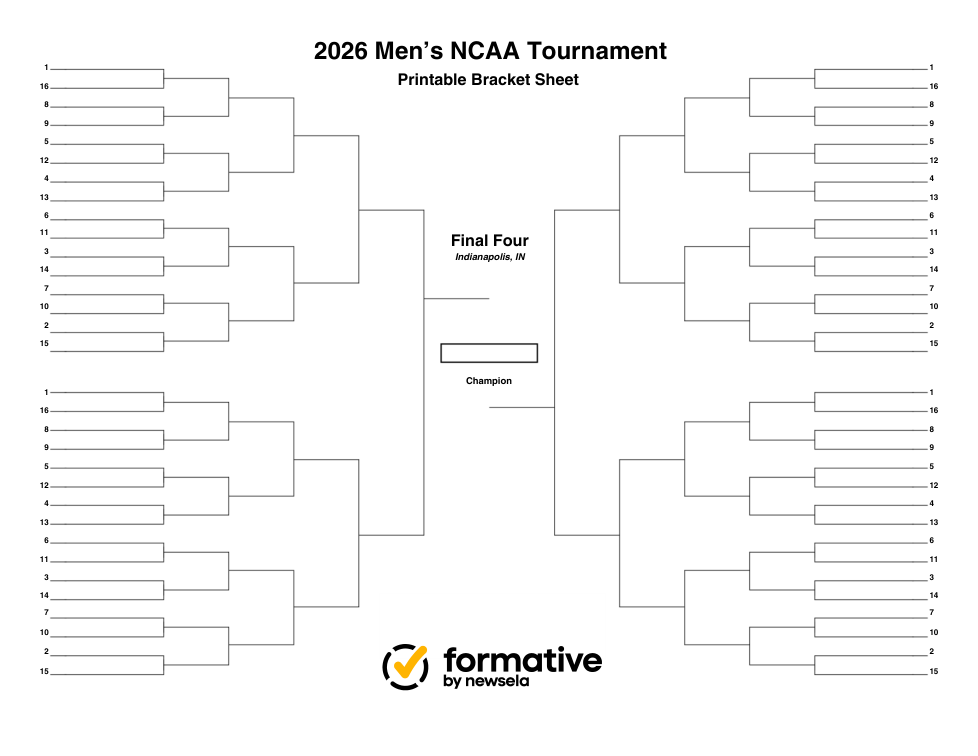
Students will answer five short items applying numeric probability and basic statistical thinking to March Madness bracket scenarios. Questions include percentage conversion, expected value of upsets, independence vs. dependence, complements, and updating probabilities after an elimination. Students should show their reasoning where applicable.

Add the names of the 64 teams paired up for the first round of the NCAA Men's March Madness Tournament.
Add the names of the teams you think will make it to the round of 32 and their pairings.
Add the names of the teams you think will make it to the Sweet Sixteen and their pairings.
Add the names of the teams you think will make it to the Elite Eight and their pairings.

Add the names of the teams that actually made it to the round of 32 and their pairings.
Add the names of the teams that actually made it to the Sweet Sixteen and their pairings.
Add the names of the teams that actually made it to the Elite Eight and their pairings.
Add the names of the teams that actually made it to the Final Four and their pairings.
An analyst estimates that a 3-seed has a
There are 32 first-round games. If each game independently has a
Consider two different first-round games on the same day, Game A and Game B. Which TWO statements are true? (Choose two.)
In a bracket, the probability that a given team does not win a particular game is called its _____. (Three words or less.)
Suppose you predicted a team had a
Add the names of the teams you think will make it to the Final Four and their pairings.
Add the two teams you think will make it to the National Championship.
Add the team you think will win the NCAA Men's March Madness tournament this year.
Add the names of the teams that actually made it to the National Championship.
Add the team that actually won the NCAA Men's March Madness tournament this year.