The engine of a car is a complex machine, including both electrical and mechanical parts. One of the most important sections of a car engine is the cylinders. Most car engines have four to eight cylinders. The chemical reaction that takes place inside each cylinder causes the pistons inside of them to move up and down, which causes the crankshaft to turn, which—through a series of many other parts—causes the wheels of the car to turn. So, what exactly goes on inside of a car’s cylinder?
Remember that a chemical equation without coefficients is not truly balanced. For example, the formula O2+H2→H2O is not balanced. On the reactant side, the subscript 2 indicates two atoms of oxygen in the molecule. On the product side, there is no subscript, indicating there is only one atom of oxygen. You can fix that by adding a coefficient in front of the water molecule: O2+H2→2H2O . Now, the oxygen is balanced, but the hydrogen is not. The atoms of hydrogen can be determined by multiplying the coefficient (2) by the subscript (2), indicating that there are now four atoms of hydrogen on the product side. Again, an added coefficient will fix that problem: O2+2H2→2H2O . The equation is now balanced.
Select and order the statements to reflect the energy changes that take place during the chemical reaction within an engine cylinder.
Choose only one option for each step.
Energy is released as heat/light/sound.
Energy is added by light/sound.
Energy is released as a spark.
Energy is added by a spark.
Products have a higher energy state than the reactants.
Products have a lower energy state than the reactants.
Step 1
Step 2
Step 3
Chemical equations can show you which reactants and products are present in an equation, but they can also help you determine how electrons move!
A combustion reaction is also a form of reduction/oxidation (redox) reaction. In redox reactions, electrons are transferred between atoms. A loss of electrons is called oxidation and results in a positive ion. A gain of electrons is called reduction and results in a negative ion.
One way to determine whether an atom is being reduced or oxidized is to know its oxidation number before and after the reaction. The oxidation number tells you how many electrons an atom has. For example, an atom with an oxidation number of −2 would have two extra electrons, while an atom with the oxidation number of +2 would be missing two electrons. Remember that extra electrons will give an atom a negative charge.
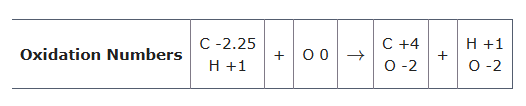
Use the given oxidation numbers to determine which atoms are being oxidized and which are being reduced in the combustion reaction for octane. Refer to the chemical equation you balanced in the first task, The Chemistry of Cars.
The coefficients in a chemical equation can stand for the number of moles needed for the reaction. If you know the number of moles needed, you can determine how many grams of the molecule you need. The molar mass of an atom is equivalent to its atomic mass in grams. For example, 1 mole of hydrogen is 1 gram. The molar mass of a molecule is found by adding the atomic mass of each atom, remembering to include subscripts in the formula. For example, the molar mass of H2O is 1(2)+8=10g .
Of course, molar equations assume 100 percent efficiency, which is often not the case in real life. Le Chatelier’s Principle is based on the idea that if the conditions surrounding the reaction are changed, the equilibrium of the equation can shift. If the equilibrium shifts to the reactants, more reactants will be needed. If the equilibrium shifts to the product, more products will be produced.
Le Chatelier’s Principle states that a change in concentration of reactants or products, a change in system pressure, or a change in system temperature can shift the equilibrium:
Changing concentration: An increase in reactant concentration will shift the equilibrium to the product side and vice versa.
Changing pressure: An increase in pressure will shift the equilibrium to the side with the fewest moles of gas and vice versa.
Changing temperature: In endothermic reactions, an increase in temperature will shift the equilibrium to the product side. In exothermic reactions, an increase in temperature will shift the equilibrium to the reactant side.
Using your balanced equation from the first task, determine how many moles of octane will fill an average gas tank and how many kilojoules (kJ) of energy that amount of octane will produce. Show your work.
Assume the fuel is 100 percent pure and the reaction is 100 percent efficient.
The average gas tank can contain 13 gallons (49.2 liters) or roughly 34,000 grams of octane.
For every mole of octane burned, 5460 kJ of energy is produced.
Choose one variable in the octane combustion reaction you would like to increase—either product or reactant—and explain what you would change to cause the shift. Describe how you could quantitatively test whether your experiment worked, including controls you would put in place and how you would measure the amount of reactants and products.
Gasoline engines are not the only combustion engines we use to power machines. Another example is the diesel engine. In a diesel engine, air is allowed into the cylinder and then supercompressed, causing its temperature to rise. When the fuel is misted in and compressed with the hot air, it ignites, creating a powerful explosion. Diesel engines have no need for spark plugs and use their fuel much more efficiently than a gasoline engine.
Another alternative to a gasoline or diesel engine is the electric car.
All cars have some sort of battery to start the engine moving and to run the electrical components of the car, but electric cars are run entirely on batteries! Electric cars use rechargeable batteries and can be plugged into your home or a charging station to build up energy instead of needing to be refueled at gas stations.
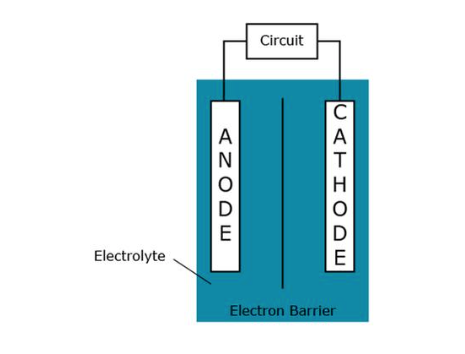
Use context clues from the video and this diagram of a rechargeable battery to determine which sentences in the explanation of rechargeable batteries are incorrect.
Select all incorrect sentences.
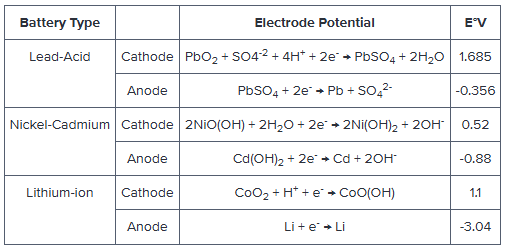
Three of the most common batteries used in electric cars are lead-acid, nickel-cadmium, and lithium-ion. You can determine the potential energy of each battery cell by using the formula E°Cell=E°Cathode − E°Anode .

Use the data from the “Electrode Potential” chart and the formula E°Cell = E°Cathode – E°Anode to determine the potential energy of each cell type. Connect the correct potential energy with each cell type.
| Draggable item | arrow_right_alt | Corresponding Item |
|---|---|---|
| arrow_right_alt | 2.041 V | |
Lead-Acid | arrow_right_alt | 1.4 V |
| arrow_right_alt | 4.14V | |
Lithium-Ion | arrow_right_alt | -2.04V |
| arrow_right_alt | -0.36V | |
Nickel-Cadmium | arrow_right_alt | 1.329 V |
Most electric cars use groups of battery cells inside of packs to power the car because a single battery cell can only do so much. Use the potential energy you calculated for lithium-ion cells to determine how many battery cells would be needed to power a 375-V car.