
Match the name of each enzyme with its function.
| Draggable item | arrow_right_alt | Corresponding Item |
|---|---|---|
ligase | arrow_right_alt | opens up the DNA, separating the two strands by breaking the hydrogen bonds between their bases |
primase | arrow_right_alt | replicates DNA molecules to make a new complementary strand |
topoisomerase | arrow_right_alt | lays down RNA primers which allow DNA polymerase to bind to the DNA |
DNA polymerase | arrow_right_alt | seals the DNA together after replication |
helicase | arrow_right_alt | prevents DNA ahead of the helicase from supercoiling |
Match the replication terms with their definition.
| Draggable item | arrow_right_alt | Corresponding Item |
|---|---|---|
lagging strand | arrow_right_alt | the position on DNA where replication begins |
semi-conservative | arrow_right_alt | special proteins that bind onto the separated DNA strands to ensure they don't come back together |
leading strand | arrow_right_alt | short pieces of RNA that allow DNA polymerase to bind to the separated DNA strands |
Okazaki fragments | arrow_right_alt | the two DNA strands run in opposite directions: one from 5' to 3' and the other from 3' to 5' |
Single-Stranded Binding Proteins (SSBs) | arrow_right_alt | the new DNA strand that DNA polymerase is continuously synthesizing |
primers | arrow_right_alt | the new DNA strand that DNA polymerase is discontinuously synthesizing |
origin | arrow_right_alt | DNA fragments formed due to discontinuous DNA synthesis |
antiparallel | arrow_right_alt | after replication is complete, both DNA molecules have one old strand and one new strand. |
What is the function of the enzyme exonuclease?
What additional step was involved in this animation besides the function of exonuclease?
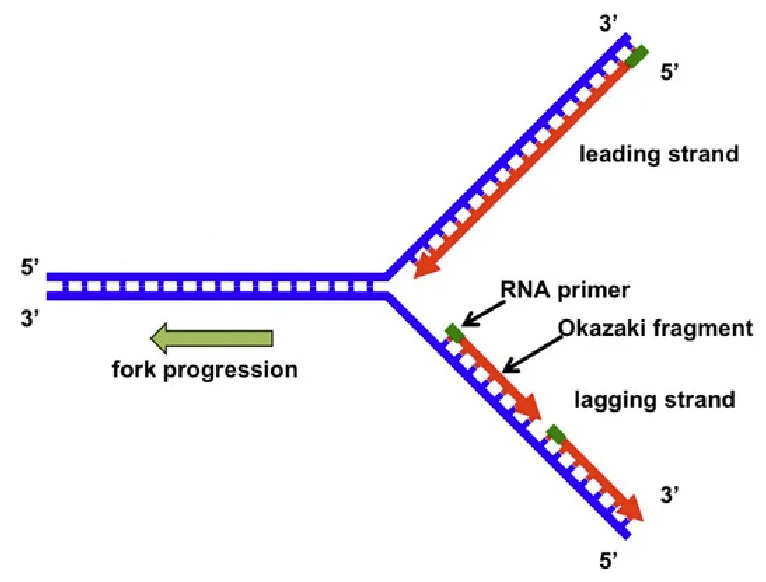
Click on the area where helicase would be located:
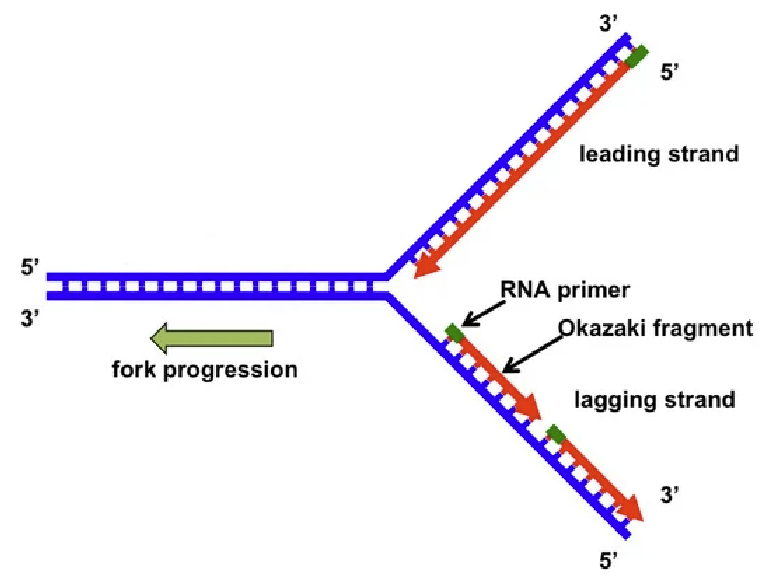
Click on the area where primase would be located:
Click on the area where DNA polymerase would be located:
Click on the area where topoisomerase would be located:

Categorize each enzyme and/or PCR process according to their function in DNA replication.
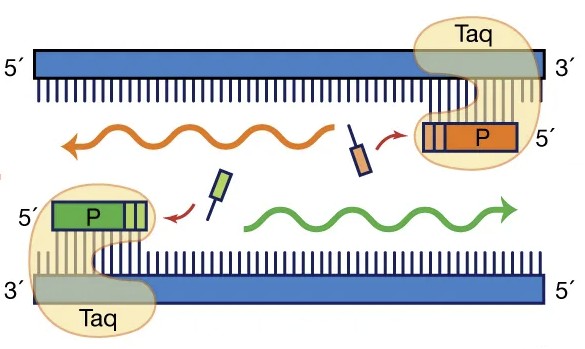
Taq polymerase + heating to 72 degrees C
DNA polymerase
helicase
heating to 95 degrees C
primase
cooling to 55 degrees C
ligase
Synthesizes new DNA
Breaks apart DNA strands
Attaches primers
Seals DNA together after replication
YOU WILL USE THE ANSWERS FROM MULTIPLE CHOICE QUESTIONS 10-13.
TO ANSWER THE FOUR (4) MULTIPLE CHOICE QUESTIONS IN CANVAS IN
"B.6(A) DNA Replication Review"
Each question must be correct on Canvas to receive full credit.
Think of all the enzymes involved in DNA replication. If ligase were to be removed from a cell, what would happen?
Compare the DNA strands replicated in PCR to the replication fork from natural DNA replication. Why does PCR not have Okazaki fragments?
What might cause the separate DNA strands in a replication fork to snap back together and end replication early?
Recall that all of these enzymes and steps occur in the S phase of the cell cycle. If it weren't for DNA replication, what might happen to dividing cells during mitosis?
YOU WILL USE THE ANSWERS FROM MULTIPLE CHOICE QUESTIONS 10-13 IN THIS FORMATIVE.
TO ANSWER THE FOUR (4) MULTIPLE CHOICE QUESTIONS IN CANVAS IN
"B.6(A) DNA Replication Review"
Each question must be correct on canvas to receive full credit.