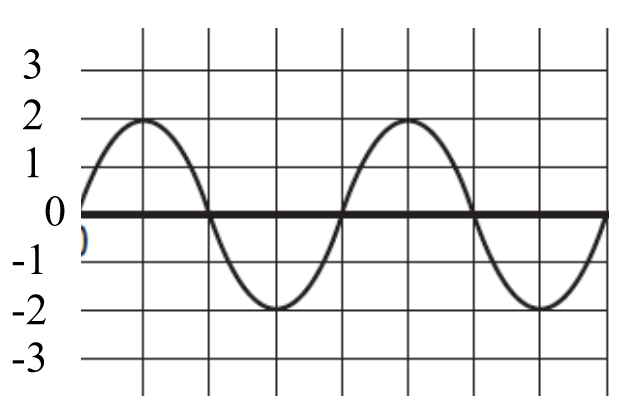
Use the diagram of a wave below to answer questions 2-4. Assume each box is equal to 1 meter.
Match the vocabulary term to its correct definition by dragging the definition next to the correct term.
| Draggable item | arrow_right_alt | Corresponding Item |
|---|---|---|
A disturbance that transfers energy from one location to another location | arrow_right_alt | Amplitude |
The height of a wave from the rest position (middle) | arrow_right_alt | Crest |
The number of waves that pass a point per unit of time | arrow_right_alt | Frequency |
The distance between two similar points in a wave (crest to crest) | arrow_right_alt | Trough |
The highest point of the wave | arrow_right_alt | Wave |
The lowest point of the wave (bottom) | arrow_right_alt | Wavelength |
Use the diagram of a wave below to answer questions 2-4. Assume each box is equal to 1 meter.
What is the wavelength (in m) of the wave above?
What is the amplitude (in m) of the wave above?
How many waves are shown in the wave diagram above?
Which of these is an electromagnetic wave?
Which type of electomgnetic waves can humans see?
A large explosion can damage a person's hearing. What causes this damage?
Choose the option that best completes the sentence.
The larger the amplitude...
Choose the option that best completes the sentence.
The higher the frequency...
There is no air in outer space and so is referred to as a vaccuum. Because of this, sound cannot travel in space.