Text and pictures adapted from "Adventure Tales of America" book. Spanish text translation by Google translate. (Apologies that I have no translation for the questions.)
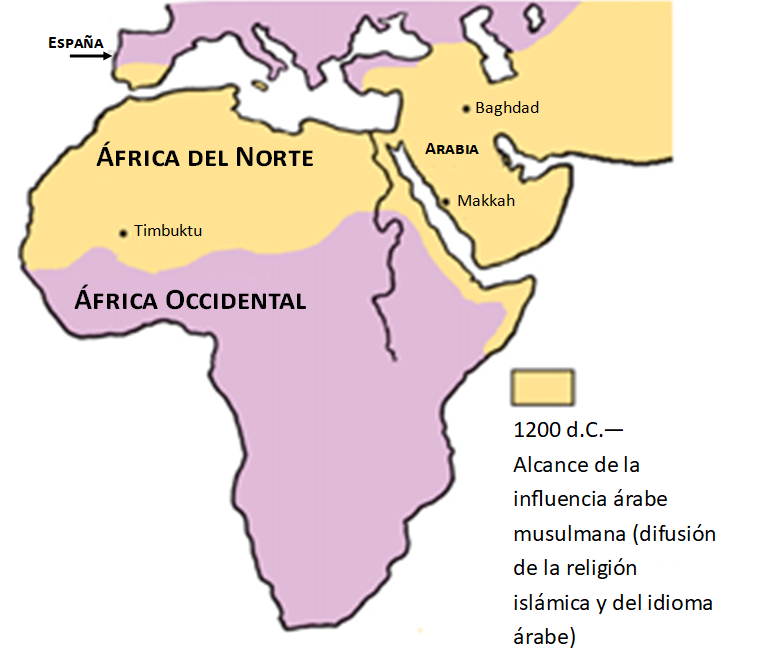
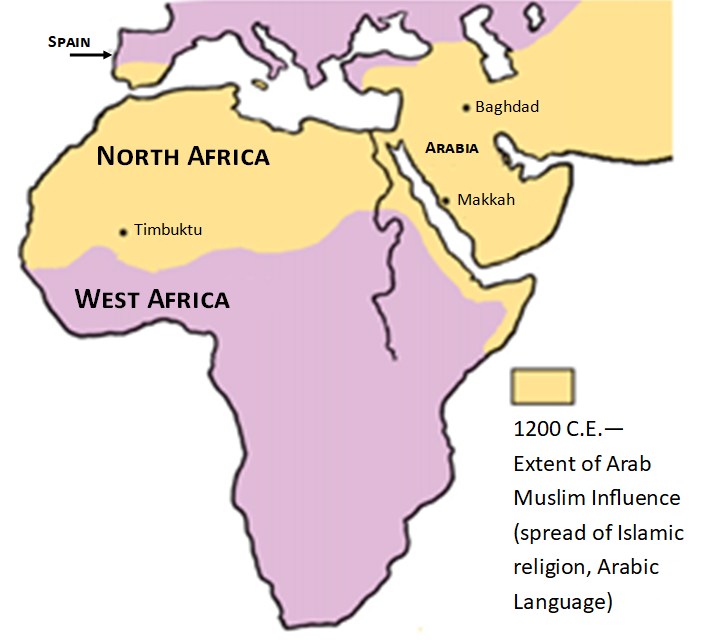
West Africa's historical record is incomplete because few written records exist prior to the 1800s. The earliest—beginning in the 900s—are travel accounts by Arab Muslims from North Africa and Spain.
During centuries of trade across the Sahara Desert (trans-Saharan trade), Muslim merchants and scholars from North Africa brought literacy to West African cities in the Sudan, such as Timbuktu, and by the 1600s some West Africans were writing their own history. An example is Abd al-Rahman as-Sadi of Timbuktu who wrote Tarikh as-Sudan (Arabic for History of the Sudan) in the 1600s.
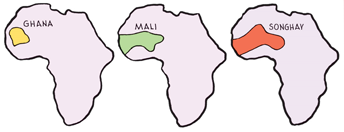
From these written records, plus archaeology (digging up or finding artifacts), and oral tradition (storytelling shared by voice), we know of wealthy, powerful kingdoms—such as Ghana, Mali, and Songhay—existing in West Africa during the medieval period (from approximately 700-1600 CE).
-- -- -- -- -- -- -- -- -- --
El registro histórico de África Occidental es incompleto debido a la escasez de registros escritos anteriores al siglo XIX. Los más antiguos, que datan del siglo XIX, son relatos de viajes de musulmanes árabes del norte de África y España.
Durante siglos de comercio a través del desierto del Sahara (comercio transahariano), comerciantes y eruditos musulmanes del norte de África llevaron la alfabetización a ciudades de África Occidental en Sudán, como Tombuctú, y para el siglo XVII, algunos africanos occidentales ya escribían su propia historia. Un ejemplo es Abd al-Rahman as-Sadi de Tombuctú, quien escribió Tarikh as-Sudan (Historia de Sudán en árabe) en el siglo XVII.
A partir de estos registros escritos, además de la arqueología y la tradición oral, conocemos la existencia de reinos ricos y poderosos, como Ghana, Mali y Songhay, en África Occidental durante el período medieval (aproximadamente entre el 700 y el 1600 d. C.).
GOLD TRADE CREATES WEST AFRICAN EMPIRES
GOLD—this precious metal located in West Africa fueled a highly organized trans-Saharan trade system between North African Arab Muslims and West Africans, which gave rise to three great West African empires.
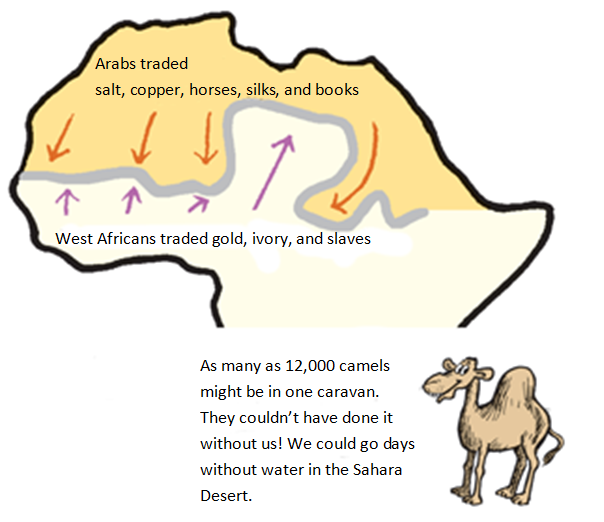
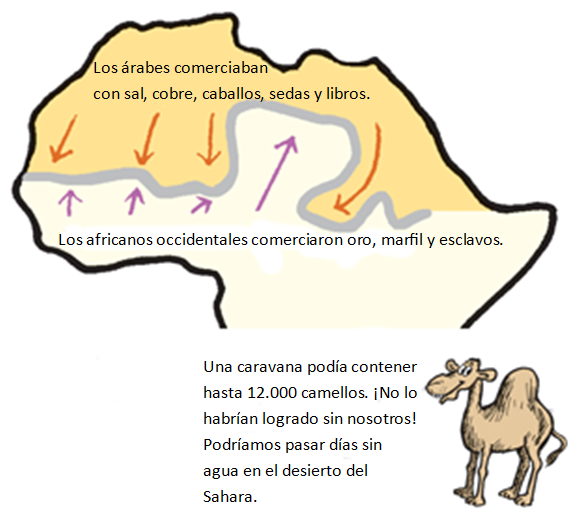
A demand for West African gold motivated North African Arab merchants to brave the dangerous 1,200 mile Sahara Desert to trade salt for gold. The demand for gold came from Europe as well as North Africa, for European and Asian gold mines were nearly depleted by 1000 C.E. For 500 years, until Spain's discovery of the New World's gold, West Africans controlled the western world's gold supply.
EL COMERCIO DE ORO CREA IMPERIOS EN ÁFRICA OCCIDENTAL
ORO: este metal precioso, ubicado en África Occidental, impulsó un sistema comercial transahariano altamente organizado entre los musulmanes árabes del norte de África y los africanos occidentales, lo que dio origen a tres grandes imperios de África Occidental.
La demanda de oro de África Occidental motivó a los comerciantes árabes del norte de África a aventurarse en el peligroso desierto del Sahara, de 1930 kilómetros de longitud, para intercambiar sal por oro. La demanda de oro provenía tanto de Europa como del norte de África, ya que las minas de oro europeas y asiáticas estaban casi agotadas para el año 1000 d. C. Durante 500 años, hasta el descubrimiento del oro del Nuevo Mundo por parte de España, los africanos occidentales controlaron el suministro de oro del mundo occidental.
What precious metal is responsible for the creation of medieval West African kingdoms?
Put the 3 major West African kingdoms in chronological order (put them in the order from oldest to youngest)
Ghana
Mali
Songhay
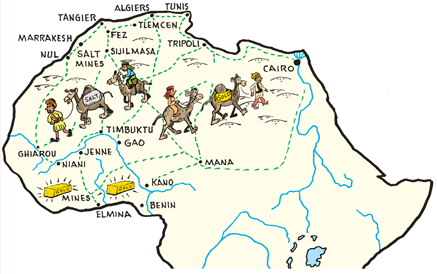
TRADE ROUTES ACROSS THE SAHARA
Centuries of trade between North African Arabs and West African kingdoms created wealthy cities along the Sudan trade routes. Rulers of the cities controlled trans-Saharan trade as middlemen, taxing both imported salt and exported gold. Using their trade wealth, successive West African rulers built military strength (based on iron weapons), conquered their neighbors, and developed large kingdoms.
RUTAS COMERCIALES A TRAVÉS DEL SÁHARA
Siglos de comercio entre los árabes del norte de África y los reinos de África Occidental dieron origen a ricas ciudades a lo largo de las rutas comerciales de Sudán. Los gobernantes de las ciudades controlaban el comercio transahariano como intermediarios, gravando tanto la sal importada como el oro exportado. Utilizando su riqueza comercial, los sucesivos gobernantes de África Occidental consolidaron su poderío militar (basado en armas de hierro), conquistaron a sus vecinos y desarrollaron grandes reinos.
This animal was essential for the gold and salt trade because they could go days without water.
WEST AFRICAN RELIGIONS
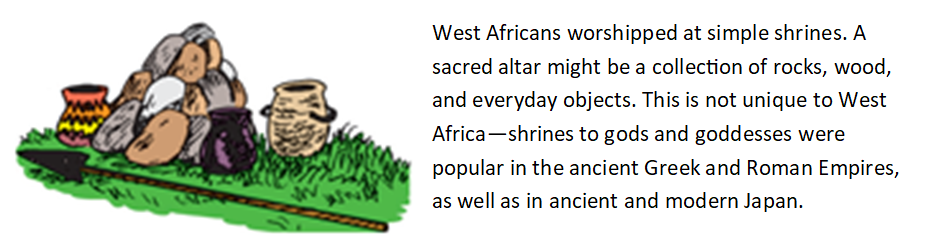
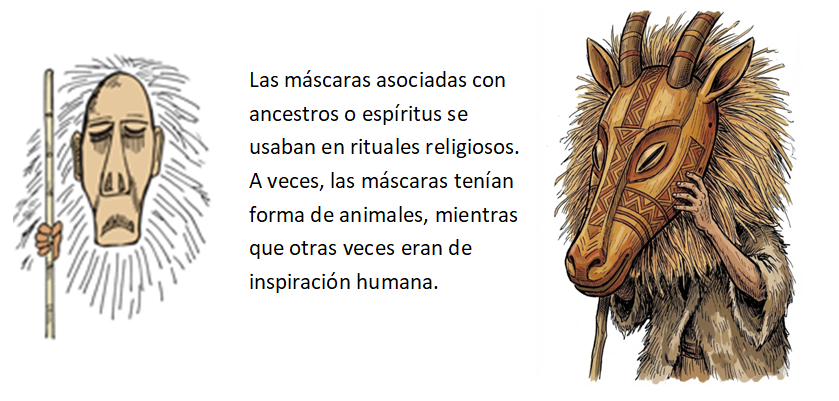
Most West Africans were polytheists—believers in many gods: a High God (the creator) and lesser gods. Some gods controlled and resided within nature (a belief system called animism) and some gods were the spirits of their ancestors.
Ancestor worship regulated all of life because of the belief that forefathers' spirits had great power over their living families and must be obeyed and pleased. This meant observing laws and rules of behavior the ancestors had established while alive—that is, living as the dead relatives had once lived. Traditions such as these were incredibly difficult to change because change was seen as suspicious and untrustworthy. Polygyny, the practice of having multiple wives, was allowed.
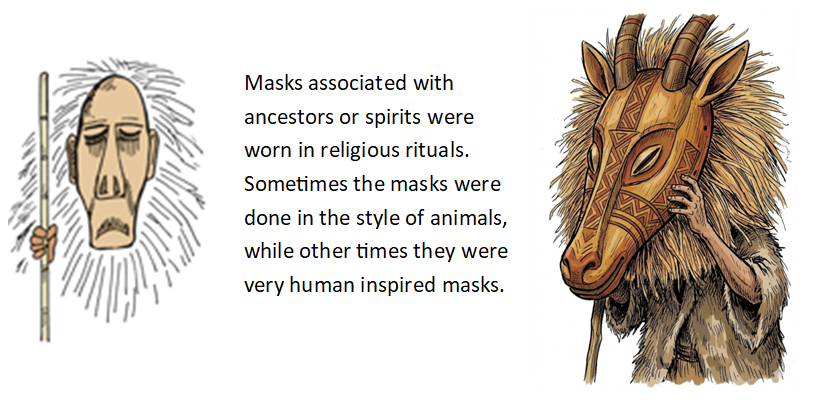
Religion and politics were one: kings, chiefs, and family heads were considered the ancestors' earthly representatives, and thus the religious as well as political leaders. Like other pre-scientific peoples, including European Christians, West Africans believed in witchcraft, the use of supernatural powers, usually for evil. In defense, West Africans relied on spiritual leaders (sometimes referred to as shamans by historians) and magic charms to combat spiritual evil.
RELIGIONES DE ÁFRICA OCCIDENTAL
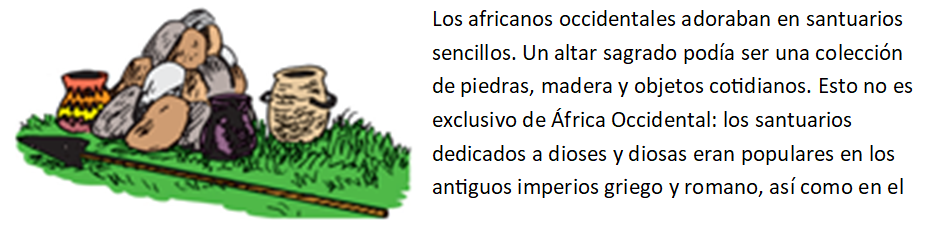
La mayoría de los africanos occidentales eran politeístas: creían en muchos dioses: un Dios Supremo (el creador) y dioses menores. Algunos dioses controlaban y residían en la naturaleza (un sistema de creencias llamado animismo) y otros eran los espíritus de sus antepasados.
El culto a los antepasados regulaba toda la vida debido a la creencia de que los espíritus de los antepasados tenían un gran poder sobre sus familias vivas y debían ser obedecidos y complacidos. Esto implicaba observar las leyes y normas de comportamiento que los antepasados habían establecido en vida; es decir, vivir como vivieron sus parientes fallecidos. Este tipo de tradiciones eran increíblemente difíciles de cambiar, ya que se consideraba sospechoso y poco fiable. La poligamia, la práctica de tener múltiples esposas, estaba permitida.
La religión y la política eran una sola: reyes, jefes y cabezas de familia eran considerados representantes terrenales de los antepasados y, por lo tanto, líderes tanto religiosos como políticos. Al igual que otros pueblos precientíficos, incluidos los cristianos europeos, los africanos occidentales creían en la brujería, el uso de poderes sobrenaturales, generalmente para el mal. Para defenderse, los africanos occidentales recurrían a líderes espirituales (a los que los historiadores a veces llamaban chamanes) y a amuletos mágicos para combatir el mal espiritual.
ISLAM
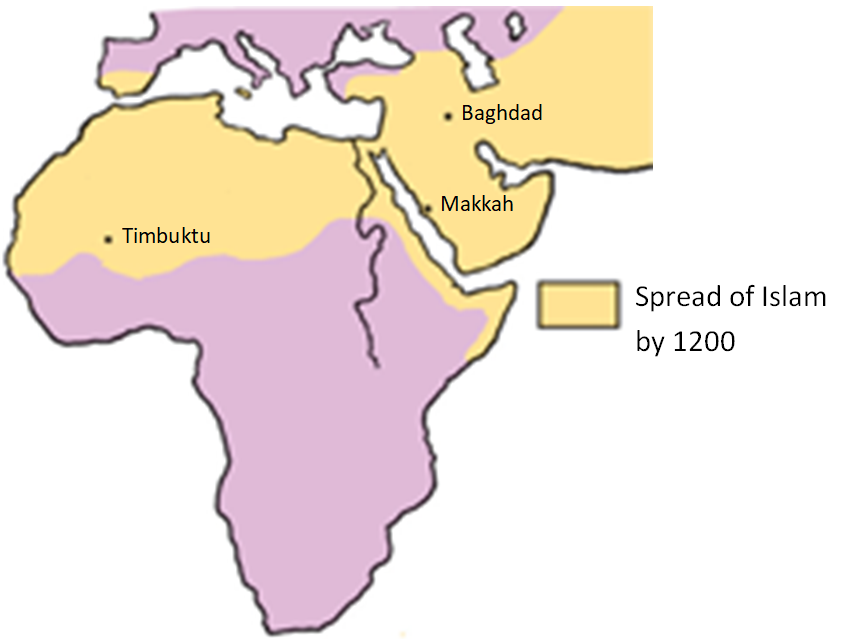
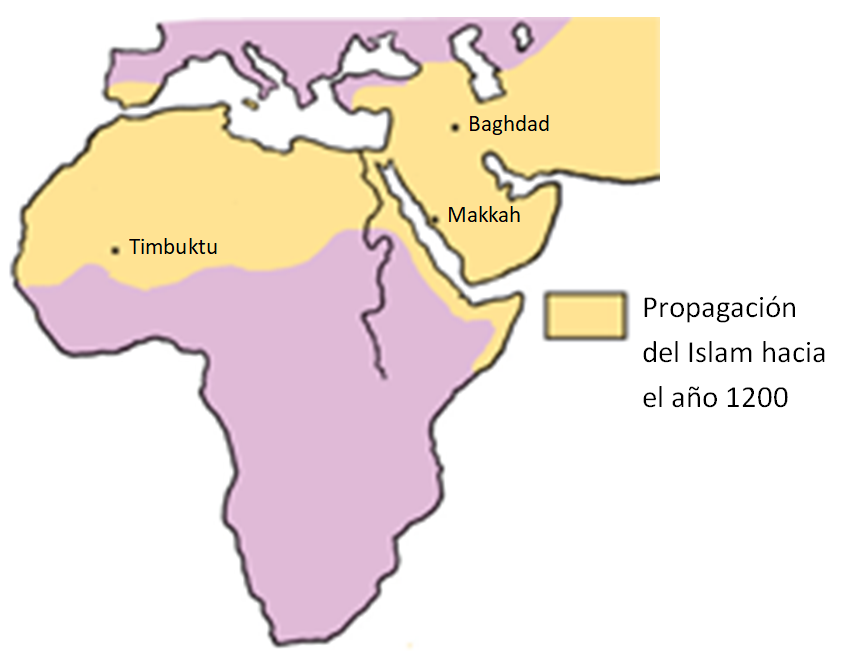
By 1100 many West Africans had converted to Islam, a monotheistic religion (belief in one god) founded in 622 by Muhammad in Mecca, Arabia. In Arabic Islam means "submission to the will of God." Muslim means "a believer in Islam. "Qur'an, the name of Islam's holy book, means "the reading."
Muhammad taught that there was only one God, Allah; that Muhammad was his prophet; and that Islam must be spread to other peoples. He taught that Muslims must practice ethical behavior, such as honesty, fairness, courage, honor, charity, and kindness—including to slaves; that evildoers must be punished on the Old Testament basis of retribution: "an eye for an eye, a tooth for a tooth." Islam allowed polygyny, as long as all the wives were treated with justice and fairness, with a limitation of four wives. Historically, this was accepted because it helped provide support for the widows of men killed--in war, by disease and famine, and so on--when they might not otherwise be able to sustain themselves.
Arabic became the language of West African literature, and the Arabic alphabet was used to write some African languages. This paralleled events in Europe, where Latin was the language of literacy and the Latin alphabet was used to write European languages.
ISLAM
Para el año 1100, muchos africanos occidentales se habían convertido al islam, una religión monoteísta (creencia en un solo dios) fundada en el año 622 por Mahoma en La Meca, Arabia. En árabe, islam significa "sumisión a la voluntad de Dios". Musulmán significa "creyente en el islam". Corán, el nombre del libro sagrado del islam, significa "la lectura".
Mahoma enseñó que solo había un Dios, Alá; que Mahoma era su profeta; y que el islam debía difundirse a otros pueblos. Enseñó que los musulmanes debían practicar un comportamiento ético, como la honestidad, la justicia, la valentía, el honor, la caridad y la bondad, incluso con los esclavos; que los malhechores debían ser castigados según el principio de retribución del Antiguo Testamento: "ojo por ojo, diente por diente". El islam permitía la poligamia, siempre que todas las esposas fueran tratadas con justicia y equidad, con un límite de cuatro esposas. Históricamente, esto se aceptaba porque ayudaba a sustentar a las viudas de los hombres que habían muerto —en guerras, enfermedades, hambrunas, etc.— cuando de otro modo no habrían podido subsistir.
El árabe se convirtió en la lengua de la literatura de África Occidental, y el alfabeto árabe se utilizó para escribir algunas lenguas africanas. Esto coincidió con los acontecimientos en Europa, donde el latín era la lengua de alfabetización y el alfabeto latino se utilizaba para escribir las lenguas europeas.
Which of the following statements best describes why West Africa's history seems incomplete [select 2 correct answers]
What factors contributed to the spread of literacy and writing in West African cities like Timbuktu? [select 2 correct answers]
According to the text, have these things helped us prove that wealthy and powerful kingdoms existed in West Africa during the medieval period?
Yes | No | |
|---|---|---|
Archaeology | ||
Genetic Testing | ||
Oral Tradition | ||
Written Records | ||
Satellite Imagery |
According to the text, which factors caused the high demand for West African gold?
West African rulers became rich and powerful because of which factors?
The practice of ancestor worship played a central role in West African life. Which of the following statements correctly describe its impact?
Islam is a polytheistic religion that believes in many gods.
Muhammad taught that Muslims were required to practice ethical behaviors, such as honesty and charity, and that kindness should be extended even to slaves.
Historically, Islam allowed a man to have an unlimited number of wives, provided he treated them all fairly.