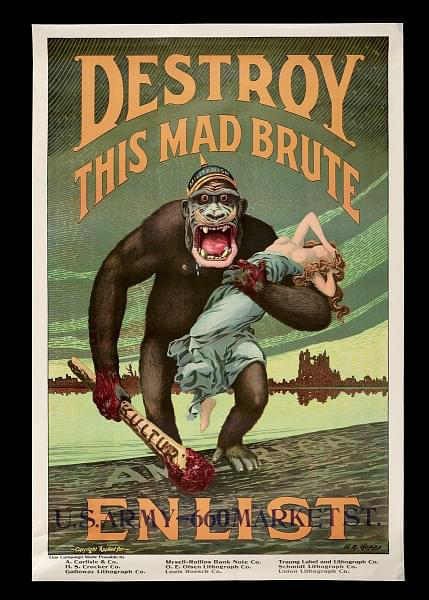
Souce 1.4 Image Description (for accessibility): A huge, violent gorilla labeled “Germany” storms across land holding a screaming woman. The Gorilla carries a bloody club reading “KULTUR.” The poster urges American men to join the army.
In this assignment, you will evaluate whether the United States was justified in entering World War I. You will analyze multiple historical sources, answer comprehension questions, and write an argumentative essay using evidence from the sources provided. Use the research notes organizer to collect your evidence and plan your essay. Be sure to use formal academic language and support your argument with evidence from at least three different sources.
Answer the following comprehension questions based on the passages above. These questions will help you analyze the sources before writing your essay.
Source 1.1
“Historians often summarize the causes of U.S. entry into WWI with the acronym S.U.L.T.Z.:
S – Sussex Pledge: Germany promised (but later violated) warnings before attacks.
U – Unrestricted Submarine Warfare: Germany resumed sinking ships without warning, including U.S. vessels.
L – Lusitania: In 1915, a German U-boat sank this passenger liner, killing 128 Americans.
T – Ties to Great Britain: America’s cultural and economic connections to Britain made neutrality difficult.
Z – Zimmermann Telegram: Germany urged Mexico to attack the U.S. in exchange for lost territory. By early 1917, many believed Germany had crossed too many lines for the United States to remain neutral.” Impact of German Actions (S.U.L.T.Z.), Secondary Source
Source 1.2
“When World War I began in 1914, many Americans saw no reason to become involved in a European conflict. The United States had a long tradition of avoiding “entangling alliances,” and millions of Americans were recent immigrants with cultural ties to countries on both sides of the war. Entering the conflict risked dividing communities and families. Businesses also feared war. American factories and farms relied on selling goods to all belligerent nations. If the United States took sides, the nation risked losing customers and damaging its economy. President Woodrow Wilson insisted the United States must remain “neutral in thought as well as action.” Isolationists argued that war would violate American democratic ideals, empower corporations, and cause unnecessary deaths. As newspapers debated the issue, the country remained sharply divided.” Why America Stayed Neutral (1914–1917), Informational Text, Approx. Lexile 1150
Souce 1.3 “The present German submarine warfare against commerce is a warfare against mankind… American ships have been sunk, American lives taken. We are accepting this challenge of hostile purpose because we know that the world must be made safe for democracy.”
Wilson’s message shifted the nation from neutrality to intervention. He argued that the United States had no choice but to defend its people and protect the rights of neutral nations.”
President Woodrow Wilson, War Message to Congress (1917), Primary Source (Excerpt)
Souce 1.4 Image Description (for accessibility): A huge, violent gorilla labeled “Germany” storms across land holding a screaming woman. The Gorilla carries a bloody club reading “KULTUR.” The poster urges American men to join the army.
“Mud clung to your boots as you crouched low in the trench, waiting for dawn. Every sound—every rat—felt like a warning of another attack. Weeks had passed with almost no sleep. You had imagined glory when you enlisted; instead, you found cold, hunger, and the constant fear of gas or shellfire.
Thousands of soldiers faced conditions like these every day. While Americans debated neutrality at home, those fighting on the Western Front wondered how much longer they could survive.”
Life in the Trenches (fictional but historically accurate), Literary/Narrative Source
Which best describes the main argument in Source 1.2?
Question What event from Passage 3 most strongly pressured the United States to enter the war? Explain why.
The purpose of the propaganda poster in Passage 4 is to:
In Passages 1.2 and 1.3, how does Wilson justify his request for a declaration of war?
Historical Understanding (3 pt)
Use of Evidence from Sources (3 pt)
Explanation and Reasoning (3 pt)
Organization and Clarity (2 pt)
Your essay must:
Take a clear position (Yes or No)
Support your argument with evidence from at least 3 sources
Acknowledge & rebut the opposing viewpoint
Explain how your evidence supports your claim
Use formal academic language
Length: 1-3 paragraphs
Use the research notes organizer to plan your essay. Refer to the rubric for guidance on how your essay will be scored.
Clear Position/Claim (3 pt)
Use of Evidence from Sources (3 pt)
Explanation and Analysis of Evidence (3 pt)
Counterargument and Rebuttal (3 pt)
Organization and Structure (3 pt)
Academic Language, Grammar, and Spelling (3 pt)