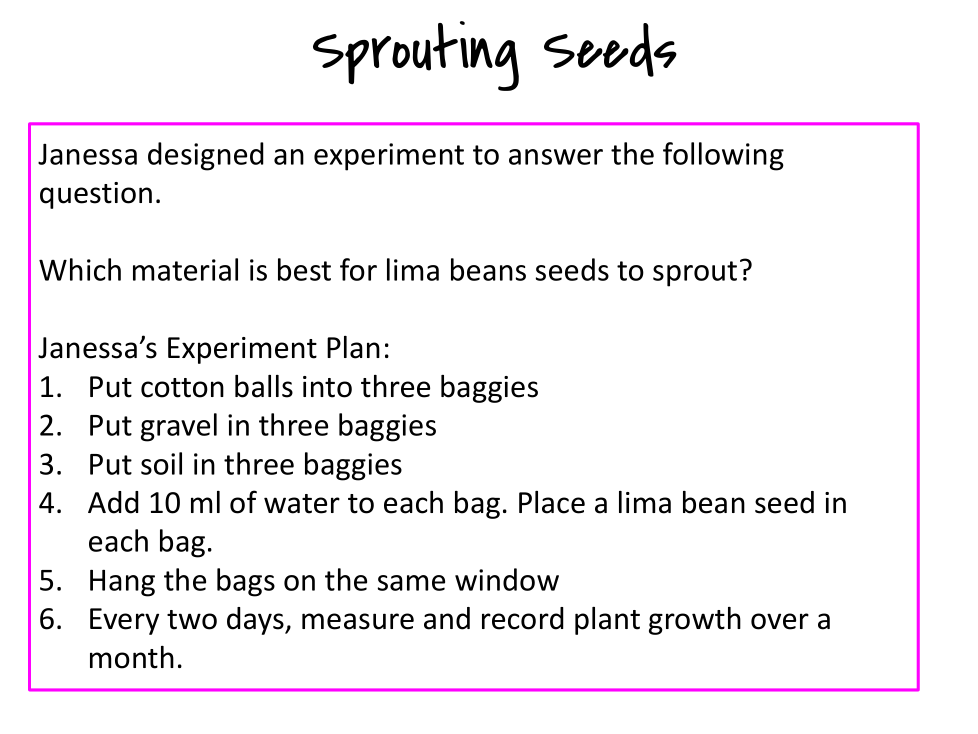
Parts of an Experiment
Independent Variable (IV): The factor that is changed or controlled in a scientific experiment. [cause]
Spanish: Variable independiente
Chinese: 独立变量 (Dúlì biànliàng)
Dependent Variable (DV): The factor that is measured or observed in a scientific experiment.[effect]
Spanish: Variable dependiente
Chinese: 因变量 (Yīn biànliàng)
Control: The standard to which comparisons are made in an experiment. [It is kept constant or the same]
Spanish: Control
Chinese: 对照 (Duìzhào)
Scientific Method vs. Engineering Design
Scientific Method: Involves forming a hypothesis and conducting experiments to observe and analyze how variables interact.
Spanish: Método científico
Chinese: 科学方法 (Kēxué fāngfǎ)
Engineering Design: Focuses on creating solutions by identifying problems, designing prototypes or models, and testing solutions.
Spanish: Diseño de ingeniería
Chinese: 工程设计 (Gōngchéng shèjì)
Physical Science ONLY
Forces and Motion
Force: Push or Pull
Definition: A force is a push or pull upon an object resulting from the object's interaction with another object.
Spanish: Empujar o tirar
Chinese: 推或拉 (Tuī huò lā)
Contact Forces
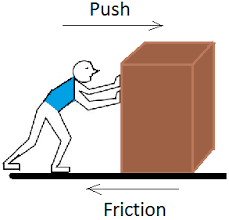
Definition: Forces that occur when two objects are in physical contact with each other.
Examples:
Friction: A force that opposes motion between two surfaces.
Tension: A force transmitted through a string, cable, or wire.
Spanish: Fuerzas de contacto
Chinese: 接触力 (Jiēchù lì)
Non-Contact Forces 
Definition: Forces that occur even when the objects are not in physical contact.
Examples:
Gravity: A force that attracts two bodies towards each other.
Electo Magnetic Force: The force produced by electrical and magnetic energy.
Spanish: Fuerzas no de contacto
Chinese: 非接触力 (Fēi jiēchù lì)
Newton's First Law
Definition: An object will remain at rest or in uniform motion in a straight line unless acted upon by an external force. This is often referred to as the law of inertia.
Spanish: La primera ley de Newton
Chinese: 牛顿第一定律 (Niúdùn dì yī dìnglǜ)
Inertia
Definition: The tendency of an object to resist changes in its state of motion. It's directly related to the mass of the object.
Spanish: Inercia
Chinese: 惯性 (Guànxìng)