Twa kɔ nsɛm atitiriw so
Log in
Sign up for FREE
arrow_back
Laabri

Unit 5 Study Guide

star
star
star
star
star
Last updated 20 days ago
46 Nsɛmmisa
Untitled Section 1
Ɛhia
1
Ɛhia
1
Ɛhia
1
Ɛhia
1
Ɛhia
1
Ɛhia
1
Ɛhia
1
Ɛhia
1
Ɛhia
1
Ɛhia
1
Ɛhia
1
Ɛhia
1
Ɛhia
1
Ɛhia
1
Extension
0
0
Asemmisa {{asɛmmisaAhyɛnsode}}
1.

Simplify (-3x^{-1}y^{2}z)^{3}(-2x^{0}y^{-5}z^{-1})

Asemmisa {{asɛmmisaAhyɛnsode}}
2.

Simplify \frac{72x^{-9}y^{-3}z}{16x^{3}y^{-3}z^{-6}}

Asemmisa {{asɛmmisaAhyɛnsode}}
3.

Condense the following expression into a single expression:

\frac{1}{2}\log_{3}x - 4 log_{3}y

Asemmisa {{asɛmmisaAhyɛnsode}}
4.

Condense the following expression into a single expression:

3lnx+\frac{1}{3}lny-ln2

Asemmisa {{asɛmmisaAhyɛnsode}}
5.

Expand the following expression:

lnx^{2}y^{4}z

Asemmisa {{asɛmmisaAhyɛnsode}}
6.

Expand the following expression:

\frac{log_{4}a^{3}\sqrt[3]{c}}{log_{4}b^{2}}

Asemmisa {{asɛmmisaAhyɛnsode}}
7.

Solve 4\cdot5^{2x+1}=500

Asemmisa {{asɛmmisaAhyɛnsode}}
8.

Solve 7^{3x+1}=49^{x+1}

Asemmisa {{asɛmmisaAhyɛnsode}}
9.

Solve 3\cdot6^{x-8}=648

Asemmisa {{asɛmmisaAhyɛnsode}}
10.

Solve 9^{2x+1}=81^{3x+4}

Asemmisa {{asɛmmisaAhyɛnsode}}
11.

Solve log_{3}(4x+773)=6

Asemmisa {{asɛmmisaAhyɛnsode}}
12.

Solve 5+log_{4}(2x+63)=8

Asemmisa {{asɛmmisaAhyɛnsode}}
13.

Solve log_{5}(6x-19)=3

Asemmisa {{asɛmmisaAhyɛnsode}}
14.

Solve log_{3}(10x-9)+6=10

Consider the function f(x)=p(0.5)^{x}+q, where p and q are constants. The graph of f(x) passes through the points (0,6) and (1,4).

Ɛhia
1
Asemmisa {{asɛmmisaAhyɛnsode}}
15.

Write down an equation relating p and q.

Ɛhia
1
Asemmisa {{asɛmmisaAhyɛnsode}}
16.

Write down the other equation relating p and q.

Ɛhia
1
Asemmisa {{asɛmmisaAhyɛnsode}}
17.

Find the value of p and q.

Type your answer in p=,q=

No Spaces

Ɛhia
1
Asemmisa {{asɛmmisaAhyɛnsode}}
18.

Write down the equation of the horizontal asymptote to the graph of f(x).

The pH of a solution measures its acidity and can be determined using the formula pH=-log_{10}C, where Cis the concentration of hydronium ions in the solution, measured in moles per liter. A lower pH indicates a more acidic solution.

Ɛhia
1
Asemmisa {{asɛmmisaAhyɛnsode}}
19.

The concentration of hydronium ions in a particular type of coffee is 1.30\cdot10^{-5} moles per liter. Calculate the pH of the coffee.

0
Asemmisa {{asɛmmisaAhyɛnsode}}
20.

A different, unknown, liquid has 10 times the concentration of hydronium ions of the coffee in part (a). Determine whether the unknown liquid is more or less acidic than the coffee. Justify your answer mathematically.

The population of mosquitoes decreases exponentially. The size of the population, P, after t days is modeled by the equation P=3200\cdot2^{-t}+50 where t\geq0.

Ɛhia
1
Asemmisa {{asɛmmisaAhyɛnsode}}
21.

Write down the exact size of the initial population.

Ɛhia
1
Asemmisa {{asɛmmisaAhyɛnsode}}
22.

Find the size of the population after 4 days.

Ɛhia
1
Asemmisa {{asɛmmisaAhyɛnsode}}
23.

Calculate the time it will take for the size of the population to decrease to 60.

Ɛhia
1
Asemmisa {{asɛmmisaAhyɛnsode}}
24.

The population will stabilize when it reaches a size of k. Write down the value of k.

Little Green island originally had no turtles. After 55 turtles were introduced to the island, their population is modeled by N(t)=a\cdot2^{-t}+10, t\geq0,where a is a constant and t is the time in years since the turtles were introduced.

Ɛhia
1
Asemmisa {{asɛmmisaAhyɛnsode}}
25.

Find the value of a.

Ɛhia
1
Asemmisa {{asɛmmisaAhyɛnsode}}
26.

Find the time, in years, for the population to decrease to 20 turtles.

Ɛhia
1
Asemmisa {{asɛmmisaAhyɛnsode}}
27.

There is a number m beyond which the turtle population will not decrease. Find the value of m. Justify your answer.

A population of 200 rabbits was introduced to an island. One week later the number of rabbits was 210. The number of rabbits, N , can be modeled by the function N(t)=200×b^{t},  t\geq0 , where t is the time, in weeks, since the rabbits were introduced to the island.

Ɛhia
1
Asemmisa {{asɛmmisaAhyɛnsode}}
28.

Find the value of b.

Ɛhia
1
Asemmisa {{asɛmmisaAhyɛnsode}}
29.

Calculate the number of rabbits on the island after 10 weeks.

Ɛhia
1
Asemmisa {{asɛmmisaAhyɛnsode}}
30.

An ecologist estimates that the island has enough food to support a maximum population of 1000 rabbits. Calculate the number of weeks it takes for the rabbit population to reach this maximum.

Sejah placed a baking tin, that contained cake mix, in a preheated oven in order to bake a cake. The temperature in the center of the cake mix, T, in degrees Celsius (°C) is given by T(t)=150-a(1.1)^{-t}, where t is the time, in minutes, since the baking tin was placed in the oven. The temperature in the centre of the cake mix was 18 °C when placed in the oven.

Ɛhia
1
Asemmisa {{asɛmmisaAhyɛnsode}}
31.

Find the value of a.

Ɛhia
1
Asemmisa {{asɛmmisaAhyɛnsode}}
32.

The baking tin is removed from the oven 15 minutes after the temperature in the center of the cake mix has reached 130 °C. Find the total time that the baking tin is in the oven.

Hint GDC!

The growing population of cats in my gnome garden forced the gnomes to migrate to my attic, so now the population of gnomes in my attic grows according to the logistic model P(t)=\frac{110}{1+27.3e^{-0.14t}}, where t is measured in days.

Ɛhia
1
Asemmisa {{asɛmmisaAhyɛnsode}}
33.

How many gnomes can my attic support?

Ɛhia
1
Asemmisa {{asɛmmisaAhyɛnsode}}
34.

What is the initial population of gnomes in my attic?

Ɛhia
1
Asemmisa {{asɛmmisaAhyɛnsode}}
35.

How many gnomes are present after a fortnight?

Ɛhia
1
Asemmisa {{asɛmmisaAhyɛnsode}}
36.

When will there be 72 gnomes in my attic?

Data for a small city’s population is shown below. P(t)=\frac{500,000}{1+9e^{-0.125t}}, t\geq0 where t is the number of years since 1980.

Ɛhia
1
Asemmisa {{asɛmmisaAhyɛnsode}}
37.

What was the population of the city in 1980?

Ɛhia
1
Asemmisa {{asɛmmisaAhyɛnsode}}
38.

What was the population of the island in 2000?

Ɛhia
1
Asemmisa {{asɛmmisaAhyɛnsode}}
39.

Assuming that this model will also be valid in the future, what is the largest population that will ever be on the island?

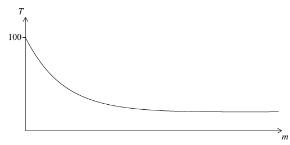
A cup of boiling water is placed in a room to cool. The temperature of the room is 20°C . This situation can be modelled by the exponential function T=a+b(k^{-m}), where T is the temperature of the water, in °C , and m is the number of minutes for which the cup has been placed in the room. A sketch of the situation is given as follows.
Ɛhia
0
Asemmisa {{asɛmmisaAhyɛnsode}}
40.

Explain why a=20.

Ɛhia
1
Asemmisa {{asɛmmisaAhyɛnsode}}
41.

Initially, at m=0, the temperature of the water is 100°C. Find the value of b.

Ɛhia
0
Ɛhia
1
Ɛhia
1
Asemmisa {{asɛmmisaAhyɛnsode}}
45.

Solve log_{2}(x+3)+log_{2}(x-3)=4

Asemmisa {{asɛmmisaAhyɛnsode}}
46.

The first three terms of a geometric sequence are lnx^{1}6,lnx^{8},lnx^{4}, for x>0. Find the common ratio.

Asemmisa {{asɛmmisaAhyɛnsode}}
42.

After being placed in the room for one minute, the temperature of the water is 84°C. Show that k=1.25.

Asemmisa {{asɛmmisaAhyɛnsode}}
43.

Find the temperature of the water three minutes after it has been placed in the room.

Asemmisa {{asɛmmisaAhyɛnsode}}
44.

Find the total time needed for the water to reach a temperature of 35°C. Give your answer in minutes and seconds, correct to the nearest second.