Preskoči na glavni sadržaj
Prijava
Sign up for FREE
arrow_back
Biblioteka

2026 Earth and Space Science Midterm

star
star
star
star
star
Posljednje ažuriranje 5 months ago
48

Base your answers to questions in this group on the information below and on your knowledge of Earth and Space Sciences. Some questions may require the use of the 2024 Edition Reference Tables for Earth and Space Sciences. Be sure to record your multiple choice questions on a separate answer sheet provided. Record your answers for the constructed response questions in your test booklet.

The Hertzsprung-Russell (H-R) diagram was developed from star charts by two scientists in different countries independently of each other in 1911. It classified stars based on their surface temperatures, observable color, and magnitude. Absolute magnitude is a measurement of how bright a star would appear if all stars are the same distance from Earth. The brighter the star, the lower the absolute magnitude value.


1
Pitanje 1
1.

Our Sun is classified as a spectral class G star with a surface temperature between $5000$ to $6000 K$ and an absolute magnitude of about five. Identify the relative temperature and relative absolute magnitude of the Sun as it transitions to a red giant. [1]
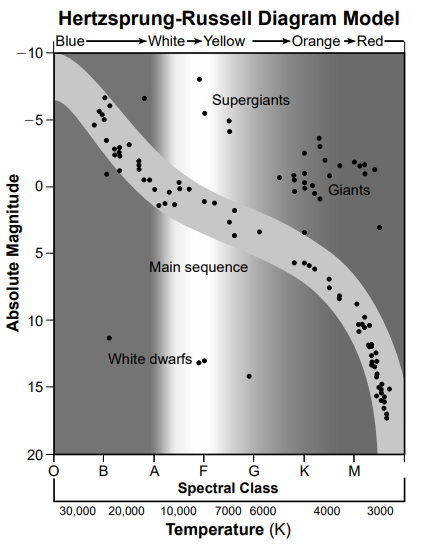
Hertzsprung-Russell Diagram Model showing the relationship between spectral class, temperature, and absolute magnitude of stars. The diagram includes regions labeled as supergiants, giants, main sequence, and white dwarfs.

Change in relative temperature: ________________________________________


Change in relative absolute magnitude:_______________________________

HS-ESS1-1
1
HS-ESS1-1
1
HS-ESS1-4
1
HS-ESS1-4
1
Pitanje 5
5.
HS-ESS1-1

Base your answers to this group of questions on the information below and on your knowledge of Earth and Space Sciences. Some questions may require the use of the 2024 Edition Reference Tables for Earth and Space Sciences.

Stars and the Big Bang

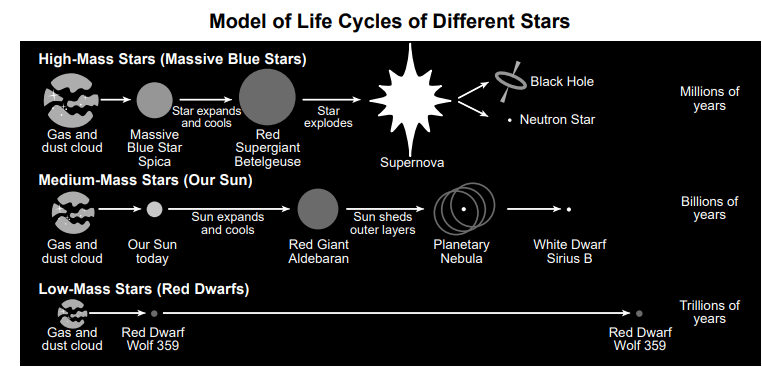
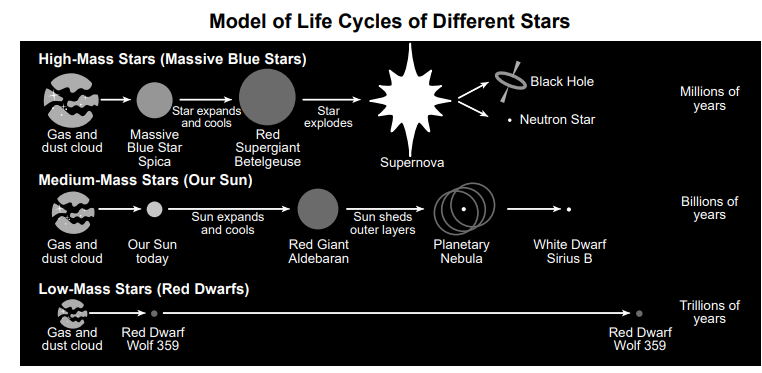
Our Sun is a 4.6 billion-year-old yellow dwarf star. It was formed either from matter produced during the Big Bang or from matter released when large stars reached supernova and exploded. This matter, in the form of hydrogen, contracted into a denser gas cloud due to gravity. The temperature at this cloud's core increased, allowing for the fusion of two hydrogen nuclei into one helium nucleus. The mass of this helium nucleus is slightly less than the mass of the hydrogen nuclei. This difference in mass is the source of the star’s energy. The model below shows some information about the life cycles of different stars.

Diagram showing the model of life cycles of different stars. It includes high-mass, medium-mass, and low-mass stars with stages such as gas and dust cloud, red supergiant, supernova, planetary nebula, and end states like a white dwarf, neutron star, and black hole.

1
Pitanje 6
6.

Identify the factor that determines the lifespan of the Sun and other stars.

1
HS-ESS1-3
1
HS-ESS1-1

Base your answers to questions in this group on the information below and on your knowledge of Earth and Space Sciences. Some questions may require the use of the 2024 Edition Reference Tables for Earth and Space Sciences. Be sure to record your answers for the multiple-choice questions on a separate answer sheet provided. Record your answers for the constructed-response questions in your test booklet.


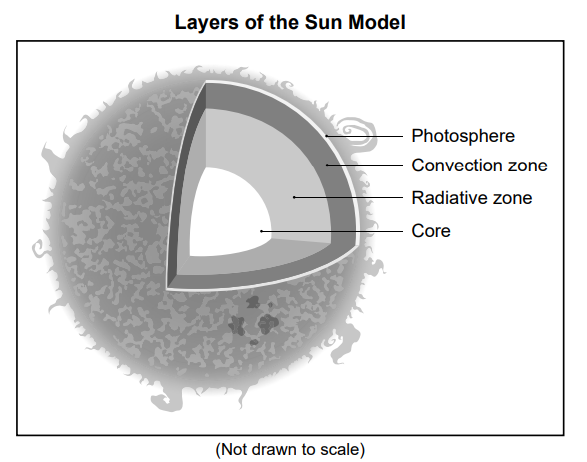
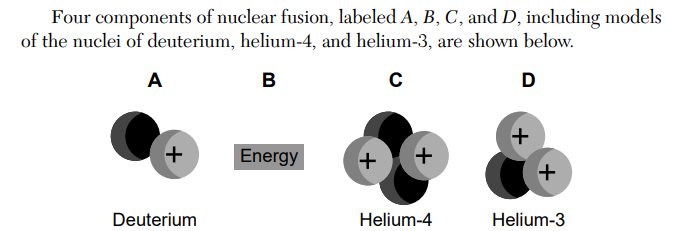
Energy in the Sun The Sun’s energy influences the environment of all celestial objects in our solar system. Different forms of the hydrogen and helium atoms contained in the Sun’s core, deuterium (2 H) and the helium atom (3 He), are under very high temperatures and pressures. These atoms combine to form helium (4 He), while releasing tremendous amounts of energy. 

The model below shows some information about the Sun.

Sun’s Layer

Information About Layer

Temperature

Photosphere

Observable layer – gives off electromagnetic energy

6,700 F-11,000 F

or

4,000 K-,6500K

Convection zone

  • Convection causes hot material to rise to surface and cool

  • Creates sunspots and solar flares

11,000 F - 2 million F

Radiative zone

Serves as a passage for radiation energy from core to surface

7 Million F

Core

Nuclear reactions occur

27 Million F or 15 Million K

1
Pitanje 9
9.
HS-ESS1-1
1
HS-ESS1-1
1
HS-ESS1-1
1
HS-ESS1-1
1
HS-ESS1-3

Base your answers to questions in this group on the information below and on your knowledge of Earth and Space Sciences. Some questions may require the use of the 2024 Edition Reference Tables for Earth and Space Sciences.

Telescopes and the History of the Universe

Two space telescopes that are providing astronomers with information about the early universe are the Hubble Space Telescope (HST) and the James Webb Space Telescope (JWST).

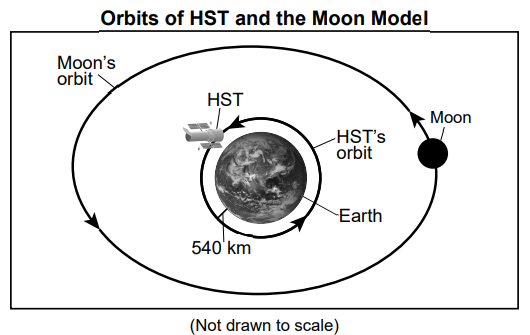
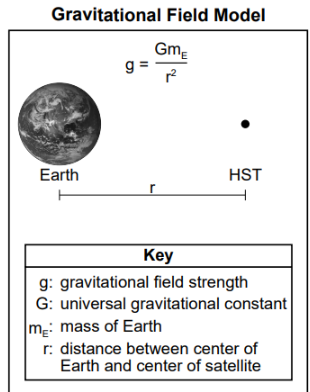
The HST orbits Earth at a distance of 540 km above the surface and can observe visible, ultraviolet (UV), and infrared (IR) radiation. It contains cameras and spectrographs that break light into the colors of the spectrum for analysis of elements found in stars.

Hubble has determined the age of the universe to a more precise date of 13.8 billion years old and has photographed galaxies in all stages of evolution—even galaxies from the early universe.

A central idea of the Big Bang theory is that the universe expanded rapidly and released energy. Scientists have been gathering evidence for this expansion and energy release since the early 1920s.

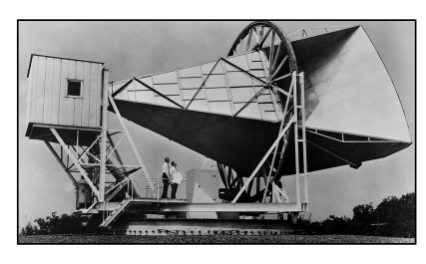
The photograph below, from 1964, shows two scientists in New Jersey with a radio telescope aimed towards outer space. This telescope was one of the first to record cosmic microwave background radiation coming from all directions in space.

1
Pitanje 14
14.
HS-ESS1-4
1
Pitanje 15
15.

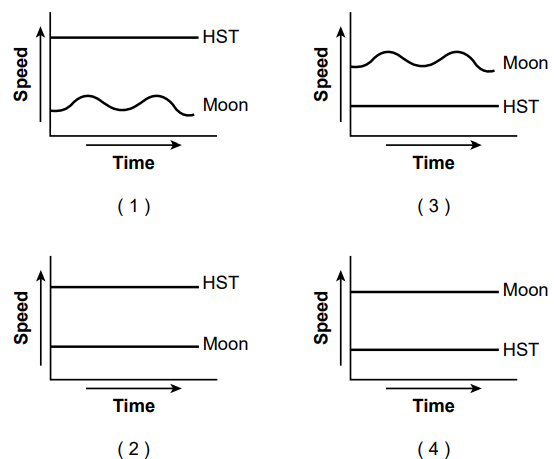
 Based on the model and Kepler’s Laws, which graph correctly represents the relative orbital speeds of HST and the Moon as the two satellites orbit Earth twice?

HS-ESS1-4

Base your answers to this group of questions on the information below and on your knowledge of Earth and Space Sciences. Some questions may require the use of the 2024 Edition Reference Tables for Earth and Space Sciences.

Earth-Moon History

About four billion years ago, the Moon was very close to Earth, and Earth may

have been rotating at a much faster rate than today. It is estimated that each Earth

day, at that time, may have been six to eight hours long, which, when calculated,

would result in an Earth year of about 1400 days. The force that causes tides on

Earth creates tidal friction which, over time, slowed Earth’s rotation, causing Earth

days to become about 24 hours long. As Earth’s rate of rotation has decreased,

the Moon has continued to move farther away from Earth at an average rate of

3.8 cm/yr. The Moon orbits Earth at an average distance of 384,400 km. The

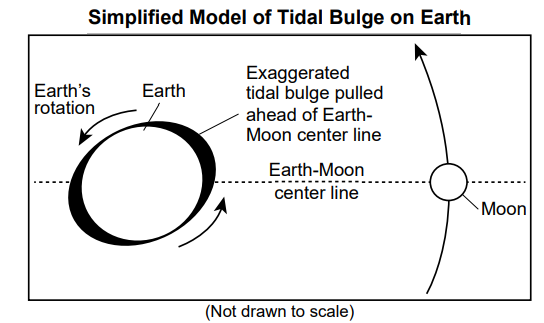
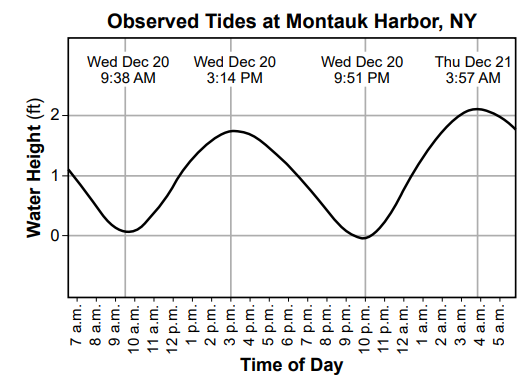
model and graph below show some information about tides.

AUG ‘25 ESS1-7


1
HS-ESS1-1
1
Pitanje 17
17.

Determine, in centimeters, how much farther away from Earth the Moon’s average orbit will be 1000 years from the present day, and explain why this change in distance will not significantly affect the Moon’s period of revolution around Earth. [1]


 Distance:_______________ cm

 Explanation:________________

HS-ESS1-4
1
Pitanje 18
18.

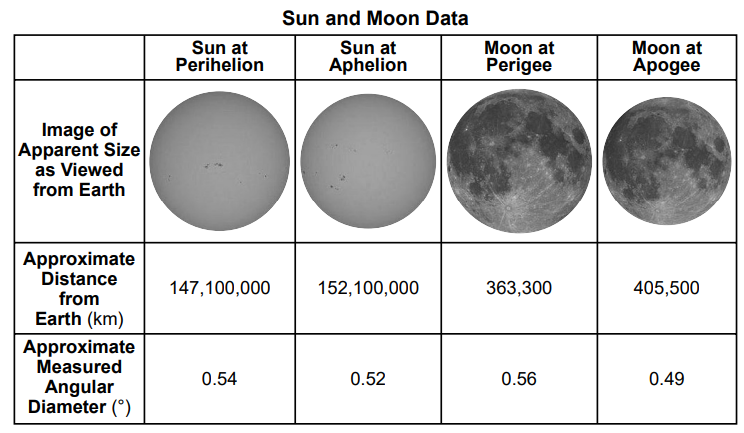
The table below shows some information about the Sun and the Moon

Table showing Sun and Moon data including distances from Earth and angular diameters at different positions.

Construct an explanation to support the claim that in about 700 million years, a total solar eclipse on Earth’s surface will be impossible.

HS-ESS1-1
1
HS-ESS1-4

Base your answers to this group of questions on the information below and on your knowledge of Earth and Space Sciences. 

The Effect of the Moon on Earth

 Earth’s Moon is the only celestial object beyond Earth where humans have set foot. It is the brightest and largest object in the night sky. The Moon makes Earth a more livable planet by moderating the wobble of Earth on its axis, leading to a relatively stable climate. 

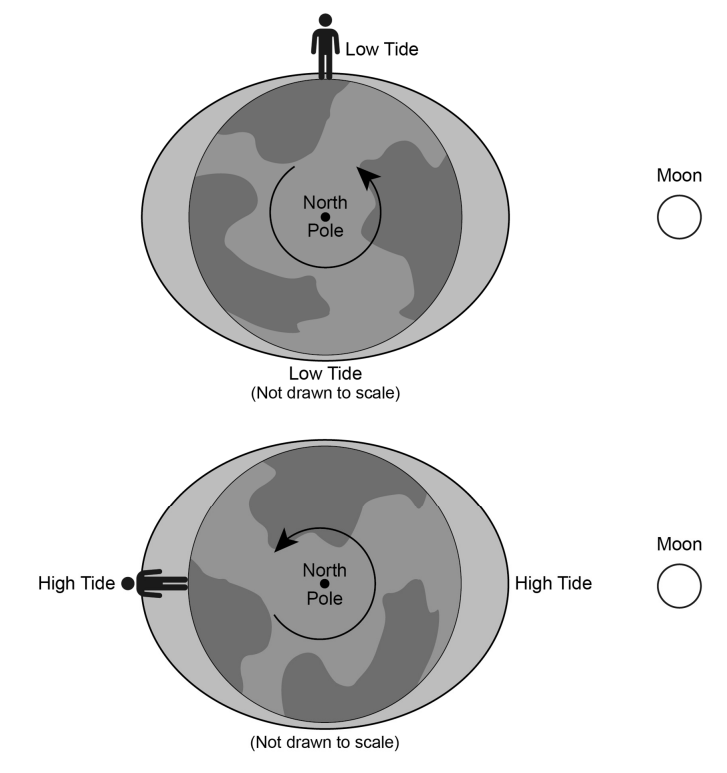
The models below represent two different positions of a person on Earth’s surface six hours apart. The relative height of the ocean tides at these positions are indicated. The arrow represents the direction of Earth’s rotation. 


1
Pitanje 20
20.

Construct an explanation using evidence from the models to support the claim that tides on Earth change cyclically. [1]

HS-ESS1-1
1
HS-ESS1-1
1
Pitanje 22
22.

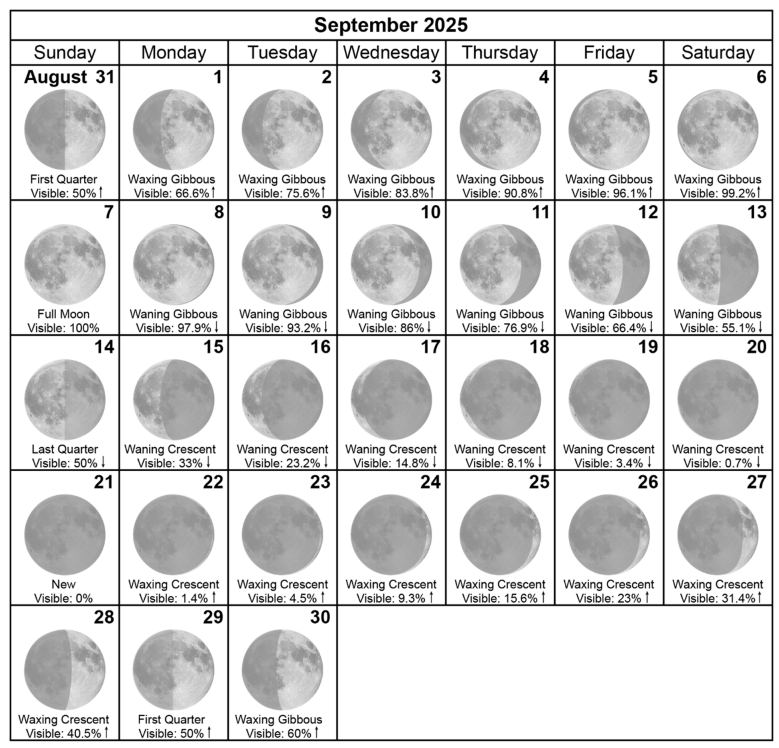
The Moon influences tides and is visible from Earth in different phases. The calendar below shows the Moon phases seen by an observer in New York State for the month of September 2025. The name of the phase and the amount of the lighted portion visible from Earth is indicated. 

Identify the date in October 2025 when a full Moon will be observed. Use evidence from the calendar to support your choice. [1]

Date:_________

Evidence:________

HS-ESS1-1
1
HS-ESS1-4

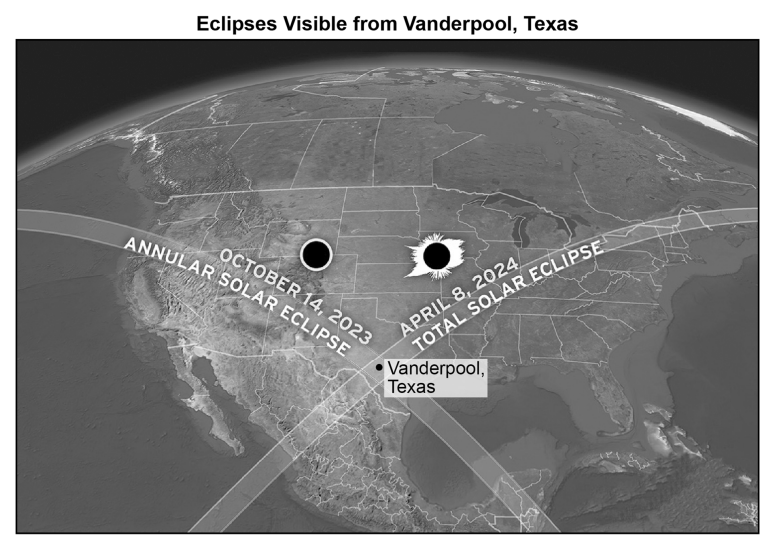
The data table below shows some information about celestial objects viewed from Vanderpool, Texas. Vanderpool, Texas is a location where two types of solar eclipses were visible.

Map showing paths of solar eclipses visible from Vanderpool, Texas. October 14, 2023 for annular eclipse and April 8, 2024 for total eclipse.Solar Eclipses at Vanderpool, Texas

Solar Eclipse Date

Type of Solar Eclipse

Earth-Sun Distance (km)

Percent of Sun Blocked

October 14, 2023

Annular

149,224,442

90%

April 8, 2024

Total

149,823,117

100%

1
Pitanje 24
24.

Which statement summarizes evidence in the Model of Moon’s Orbit Around Earth and the table Solar Eclipses at Vanderpool, Texas that describes three conditions that occur during the April 8, 2024 total solar eclipse for an observer in Vanderpool, Texas?
HS-ESS1-1

Base your answers to questions in this group on the information below and on your knowledge of Earth and Space Sciences. Some questions may require the use of the 2024 Edition Reference Tables for Earth and Space Sciences.

The Power of Water

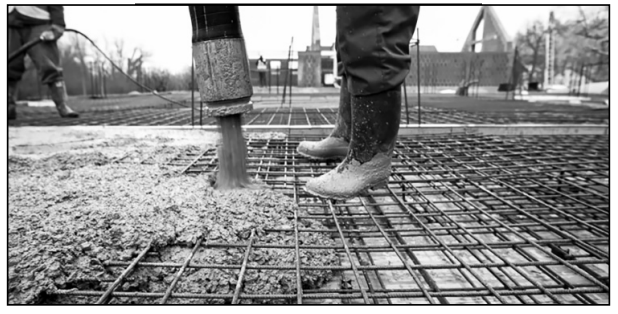
Water in its many forms is unique to our planet. It is required for life as we know it and it can be used for a wide variety of beneficial purposes such as recreation and generating electricity. However, water can also be destructive and cause problems for humanity. Concrete is an important building material that can be affected by water. The photograph below shows how structures are built with concrete and rebar (metal rods used to provide strength).

Concrete Pour With Rebar Structure

Construction workers pouring concrete over a steel frame at a construction site, possibly preparing a foundation.

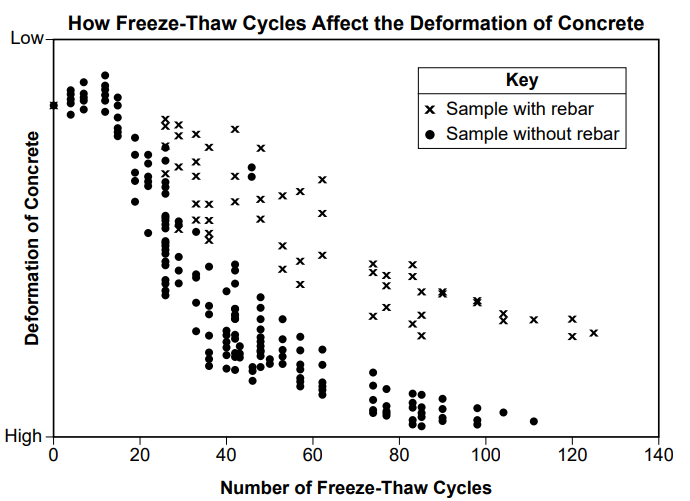
An experiment was conducted on samples of concrete, with and without rebar, to see how freeze-thaw cycles affected the deformation of the concrete. The graph shows some information about the freeze-thaw experiment.

How Freeze-Thaw Cycles Affect the Deformation of Concrete

Scatter plot showing how freeze-thaw cycles affect the deformation of concrete. The x-axis represents the number of freeze-thaw cycles, ranging from 0 to 140, and the y-axis represents the deformation of concrete, ranging from low to high. There are two types of data points: crosses for samples with rebar and dots for samples without rebar.

1
Pitanje 25
25.

Describe a property of water that increases the deformation of concrete due to repeated freeze-thaw cycles. Also, describe the relative amount of deformation to concrete samples when metal rebar is added compared to samples without rebar. [1]

Property of Water:________

Relative amount of Deformation:______

HS-ESS2-5
1
Pitanje 26
26.

HS-ESS2-5

Base your answers to questions in this group on the information below and on your knowledge of Earth and Space Sciences. Some questions may require the use of the 2024 Edition Reference Tables for Earth and Space Sciences.

Telescopes and the History of the Universe

Two space telescopes that are providing astronomers with information about the early universe are the Hubble Space Telescope (HST) and the James Webb Space Telescope (JWST).

The HST orbits Earth at a distance of 540 km above the surface and can observe visible, ultraviolet (UV), and infrared (IR) radiation. It contains cameras and spectrographs that break light into the colors of the spectrum for analysis of elements found in stars.

Hubble has determined the age of the universe to a more precise date of 13.8 billion years old and has photographed galaxies in all stages of evolution—even galaxies from the early universe.

A central idea of the Big Bang theory is that the universe expanded rapidly and released energy. Scientists have been gathering evidence for this expansion and energy release since the early 1920s.

The photograph below, from 1964, shows two scientists in New Jersey with a radio telescope aimed towards outer space. This telescope was one of the first to record cosmic microwave background radiation coming from all directions in space.

1
Pitanje 27
27.

Which explanation about the cosmic microwave background radiation provides evidence for the Big Bang theory?

HS-ESS1-2
1
HS-ESS1-2
1
HS-ESS1-2

Base your answers to questions in this group on the information below and on your knowledge of Earth and Space Sciences. Some questions may require the use of the 2024 Edition Reference Tables for Earth and Space Sciences.

How Did Earth Get Its Water?

Scientists are unsure about where and how Earth got its water. Early Earth lacked an atmosphere and was very hot, so water would not have formed in such an environment. One theory is that water was brought to Earth when comets collided with Earth, since comets are made of frozen water, gases, and dust.

Another theory centers around asteroids. Earth is believed to have formed from the clumping together of space debris. These early solar system materials contained the elements hydrogen and oxygen. The chemical proportions of the water found on asteroids are similar, though different, from Earth's water.

The most recent discoveries have come from studies of dust particles brought back to Earth from the Hokawa asteroid. The particles were found to have water and an oxygen-hydrogen ion. The source of the hydrogen is believed to be from solar wind — hydrogen ions ejected from the Sun streaming through space and lodging onto the surface of dust particles. These particles have been falling to Earth since the solar system formed. The space dust is believed to have provided about 50% of Earth's water.

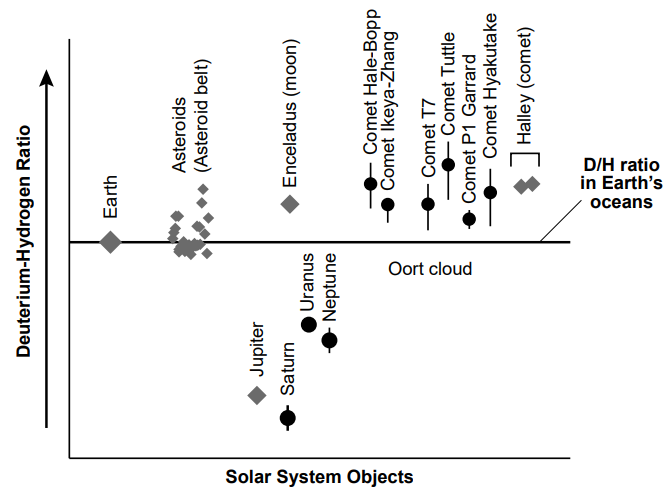
The graph below shows the relative deuterium-to-hydrogen ratio ($D/H$) in water found in solar system objects. Diamond symbols are measurements obtained by satellites. Dots are estimated values. Deuterium is a “heavier” form of hydrogen. This ratio is an important factor in determining where in the solar system an object formed and how asteroids, comets, and the solar wind contributed to the water in Earth's oceans.

Graph showing the Deuterium-Hydrogen Ratio of various Solar System Objects including Earth, Asteroids, Enceladus, and several comets.

1
HS-ESS1-6
1
HS-ESS2-7
1
Pitanje 32
32.

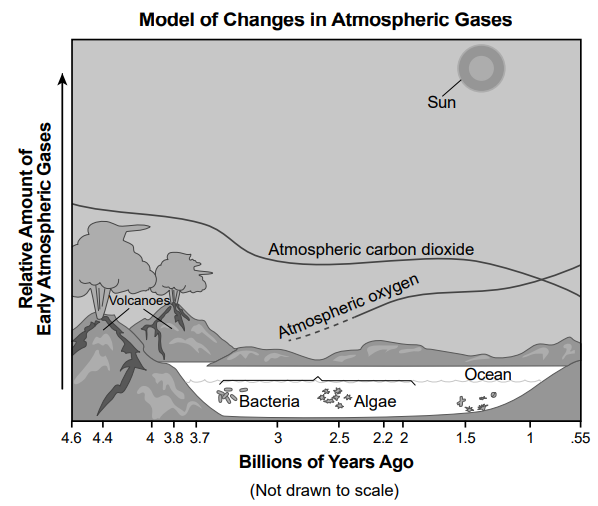
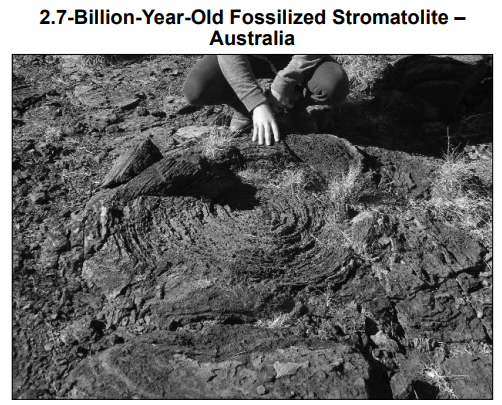
The water in Earth’s early oceans provided the necessary environment for life about 3 to 3.5 billion years ago. Organisms such as stromatolites were the earliest example of life on Earth and were capable of photosynthesis. From about two billion years ago to 500 million years ago, Earth’s atmosphere changed significantly, driven by an increase of many different life forms. Living and fossilized stromatolites can still be found today in Australia.

2.7-Billion-Year-Old Fossilized Stromatolite in Australia with a person touching it.
Graph showing changes in atmospheric gases over billions of years with elements like volcanoes, bacteria, and algae depicted.

Construct an argument, based on evidence in the model, about how stromatolites in Earth’s oceans caused Earth’s early atmosphere to evolve. [1]

HS-ESS2-7
1
HS-ESS2-5

Base your answers to questions in this group on the information below and on your knowledge of Earth and Space Sciences. Some questions may require the use of the 2024 Edition Reference Tables for Earth and Space Sciences.

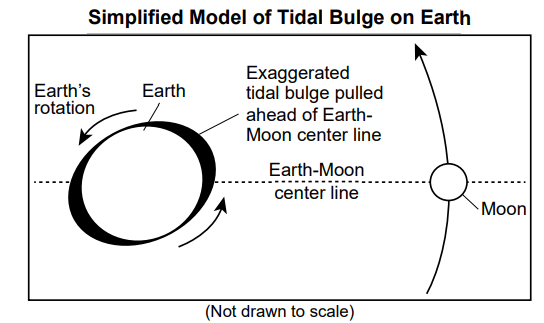
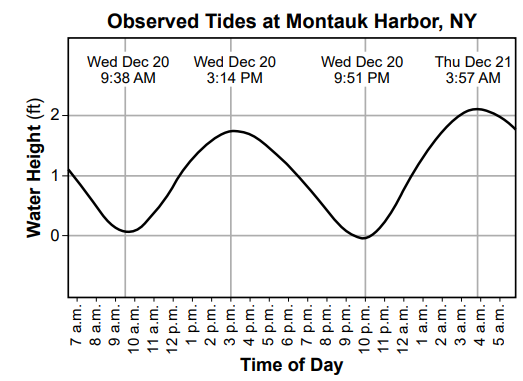
About four billion years ago, the Moon was very close to Earth, and Earth may have been rotating at a much faster rate than today. It is estimated that each Earth day, at that time, may have been six to eight hours long, which, when calculated, would result in an Earth year of about 1400 days. The force that causes tides on Earth creates tidal friction which, over time, slowed Earth’s rotation, causing Earth days to become about 24 hours long. As Earth’s rate of rotation has decreased, the Moon has continued to move farther away from Earth at an average rate of $3.8 \, \text{cm/yr}$. The Moon orbits Earth at an average distance of $384,400 \, \text{km}$. The model and graph below show some information about tides.

Diagram showing a simplified model of tidal bulge on Earth. The Earth is depicted with its rotation direction, and the position of the tidal bulge is exaggerated and pulled ahead of the Earth-Moon center line. The Moon is shown with a dashed line indicating the Earth-Moon center line. It is noted that the image is not drawn to scale.
Graph depicting observed tides at Montauk Harbor, NY. The x-axis represents time of day, and the y-axis represents water height in feet. The graph shows tide data over a two-day period.


1
Pitanje 34
34.

Astronomers theorize that the Moon formed as a result of a collision between Earth and another planet. The debris created during this collision circulated around Earth and formed the Moon. Evidence for the age of the Moon is found in zircon, a mineral found in lunar rocks. This mineral contains uranium-238. The table below shows some information about four rock samples taken from the lunar surface.

Lunar Samples and Percent of Uranium Remaining

Sample

Location

Percent of Uranium Remaining

A

Highland Crust

49.31%

B

Lunar Mare

79.25%

C

Oceanus Procellarum

73.33%

D

Imbrium Basin

61.83%

Using the table, identify the letter of the sample that provides evidence to support the claim that the Moon is approximately 4.53 billion years old. Explain how this evidence supports the claim. [1]

Sample: _____________

Explanation: _____________

HS-ESS1-6

Base your answers to questions in this group on the information below and on your knowledge of Earth and Space Sciences. Some questions may require the use of the 2024 Edition Reference Tables for Earth and Space Sciences.

New York State Fossils of Note

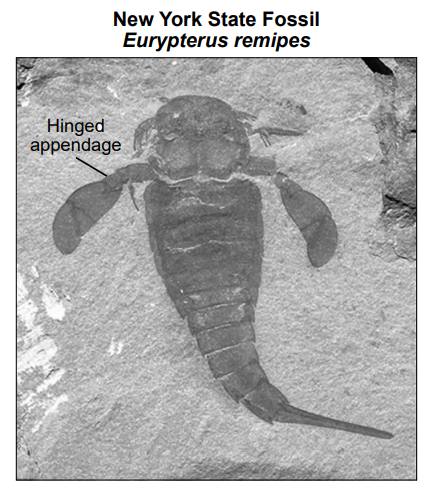
The New York State fossil shown below is a Silurian-age eurypterid called Eurypterus remipes.

This fossil was originally believed to be a catfish before being correctly described as an arthropod — an invertebrate with a segmented exoskeleton and hinged appendages. Some eurypterid appendages were used for walking, while other appendages were used for swimming.

Black and white image of the New York State fossil, Eurypterus remipes, with a highlighted hinged appendage.

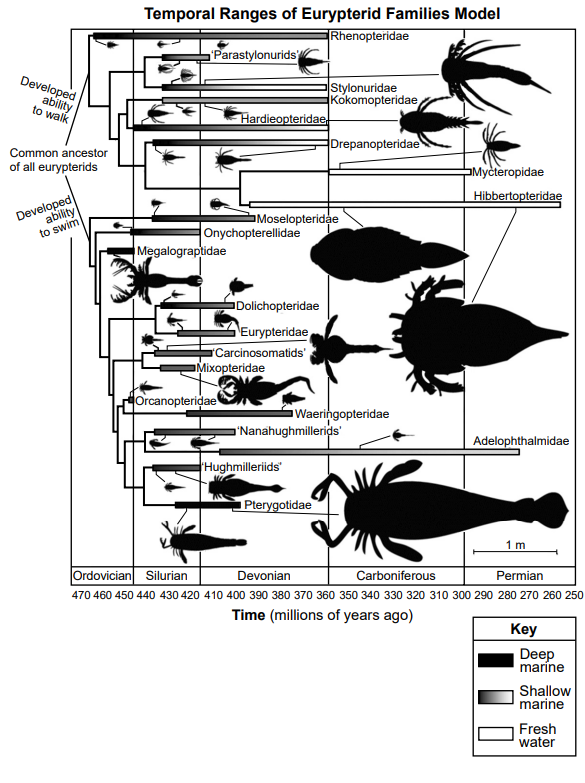
The model below is a family-level evolutionary tree (cladogram) for various eurypterids. The bars represent known temporal ranges for each family. Some eurypterid silhouettes are shown to scale with lines indicating their temporal placement in each family.

A chart titled 'Temporal Ranges of Eurypterid Families Model' showing the evolutionary timeline and habitat of various eurypterid families from the Ordovician to the Permian period. The chart includes silhouettes of different eurypterids, indicating size and morphological differences, with a key distinguishing deep marine, shallow marine, and fresh water environments.

1
HS-ESS1-6
1
HS-ESS1-6
1
HS-ESS1-6

Base your answers to questions in this group on the information below and on your knowledge of Earth and Space Sciences. Some questions may require the use of the 2024 Edition Reference Tables for Earth and Space Sciences.

Stars and the Big Bang

Our Sun is a 4.6 billion-year-old yellow dwarf star. It was formed either from matter produced during the Big Bang or from matter released when large stars reached supernova and exploded. This matter, in the form of hydrogen, contracted into a denser gas cloud due to gravity. The temperature at this cloud’s core increased, allowing for the fusion of two hydrogen nuclei into one helium nucleus. The mass of this helium nucleus is slightly less than the mass of the hydrogen nuclei. This difference in mass is the source of the star’s energy. The model below shows some information about the life cycles of different stars.

Diagram depicting the life cycles of different types of stars, including high-mass, medium-mass, and low-mass stars.
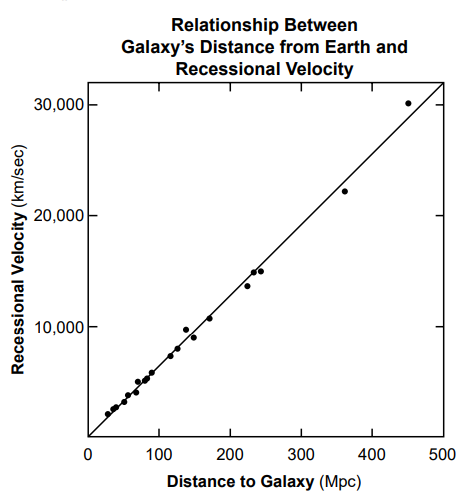
In the 1920s, Edwin Hubble studied the motion of galaxies. He found a relationship between a galaxy’s velocity as measured from Earth (recessional velocity) and the galaxy’s distance from Earth. This relationship is known as Hubble’s Law. This law has implications for understanding how the universe has changed since the Big Bang.

The graph below shows data on several galaxies’ distances from Earth in megaparsecs (Mpc) and their recessional velocities.

Graph showing the relationship between galaxy's distance from Earth in megaparsecs and recessional velocity in km/sec.

1
Pitanje 38
38.

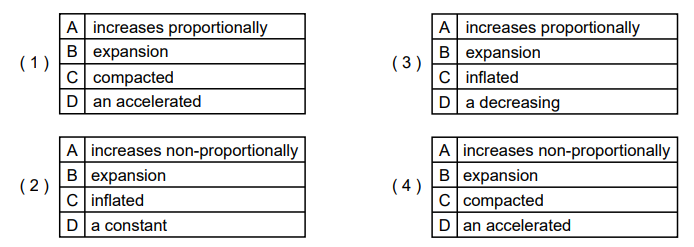
The Relationship Between Galaxy’s Distance from Earth and Recessional Velocity graph shows that the recessional velocity of a galaxy   A   as the galaxy’s distance from Earth increases. This is evidence for the   B   of the universe and suggests that the universe initially was   C   at the time of the Big Bang. As a result, this data suggests that the universe is changing at   D  

Which table below correctly identifies the missing words and phrases labeled A, B, C, and D in the passage above?

Four labeled options showing words related to increases, expansion, and acceleration, displayed in a tabular format for different scenarios.

HS-ESS1-2
1
HS-ESS1-2

Base your answers to questions in this group on the information below and on your knowledge of Earth and Space Sciences. Some questions may require the use of the 2024 Edition Reference Tables for Earth and Space Sciences.

New York State’s Hudson River

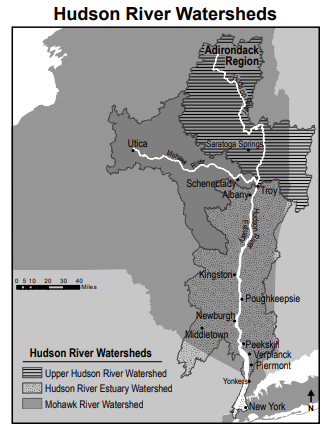
New York State’s Hudson River watershed covers almost 1340 square miles and includes three different watersheds: Mohawk River, Hudson River Estuary, and Upper Hudson River watersheds. The Hudson River flows south for almost 325 miles from the Adirondacks to New York City. The 153-mile-section from Troy to New York Harbor in New York City is a tidal estuary. Here, fresh water flowing south down the river meets salt water pushing in from the Atlantic Ocean. The leading edge of sea water entering the estuary is called the salt front. The salt front moves with the tides, the weather, and the seasons. When there is heavy rain, more fresh water flows into the Hudson River.

Cities and towns that take their drinking water from the Hudson River carefully track the salt front as it affects the quality of drinking water.

Map of Hudson River Watersheds showing regions including the Upper Hudson River Watershed, Hudson River Estuary Watershed, and Mohawk River Watershed. Key locations like Albany, Saratoga Springs, and New York are marked.

1
Pitanje 40
40.

Describe how heavy rain events along the Hudson River would affect the location of the salt front.

HS-ESS2-5

Base your answers to questions in this group on the information below and on your knowledge of Earth and Space Sciences. Some questions may require the use of the 2024 Edition Reference Tables for Earth and Space Sciences.

The Origin of Our Solar System

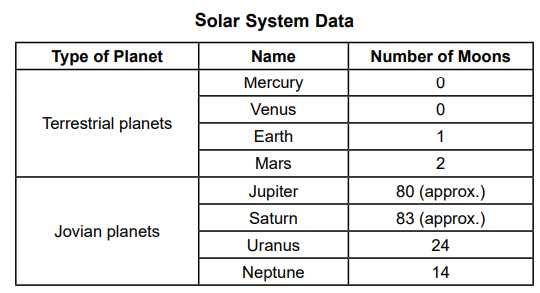
The Sun and eight planets in the Solar System formed at the same time. Evidence of their formation can be found throughout the Solar System. Scientists have used data from planets, meteorites, and Earth to determine how the Solar System formed and its early history. The data table below lists some information for the eight planets.

Table showing the number of moons for each planet in the solar system. Terrestrial planets listed are Mercury (0 moons), Venus (0 moons), Earth (1 moon), Mars (2 moons). Jovian planets listed are Jupiter (approximately 80 moons), Saturn (approximately 83 moons), Uranus (24 moons), Neptune (14 moons).

1
HS-ESS1-6
1
HS-ESS1-4
1
Pitanje 43
43.

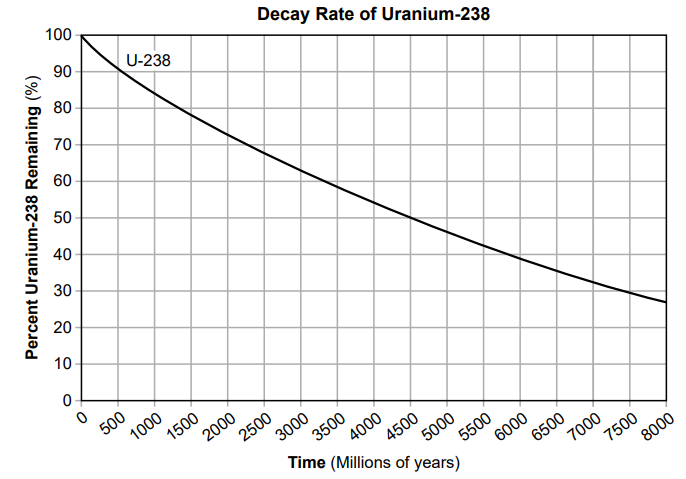
Meteorites on Earth have been helpful in reconstructing the history of our solar system and our planet. Samples taken from meteorites have been age dated using absolute dating techniques that measure the amount of Uranium-238 compared to the amount of its decay product in samples found on Earth. The graph below shows some information about Uranium-238.

Graph showing the decay rate of Uranium-238 over time. The x-axis represents time in millions of years, and the y-axis represents the percentage of Uranium-238 remaining. The curve shows a gradual decline in the percentage over time.

A sample of a meteorite was tested and found to contain 50% Uranium-238. Use evidence from the graph to make a claim about how the radiometric dating of meteorites can be used to construct an account about when Earth formed. [1]

HS-ESS1-6
1
Pitanje 44
44.

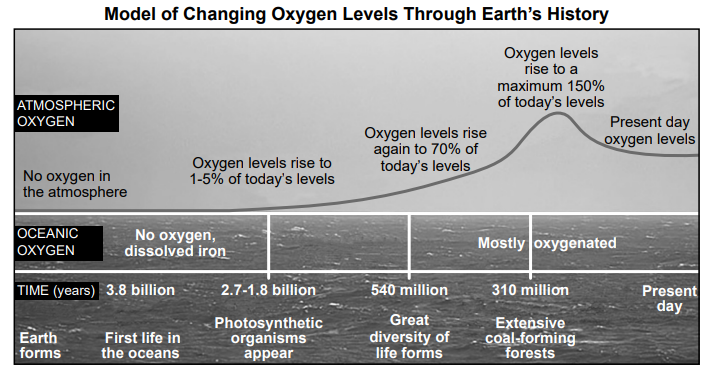
Earth’s systems do not operate independently. For instance, changes in the ocean’s temperature can influence atmospheric temperatures. A similar coevolutionary process occurred in Earth’s early history when oxygen levels were transitioning from Earth’s ocean to the atmosphere. The model below shows some information about Earth’s ocean and atmosphere.

Graph showing the model of changing oxygen levels through Earth's history with time periods and stages of atmospheric and oceanic oxygen.

Identify the process that caused the oxygen levels in Earth’s oceans and atmosphere to change. Then, construct an argument, based on evidence, that describes how oxygen levels changed in Earth’s oceans and atmosphere and how these changes led to a coevolution of life on two Earth spheres. [1]

Process:______________

Argument with evidence:________

HS-ESS2-7

Base your answers to questions in this group on the information below and on your knowledge of Earth and Space Sciences.

Plate Tectonics

Alfred Wegener was a German geophysicist and meteorologist who proposed the theory of continental drift in 1912. This theory attempted to explain how similar rock formations and plant and animal fossils could be found on separate continents. Widely dismissed by other scientists from Wegener’s time, continental drift would eventually be accepted and become known as the theory of plate tectonics by the 1960s.

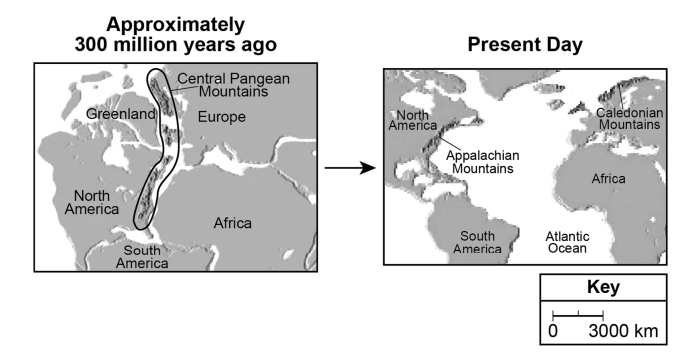
The model below shows some information about the position of the continents.

Map showing the position of continents 300 million years ago and present day, highlighting the Central Pangean Mountains and Appalachian Mountains.One of the methods used to determine the absolute age of a rock is through the collection and analysis of zircon crystals. Zircon crystals have been found in some Appalachian Mountain regions. They grow in magma or semi-molten rock and are made of silicon, oxygen, and zirconium. Zircon crystals are ideal for age dating because they have the following characteristics:
  • commonly formed in felsic igneous rocks

  • found in numerous sediments, such as beach sand, river sediments, and wind (eolian) deposits

  • have a very high melting temperature and hardness

  • high density but non-magnetic

  • contain small but measurable amounts of uranium (which substitutes for the zirconium in the crystal lattice when the crystal grows)

1
Pitanje 45
45.

Identify one characteristic of zircon crystals that makes them ideal for determining the absolute age of rocks found in the Appalachian Mountains. Explain how this characteristic can be used to determine absolute age. [1]

Characteristic: _____________

Explanation:_____________

HS-ESS1-6

Base your answers to questions in this group on the information below and on your knowledge of Earth and Space Sciences.

Theia and the Moon

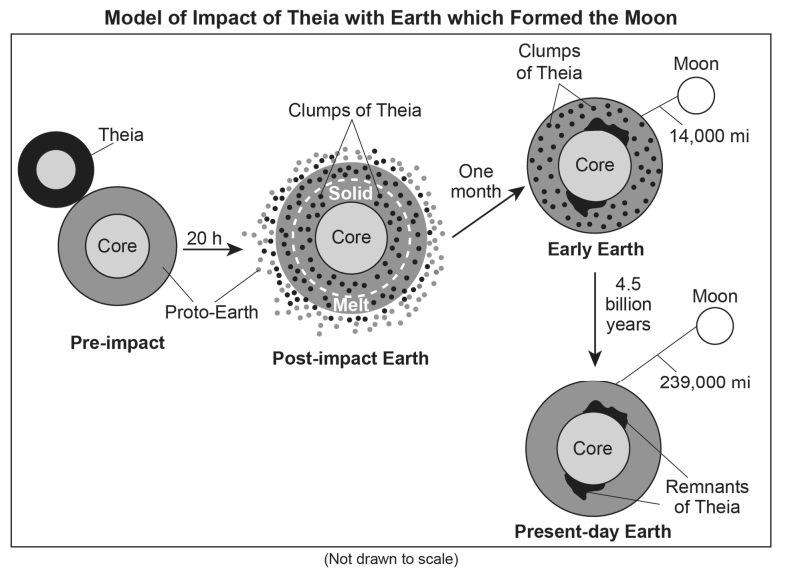
The Giant Impact hypothesis is the most widely accepted theory for the formation of the Moon. Shortly after Earth formed, a small planetary body called Theia collided with Earth. Some remains of Theia were included into Earth's interior. Other remains formed into a ring of vapor, dust, and molten rock. Eventually, the pieces clumped together (accreted), forming the Moon.

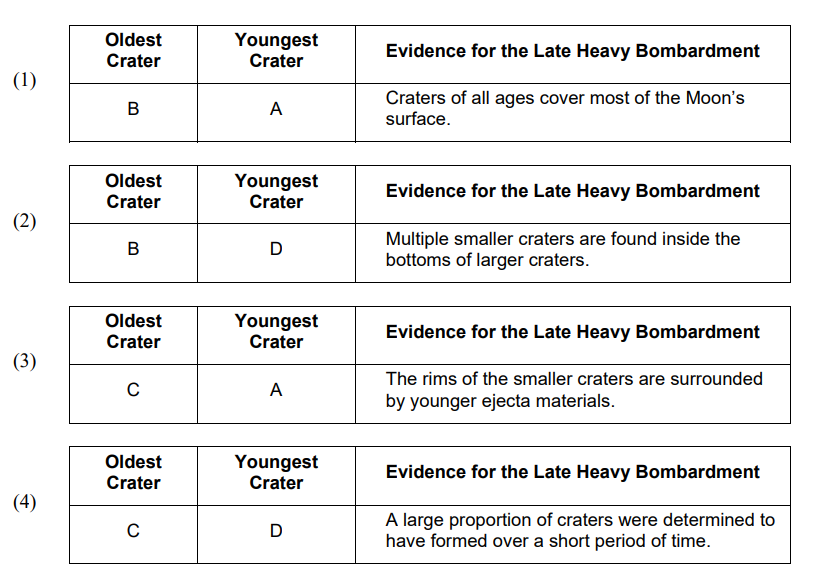
The Late Heavy Bombardment is a period of time when Earth, the Moon, and the other inner planets experienced intense impact activity from asteroids and comets. These impacts created cratered surfaces on both Earth and the Moon. The Late Heavy Bombardment is believed to have peaked about 3.9 billion years ago.

The model below shows some information about the impact of Theia with Earth, an event that eventually led to the Moon's formation.

Diagram showing the model of the impact of Theia with Earth which formed the Moon, detailing pre-impact, post-impact Earth, early Earth, and present-day Earth stages.
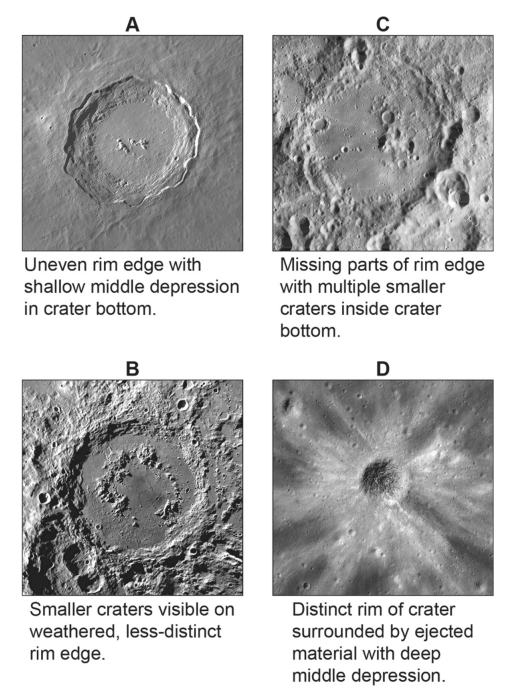
Information about the Moon’s early history can be obtained from observations of craters on the Moon’s surface. The photographs below show four different impact craters.

Four lunar crater images labeled A, B, C, and D. A shows an uneven rim with a shallow depression. B has smaller craters and a weathered rim. C displays missing rim parts and smaller craters inside. D features a distinct rim with ejected material and a deep depression.


1
HS-ESS1-6
1
Pitanje 47
47.

Construct an account, using radioactive elements and their decay products, to support the Giant Impact Hypothesis, which provides evidence that zircons found in Moon rocks formed at approximately the same time as Earth. [1]

HS-ESS1-6
1
HS-ESS1-6
Pitanje 2
2.

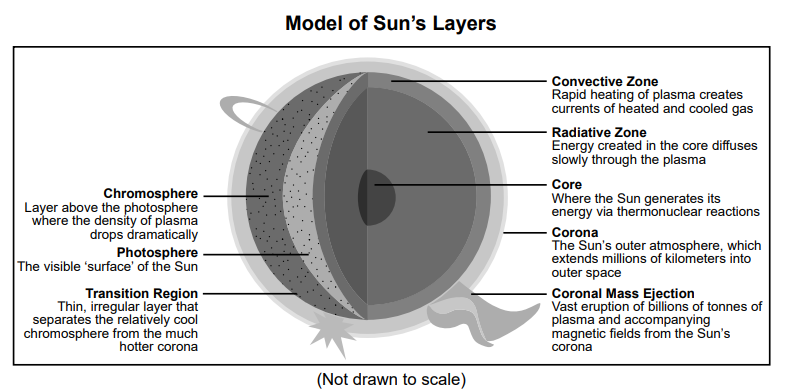
The model below shows the layers of the Sun and information about some features of each layer

Diagram titled 'Model of Sun’s Layers' showing various layers of the sun: the core, radiative zone, convective zone, photosphere, chromosphere, transition region, corona, and coronal mass ejection. Each layer has descriptive text explaining its function or characteristics.

Based on the information in the model, which list of five of the Sun’s layers are in the correct sequence to allow energy generated by fusion to eventually reach the Sun’s surface as radiation?

Pitanje 3
3.

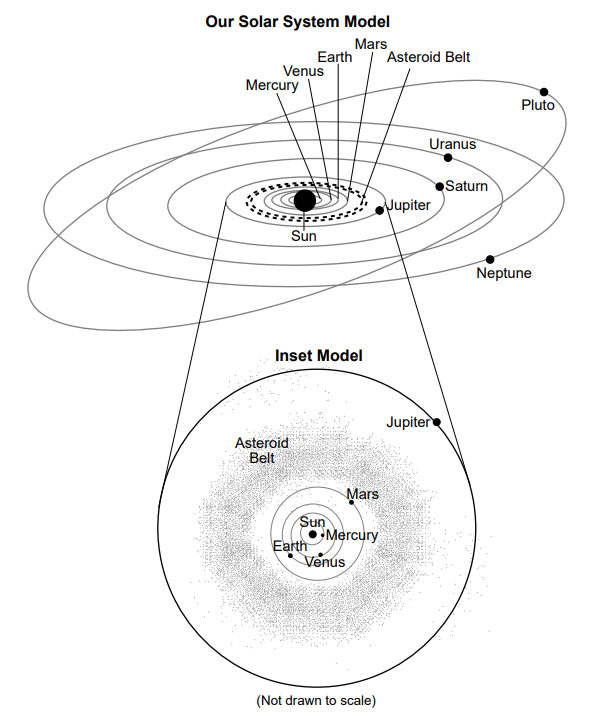
The model below represents the orbits of celestial bodies around our Sun. The inset model shows some information about the region of the solar system inside the orbit of Jupiter.

The table below shows the eccentricity of the orbits of Mercury and Venus around the Sun

Planet

Eccentricity

Mercury

0.206

Venus

0.007

Place a check mark (✓) in the boxes to indicate the two statements that are correctly predicted by Kepler’s Laws. [1]

Pitanje 4
4.

Based on the Our Solar System Model, if a new planet was identified that orbited the Sun at an average orbital distance greater than that of Mercury but less than that of Venus, the average speed of this planet would be

Pitanje 7
7.

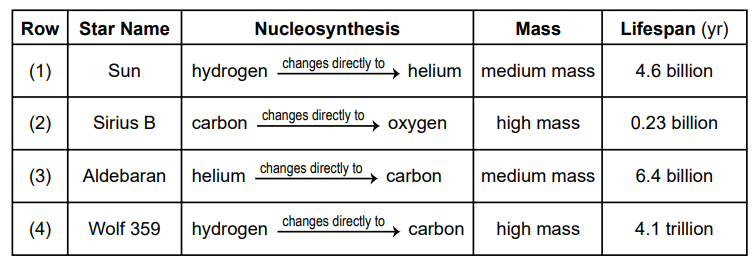
The table below shows some information about different types of stars. Solar mass is the mass of the star compared to the Sun.

Star

Solar Mass

Distance from Sun (light years)

Approximate Lifespan (yr)

Spica

10.3

260.9

less than 30 million

Betelgeuse

16.5

548

10 million

Sun

1.0

0

9 billion

Aldebaran

1.16

65

6.4 billion

Sirius B

0.98

8.6

0.23 billion

Wolf 359

0.09

7.86

4.1 trillion

A student created a data table containing information on how stars synthesize common elements through nucleosynthesis. Which row of data correctly identifies all the characteristics for that star?

Table showing star data including star name, nucleosynthesis, mass, and lifespan.

Pitanje 8
8.

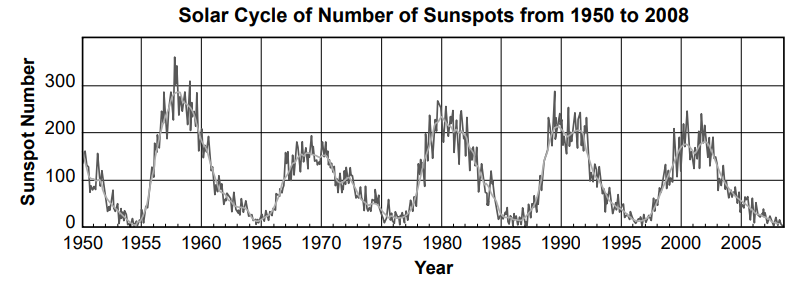
Sunspots are areas where the magnetic field is about 2500 times stronger than Earth’s magnetic field. Because of this strong magnetic field, the magnetic pressure increases and the Sun’s surrounding atmospheric pressure decreases. This lowers the temperature relative to surrounding areas because it inhibits the flow of new super-hot gas (plasma) to the surface. Sunspots occur in pairs because they have magnetic fields pointing in opposite directions. However, from 1645 to 1715 there was nearly zero sunspot activity. This time period is referred to as the Maunder Minimum. Some scientists also called this time period on Earth “The Little Ice Age”. The graph below shows some information about sunspot frequency.


Using information from the passage and the graph, place a check mark (✓) in three boxes to identify the statements that accurately describe sunspots. [1]

Pitanje 10
10.

Which claim best describes where energy is produced in the Sun and how the energy is released into space?

Pitanje 11
11.

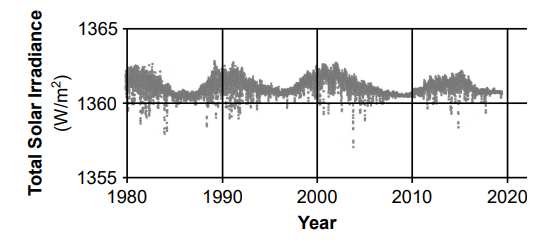
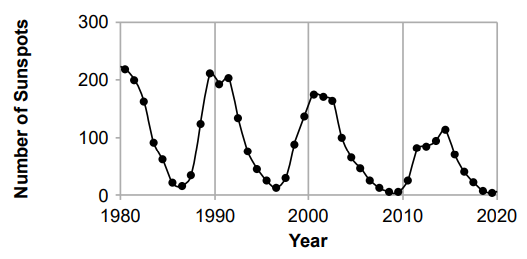
Scientists have identified an 11-year solar cycle. During this cycle there is an increase and a decrease in the number of dark areas (sunspots) on the Sun’s surface. Periods in the cycle with the highest numbers are called maxima, while periods in the cycle with the lowest numbers are called minima. 

The graphs below show the output of light energy from the entire disk of the Sun, measured at Earth (Total Solar Irradiance) in watts per meter squared (W/m2 ), and some information about sunspots.

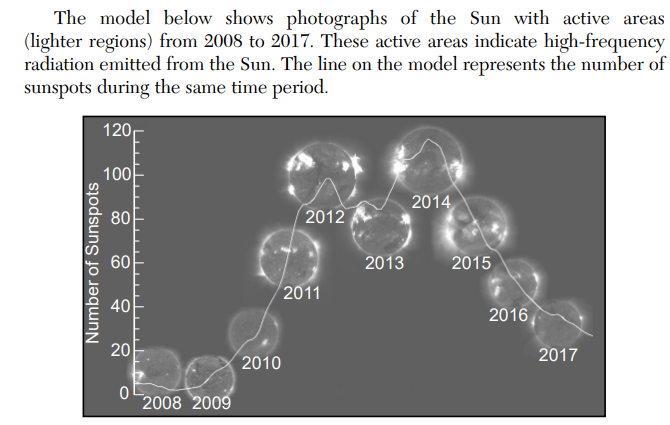
Use evidence from the two graphs and the model to describe how the Sun’s irradiance varies with sunspot activity. [1]

Pitanje 12
12.

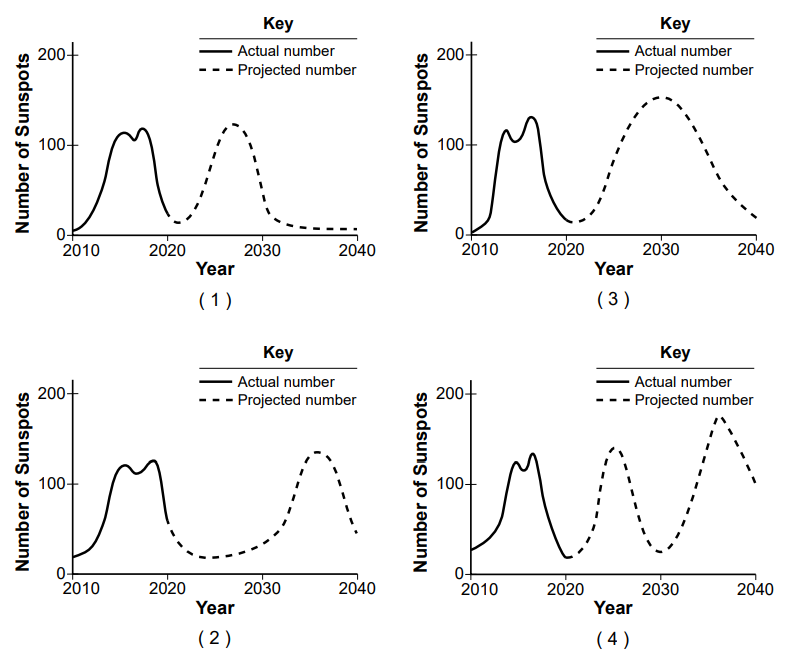
Which graph best illustrates the projected pattern of the number of sunspots from 2020–2040, based on evidence from the graphs and model?A set of four graphs showing the actual and projected number of sunspots from 2010 to 2040, each with different projections for future sunspot trends.

Pitanje 13
13.

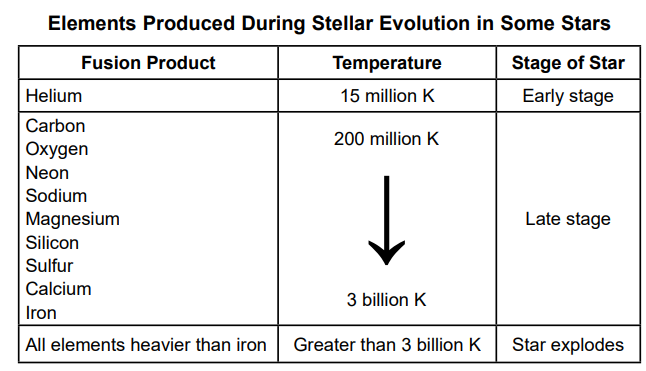
Table illustrating elements produced during stellar evolution. Helium forms at 15 million K in early stages. Carbon, oxygen, neon, sodium, magnesium, silicon, sulfur, calcium, and iron form from 200 million K to 3 billion K in late stages. Elements heavier than iron form at temperatures greater than 3 billion K, leading to star explosion.

Which claim best describes the process of nucleosynthesis in a star?

Pitanje 16
16.

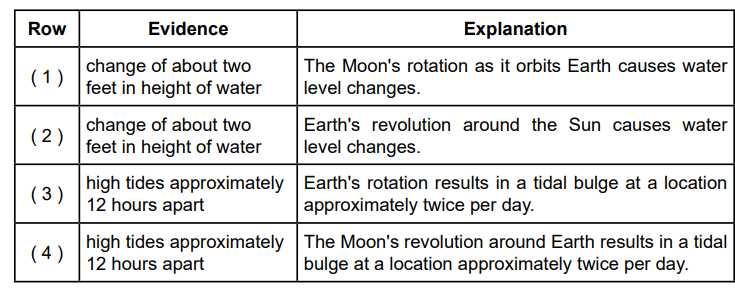
Which row in the table below correctly identifies the evidence and explanation for the observed cyclic change in tides at Montauk Harbor?

Pitanje 19
19.

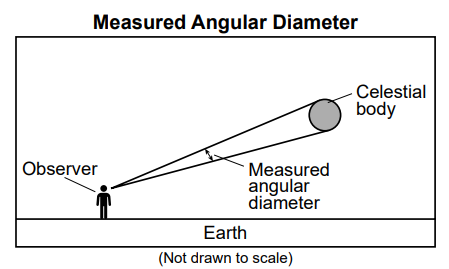
The measured angular diameter of a celestial body is the angle that the diameter of the body makes as seen from Earth.

Based on the information in the table, which lettered pair correctly completes the passage below?


The change in the angular diameter of the Moon during the Moon’s orbit is __A__ than the change in the angular diameter of the Sun during Earth’s orbit because the Moon’s orbit is inferred to be _B__ elliptical than Earth’s orbit.


Pitanje 21
21.

The Moon is moving away from Earth at approximately 2.5 cm per year. Which explanation correctly describes how this increased distance from Earth would affect Earth’s tides after 1,000,000 years?

Pitanje 23
23.

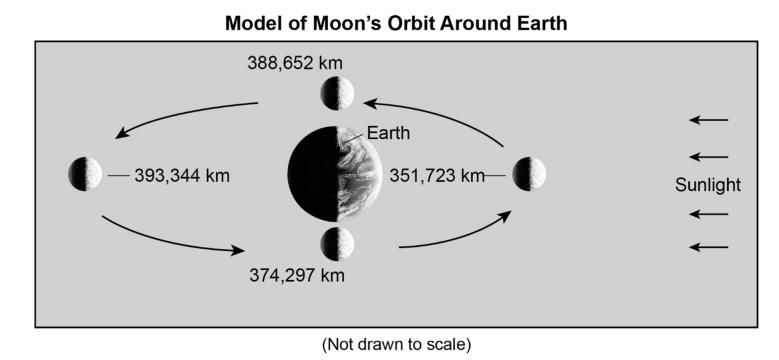
The model below shows the Moon in four positions in its orbit around Earth and the distances between Earth and the Moon at these four positions. Below the model, claims about the Moon’s visibility, distance from Earth, and orbital velocity are listed. 

Claim 1: The amount of the Moon visible is increasing from one day to the next. 

Claim 2: The amount of the Moon visible is decreasing from one day to the next. 

Claim 3: The distance between Earth and the Moon is increasing from one day to the next. 

Claim 4: The distance between Earth and the Moon is decreasing from one day to the next. Claim 5: The orbital velocity of the Moon is increasing from one day to the next. 

Claim 6: The orbital velocity of the Moon is decreasing from one day to the next. 

Which set of claims correctly predicts the amount of the Moon visible, the distance from Earth, and the orbital velocity for the Moon during the waning gibbous phase? 


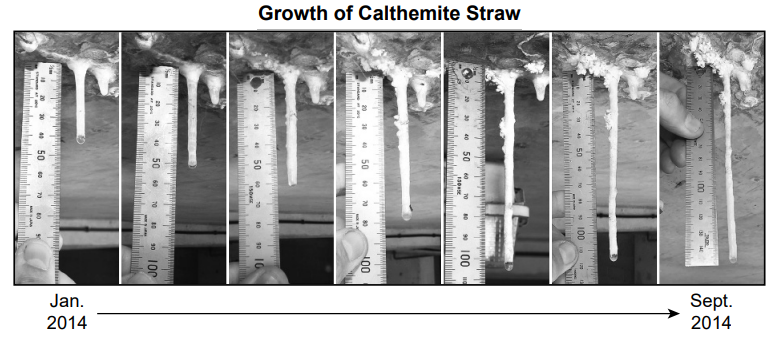
Calthenite straws are deposits found on the underside of concrete structures such as parking garages. Calthenites are not considered stalactites, as they do not form naturally in caves and cavern systems. The series of photographs below shows the growth of a calthenite straw measured in millimeters (mm).

Series of images showing the growth of a calthemite straw over time, from January 2014 to September 2014, measured with a ruler.

Which claim correctly summarizes the effect of water on the concrete in the parking structure producing the calthemite straws?

Pitanje 28
28.

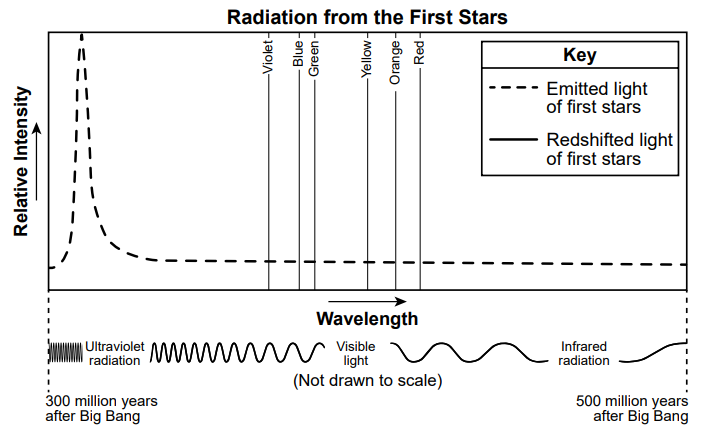
The only evidence astronomers have for the first stars that formed is the electromagnetic radiation they left behind. Telescopes like Hubble can detect objects billions of light-years away (billions of years back in time).

The graph below shows some information about the first stars that formed after the Big Bang

Describe how wavelengths of emitted radiation from first stars have changed since the Big Bang and explain how this difference in wavelength is evidence for how the universe changed since the Big Bang. [1]

Difference in wavelength:________

How the universe changed:______

Pitanje 29
29.

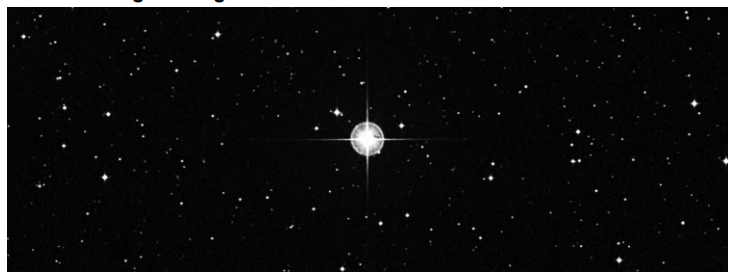
One of the oldest stars ever observed by HST is classified as a giant star called Methuselah in the Milky Way Galaxy. It is believed to be almost as old as the universe itself. Based on Methuselah's composition, scientists do not believe it is one of the first stars.

Digital Image of Methuselah in the Constellation Libra

Which statement correctly explains why the composition of Methuselah, a massive star, provides evidence that Methuselah is not one of the first stars formed during the Big Bang?

Pitanje 30
30.

A student makes a claim that the water on our planet is most similar to the water found on comets based on its D/H ratio, so comets must be a major source of water on early Earth. Which statement, based on evidence from the graph, would refute this claim?

Pitanje 31
31.

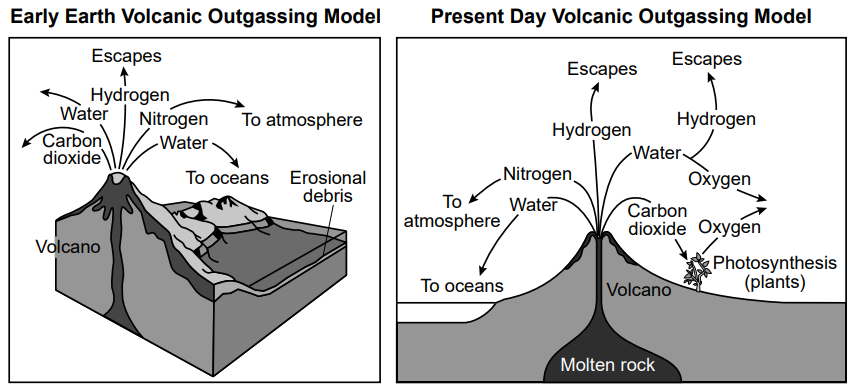
Earth's first significant atmosphere was formed from the release of gases from volcanic eruptions, when the mantle is believed to have been molten. Gases from the interior were released and accumulated into a gaseous surface layer trapped by gravitational forces. Solar wind from the Sun swept the light gases (hydrogen and helium) away, leaving behind heavier gases in the early atmosphere.

The models below show gases entering Earth’s atmosphere at two different times. Comparison of Early Earth and Present Day Volcanic Outgassing Models. The early Earth model shows volcanic emissions of hydrogen, water, nitrogen, and carbon dioxide, impacting the atmosphere and oceans. The present day model includes similar emissions but also highlights oxygen and photosynthesis by plants.

Which statement is correctly supported by evidence from the two models showing volcanic outgassing?

Pitanje 33
33.

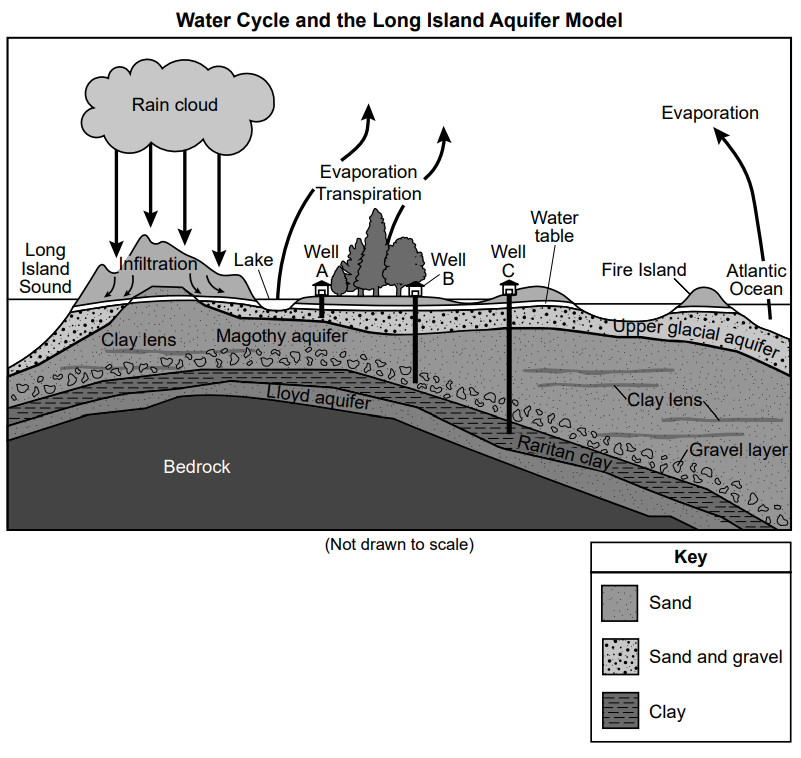
In areas where human population density is high, managing fresh water availability is essential. A large, underground store of water is called an aquifer. One of the most important aquifers in New York State is beneath Long Island and supplies 400 million gallons of water per day to over 2.8 million people. The cross section below represents water cycle processes for the Long Island area. The three aquifers (Upper Glacial, Magothy, and Lloyd) and sediment or rock layers that together make up the larger Long Island aquifer region are shown.

Diagram of the Water Cycle and Long Island Aquifer Model showing various layers such as the Upper glacial aquifer, Magothy aquifer, Lloyd aquifer, Raritan clay, and Bedrock. Includes features like wells, clay lenses, and water bodies with infiltration, evaporation, and transpiration processes.

A groundwater investigation is planned for water Well B and Well C from the cross section. A scientist believes that Well B will supply water at a faster rate than Well C. Which statement most likely explains why the scientist is correct?

Pitanje 35
35.

Which row in the table correctly identifies the family of Eurypterus remipes, the age of the fossil, and the type of movement its appendages were used for?

Row

Family

Age (mya)

Type of Movement

(1)

Rhenopteridae

350

walking

(2)

Pterygotidae

330

walking

(3)

Eurypteridae

420

swimming

(4)

Mycteropidae

355

swimming

Pitanje 36
36.

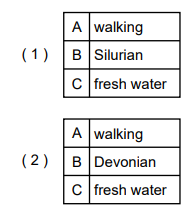
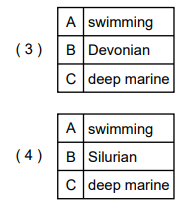
Based on evidence in the model, which table correctly completes the passage below? Evidence of the mass extinction of $A$ eurypterid families can be inferred from the model. This extinction event occurred at the end of the $B$ period. After this event, the majority of remaining eurypterid families lived in a $C$ environment.

Two small tables, each with three rows labeled A to C. Details include walking, Silurian, fresh water, and Devonian.Two small tables, each with three rows labeled A to C. Details include swimming, Devonian, deep marine, and Silurian.

Pitanje 37
37.

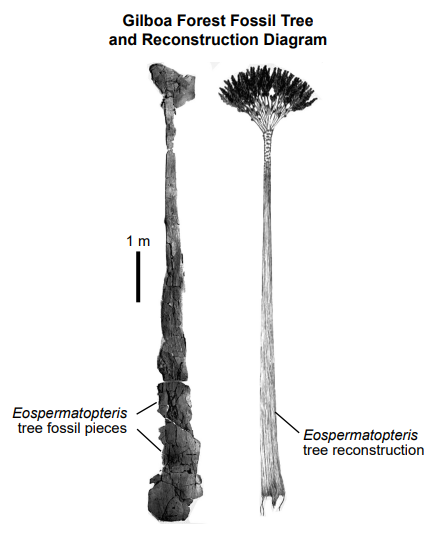
The image below shows the fossils found in sandstones and mudstones near Gilboa, New York, and an artist’s reconstruction of this type of tree typically found in the Devonian forest.

Gilboa Forest Fossil Tree and Reconstruction Diagram showing Eospermatopteris tree fossil pieces and reconstruction.
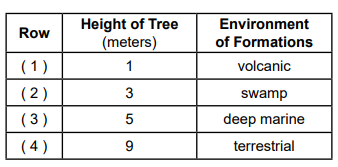
Based on the diagram, which row in the table below provides the correct evidence that accurately describes the height (in meters) and environment of formation for the Eospermatopteris tree fossil?

Table showing the height of trees in meters and the environment of formations, including volcanic, swamp, deep marine, and terrestrial.

Pitanje 39
39.

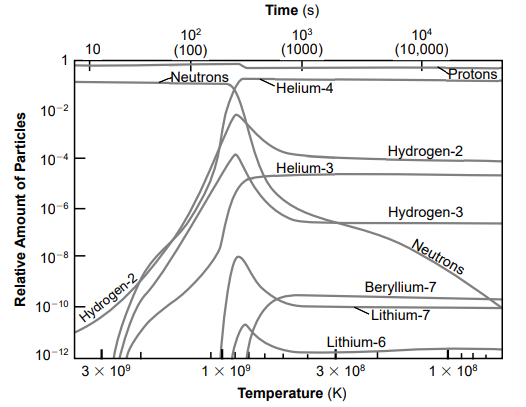
Particles were created as a result of the Big Bang. The first particles were subatomic particles like the protons, neutrons, and nuclei of lighter elements such as hydrogen, helium, lithium, and beryllium. The graph below shows some information about these particles, the temperature of the universe at the time they were created, and the amount of time after the Big Bang that they were created.

Relationship Between Relative Amount of Different Particles and Temperature of the Universe After the Big Bang Over Time

Graph showing the relative amount of particles like Helium, Hydrogen, and Neutrons over time and temperature.

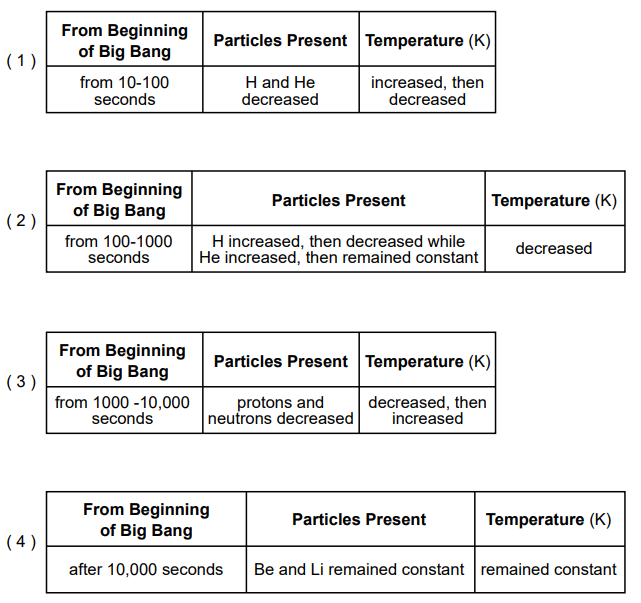
Based on information from the Relationship Between Relative Amount of Different Particles and Temperature of the Universe After the Big Bang Over Time graph, which table correctly identifies the composition of matter in the universe as evidence for the Big Bang theory?

Table showing data from the beginning of the Big Bang, describing changes in particles present and temperature over time. The table is divided into four sections, each detailing a different time range and corresponding observations.

Pitanje 41
41.

Which statement best describes the differences between terrestrial planets and Jovian planets in the solar system as a result of the early history of their formation?

Pitanje 42
42.

Which value would be the most accurate prediction for the period of revolution for Saturn?

Pitanje 46
46.

Which table identifies the correct relative ages of two craters and a piece of evidence that supports the hypothesis for the Late Heavy Bombardment?

Pitanje 48
48.

Which two geologic processes have provided information about Earth’s formation and early history by altering or destroying most of the very early rock record on Earth, while 4.2 billion year old craters on the Moon still remain?