Complete your notes before completing this Sum It Up.
Complete this Sum It Up on your own.
Question 1
1.
Other Answer Choices:
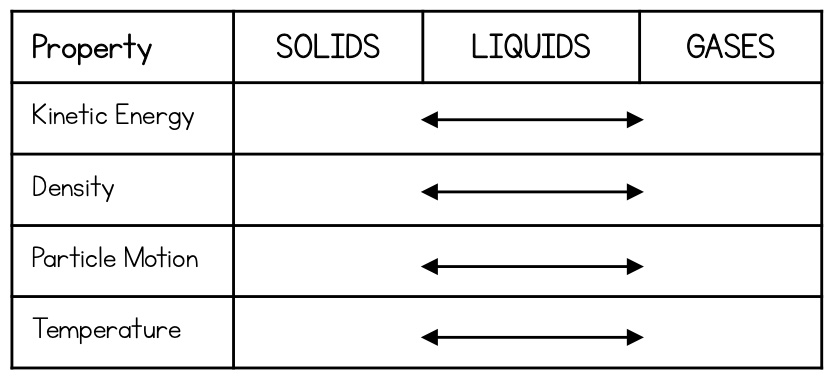
high Temp. <-----> low Temp.
high KE <-----> low KE
slow Particle Motion <-----> fast Particle Motion
fast Particle Motion <-----> slow Particle Motion
low KE <-----> high KE
high Density <-----> low Density
low Density <-----> high Density
low Temp. <-----> high Temp.
Question 2
2.
Question 3
3.
Question 4
4.
Other Answer Choices:
particles
increases
solid
decreases
liquid
deposition
sublimation
gas
phase change
Bose-Einstein condensate
motion
kinetic
states
condensation
temperature
plasma
Question 5
5.
Other Answer Choices:
states
motion
increases
gas
kinetic
decreases
condensation
solid
phase change
Bose-Einstein condensate
plasma
particles
deposition
temperature
liquid
sublimation
Question 6
6.
Other Answer Choices:
Bose-Einstein condensate
particles
temperature
decreases
motion
solid
sublimation
condensation
plasma
phase change
gas
states
increases
deposition
kinetic
liquid
Question 7
7.
Other Answer Choices:
liquid
plasma
particles
kinetic
decreases
Bose-Einstein condensate
solid
condensation
phase change
sublimation
temperature
increases
states
motion
deposition
gas
Question 8
8.
Answer(s) Confidence Tracker:__________
Thank you for completing this Sum It Up!
Fill in the trends for each of the properties listed in the table.
What are three things that affect the total thermal energy of a substance? Select ALL that apply.
the amount of substance
the type of substance
the container that the substance is in
the temperature of the substance
What is the definition of 'absolute zero'?
Boiling point of water
A null value in temperature
Lowest possible temperature where all molecular motion stops
Temperature where all substances freeze
According to the kinetic molecular theory of matter, all matter is made of tiny ______________ . The particles are in constant ___________ . ____________ energy is the enerty of an object because of motion. The measure of the speed of the moving or vibrating particles is called ________________ .
There are three ordinary ___________ of matter: solid, liquid, and gas. Matter that has definite volume and shape is called a __________ . If matter has definite volume, but no definite shape it is called a ___________ . When matter does not have a definite shape or volume it is a ________ . A fourth state of matter, the ___________ state, is matter that exists at extremely high temperatures and consists of electrically charged particles. A fifth state of matter is called _____________________________ , which is a low-density gas of extremely low energy.
When substances go from one state to another, this is called a _________________ . When you add heat to matter, its thermal energy ______________ . When you remove heat, its thermal energy ______________ .
The phase change when a liquid becomes a gas is called vaporization or evaporation. The opposite phase change is _________________ . When a solid skips the liquid phase and turns directly into a gas, this is called ________________ . The opposite phase change is called _______________ .