Where do you think each part of the water cycle is happening on the image? Drag and drop the key terms on to the image.
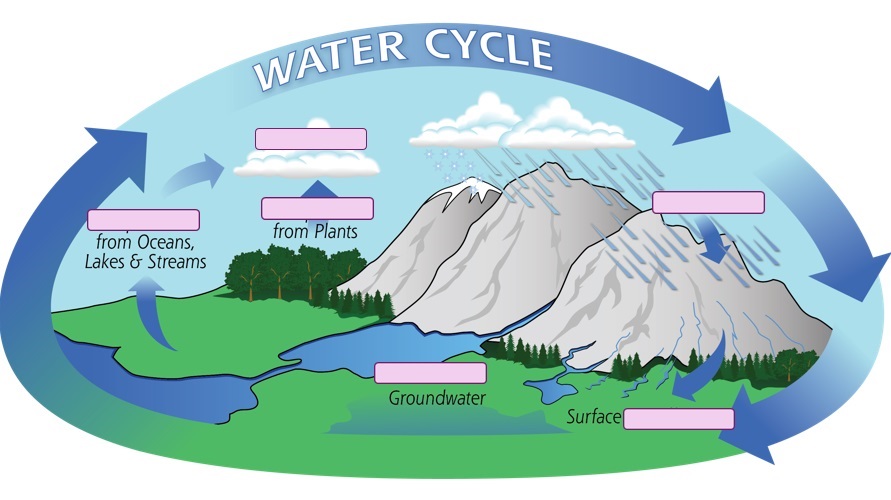
Mmuae Afoforo a Wobɛpaw:
Evaporation
Precipitation
Transpiration
Condensation into a cloud
Runoff
Infiltration
A biogeochemical cycle refers to the continuous movement and transformation of chemical elements between living organisms, the atmosphere, and the Earth's crust, essentially recycling essential elements like carbon, nitrogen, and water through various parts of the planet's systems, including the biosphere, hydrosphere, and geosphere; essentially, it's nature's way of recycling nutrients necessary for life on Earth.
What sphere is the Earth's crust?
What sphere are living orgamisms
Where do you think each part of the water cycle is happening on the image? Drag and drop the key terms on to the image.
Find a video that talks about how the water cycle is a biogeochemical cycle, paste a link to the video here.
The water cycle is a biogeochemical cycle.
As a group, discuss how the water cycle is a biogeochemical cycle.
Take a snip or screenshot of the slide from the activity and paste in the answer box.
Give an example of how water can move from the atmosphere to the geosphere (Precipitation).
(Feel free to use your favorite web browser to help you find examples, but make sure your answer is in your own words)
Give an example of water can move from the biosphere to the atmosphere (transpiration)
(Feel free to use your favorite web browser to help you find examples, but make sure your answer is in your own words)
How much of water on our planet do you think is freshwater? (no wrong answers, I want to know what you think).
Check your answer, use your favorite web browser to check your answer, were you right? Close? Way off?
Key Processes in the Water Cycle
Evaporation: The process where liquid water is transformed into water vapor due to heat from the sun. It occurs in oceans, lakes, and rivers.
Transpiration: The release of water vapor from plants into the atmosphere. Together with evaporation, it is often referred to as "evapotranspiration."
Condensation: When water vapor cools and changes back into liquid water, forming clouds. This process is essential for precipitation.
Precipitation: Water falls from the atmosphere to the Earth's surface in the form of rain, snow, sleet, or hail.
Infiltration and Runoff: Water that reaches the ground can either seep into the soil (infiltration) or flow over the land surface (runoff), eventually returning to bodies of water.
What's Your Water Footprint (water usage)?
How did your water footprint compare to others in your group?
Discussion: What are some ways to preserve water?
Paste a picture of the slide where your group worked on this discussion
I can explain what a biogeochemical cycle is and how the water cycle is an example of one.