Compare multiple climate scenarios to evaluate the effectiveness of different policy approaches.
Create your own climate policy plan and explain the reasoning behind it.
Complete 5 scenarios and identify which meet Paris Climate Agreement goals.
Design a climate policy based on your evaluation of the 5 scenarios.
Compare multiple climate scenarios to evaluate the effectiveness of different policy approaches.
Create your own climate policy plan and explain the reasoning behind it.
Complete 5 scenarios and identify which meet Paris Climate Agreement goals.
Design a climate policy based on your evaluation of the 5 scenarios.
We will be using En-ROADS for this assignment. Click here to open the simulator in a new tab or use the embedded website below.
Take a minute to look over the various areas of the En-Roads simulation.
Identify the area that displays a stacked area chart showing energy sources from 2000–2100 with a color-coded legend for coal, oil, gas, renewables, bioenergy, nuclear, and new zero.
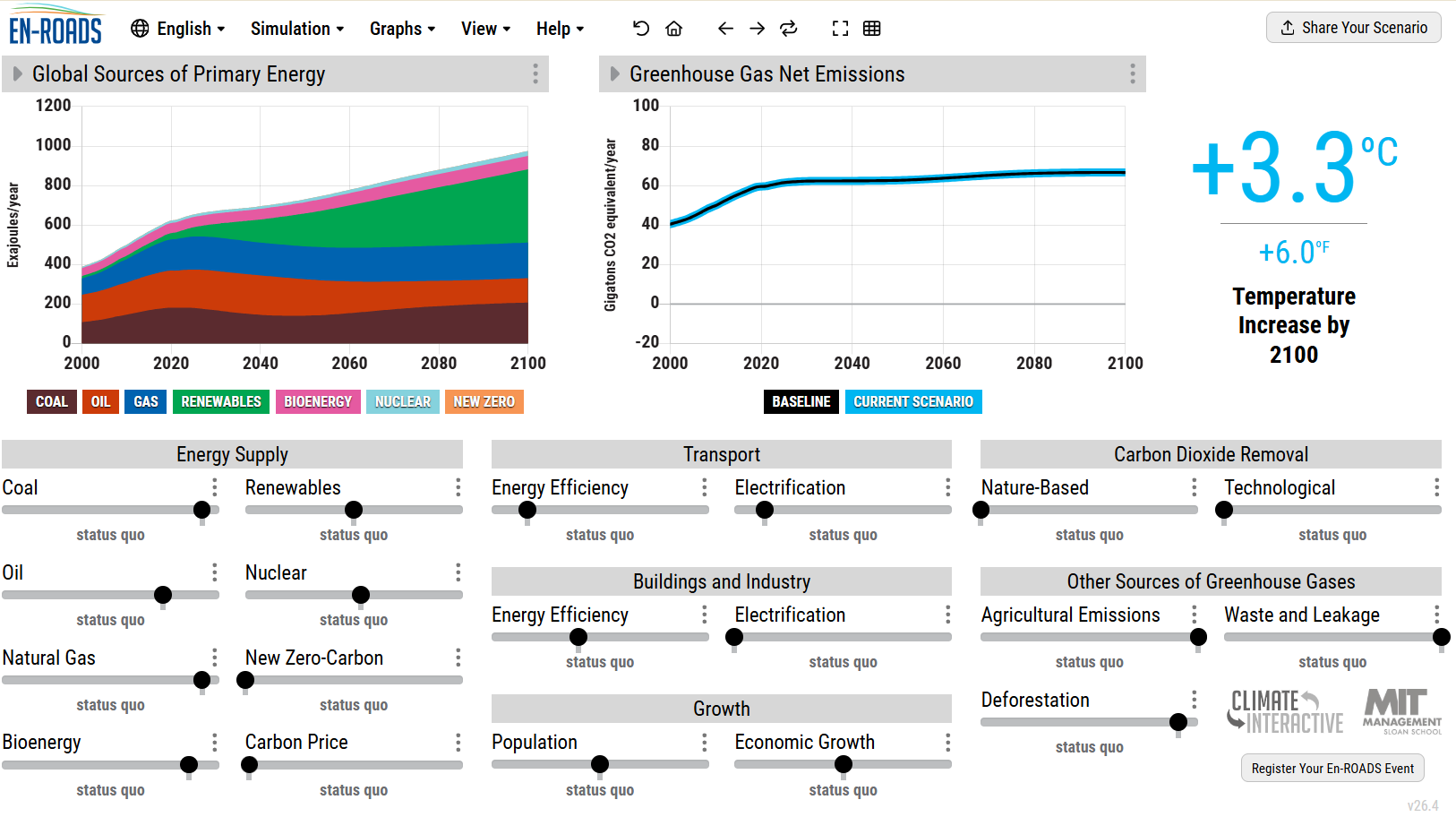
Identify the control panel with sliders to adjust different aspects of energy supply, transport, buildings and industrict, growth, carbon dioxide removal, and other sources of greenhouse gases.

Identify the line graph comparing baseline greenhouse gas net emissions versus the current scenario.

Identify the area with the projected global temperature change by 2100 with the given conditions.

Identify the area where you could get a link to share for your current scenario.

The sliders in the control panel are set to "status quo" by default. Which of the following best defines "status quo?"
What is the predicted global temperature increase by 2100 with no climate action (keeping everything at the status quo)?

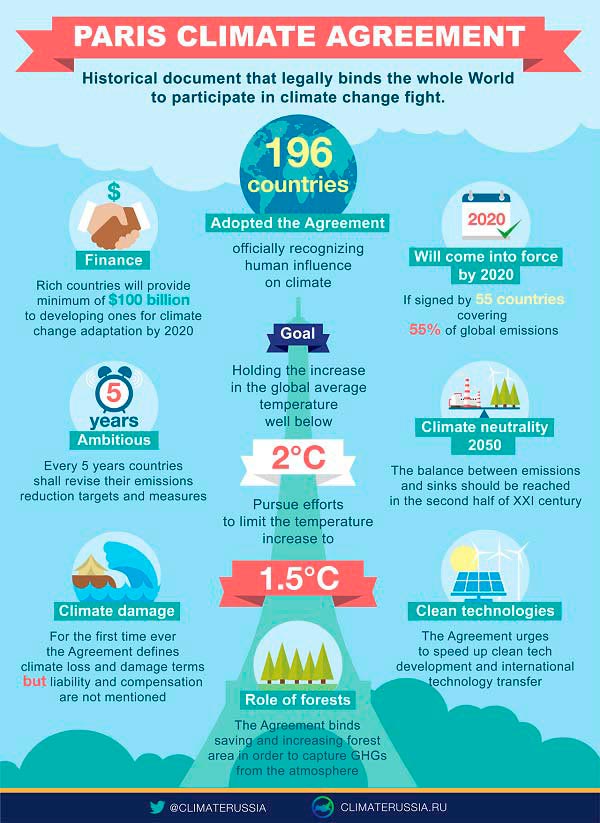
The Paris Climate Agreement is a landmark international treaty on climate change adopted by almost 200 countries in 2015.
These countries pledged to work together to limit global temperature change to 1.5°C above pre-industrial levels by 2100.
Predict: What action needs to be taken to limit global temperature change to 1.5°C?
In this scenario, let's see what happens when we increase renewable energy and decrease fossil fuels.
Make sure En-Roads is at the baseline by clicking Simulation > Reset Policies.
Adjust the following sliders to these targets:
Slider | Target |
|---|---|
Energy Supply: Renewables | Highly Encouraged |
Building and Industry: Energy Efficiency | Increased |
Energy Supply: Coal | Highly Discouraged |
Energy Supply: Oil | Highly Discouraged |
Energy Supply: Natural Gas | Highly Discouraged |
Energy Supply: Nuclear Energy | More Encouraged |
Use the "Share Your Scenario" button to Copy Scenario Link and paste here:
What is the predicted global temperature by 2100 in Scenario 1?
Will increasing renewable energy sources and decreasing fossil fuels be enough to reach the goal of 1.5°C by 2100?
In this scenario, let's add on to Scenario 1 and charge polluters for their greenhouse gas emissions through carbon taxs, cap-and-trade systems, and carbon credit markets.
The only slider you should need to change is Carbon Pricing.
Slider | Target |
|---|---|
Energy Supply: Renewables | Highly Encouraged |
Building and Industry: Energy Efficiency | Increased |
Energy Supply: Coal | Highly Discouraged |
Energy Supply: Oil | Highly Discouraged |
Energy Supply: Natural Gas | Highly Discouraged |
Energy Supply: Nuclear Energy | More Encouraged |
Energy Supply: Carbon Pricing | Very High |
Use the "Share Your Scenario" button to Copy Scenario Link and paste here:
What is the predicted global temperature by 2100 in Scenario 2?
Will adding Carbon Pricing be enough to reach the goal of 1.5°C by 2100?
In this scenario, we'll focus on improving land-use and reducing agricultural emissions.
Reset En-Roads by clicking Simulation > Reset Policies
Slider | Target |
|---|---|
Other Sources of Greenhouse Gases: Deforestation | Highly Reduced |
Other Sources of Greenhouse Gases: Agricultural Emissions | Highly Reduced |
Other Sources of Greenhouse Gases: Waste and Leakage | Highly Reduced |
Carbon Dioxide Removal: Nature-Based | High Growth |
Energy Supply: Bioenergy | Highly Reduced |
Use the "Share Your Scenario" button to Copy Scenario Link and paste here:
What is the predicted global temperature by 2100 in Scenario 3?
Will improving land-use and reducing agricultural emissions be enough to reach the goal of 1.5°C by 2100?
In this scenario, we'll pretend that every change below can be effectively implemented.
You should only have to change the sliders in bold below:
Slider | Target |
|---|---|
Other Sources of Greenhouse Gases: Deforestation | Highly Reduced |
Other Sources of Greenhouse Gases: Agricultural Emissions | Highly Reduced |
Other Sources of Greenhouse Gases: Waste and Leakage | Highly Reduced |
Carbon Dioxide Removal: Nature-Based | High Growth |
Energy Source: Bioenergy | Highly Reduced |
Carbon Dioxide Removal: Technological | High Growth |
Energy Supply: Renewables | Highly Encouraged |
Transportation: Energy Efficiency | Highly Increased |
Building and Industry: Energy Efficiency | Highly Increased |
Energy Supply: Coal | Highly Discouraged |
Energy Supply: Oil | Highly Discouraged |
Energy Supply: Natural Gas | Highly Discouraged |
Energy Supply: Nuclear Energy | More Encouraged |
Energy Supply: Carbon Pricing | Very High |
Use the "Share Your Scenario" button to Copy Scenario Link and paste here:
What is the predicted global temperature by 2100 in Scenario 4?
Will making radical changes in energy sources, efficiency, and land use be enough to reach the goal of 1.5°C by 2100?
In this scenario, we'll look at a more realistic future.
Click on Simulation > Reset Policies
Then set the sliders to the following:
Slider | Target |
|---|---|
Other Sources of Greenhouse Gases: Deforestation | Reduced |
Other Sources of Greenhouse Gases: Agricultural Emissions | Reduced |
Other Sources of Greenhouse Gases: Waste and Leakage | Reduced |
Carbon Dioxide Removal: Nature-Based | Low Growth |
Energy Source: Bioenergy | Discouraged |
Carbon Dioxide Removal: Technological | Low Growth |
Energy Supply: Renewables | More Encouraged |
Transportation: Energy Efficiency | Increased |
Building and Industry: Energy Efficiency | Increased |
Energy Supply: Coal | Discouraged |
Energy Supply: Oil | More Discouraged |
Energy Supply: Natural Gas | Discouraged |
Energy Supply: Nuclear Energy | More Encouraged |
Energy Supply: Carbon Pricing | Medium |
Use the "Share Your Scenario" button to Copy Scenario Link and paste here:
What is the predicted global temperature by 2100 in Scenario 5?
Will making more realistic changes in energy sources, efficiency, and land use be enough to reach the goal of 1.5°C by 2100?
Congratulations, you're now the Supreme Leader of Planet Earth and can dictate climate policy! Use En-Roads to create a custom plan for your minions to implement.
Use the "Share Your Scenario" button to Copy Scenario Link and paste here:
Describe your climate policy in 2-3 sentences. What were your top priorities?
Now that you've imagined absolute power, what's the ONE realistic action you could take today to move the world toward your vision
Reflect on your understanding of the learning objectives:
Compare multiple climate scenarios to evaluate the effectiveness of different policy approaches. | |
|---|---|
Create your own climate policy plan and explain the reasoning behind it. |
Reflect on your mastery of the success criteria:
Complete 5 scenarios and identify which meet Paris Climate Agreement goals. | |
|---|---|
Design a climate policy based on your evaluation of the 5 scenarios. |