Warm Up: Examine the following graph.
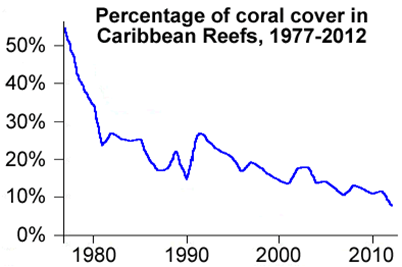
What trend does the graph show? Why do you think this is happening?
Warm Up: Examine the following graph.
What trend does the graph show? Why do you think this is happening?
In order to complete this assignment, you will need to use Click on the link to open the Gizmo in a new tab. https://apps.explorelearning.com/gizmos/launch-gizmo/1056
If you haven't joined our Gizmos class yet, go https://go-el.com/join and click "Log in/Enroll" in the upper right hand corner to log in.
Use the code EL8T2J5F to join our class and gain full access to Gizmos.
Warm Up: Examine the following graph.
What trend does the graph show? Why do you think this is happening?
Question: How are coral reefs affected by high temperatures and acidic water?
In the Caribbean, water temperatures typically range from 24 °C to 30 °C. What do you think might happen if temperatures rise much higher than 30 °C?
Set the Ocean temperature to 33 °C. Click Advance year 10 times.
What changes do you notice?
The white corals you see have undergone coral bleaching. At high temperatures, corals may lose their zooxanthellae, causing corals to lose their color and their main source of food. Once bleaching occurs, the coral colony usually dies.
Select the DATA tab. Which species is most affected (experienced the greatest decline) by bleaching?
On the DATA tab, select every organism.
In general, how does the decline in corals affect the other organisms on the reef?
The pH of a solution is a measure of how acidic or basic it is. The greater the pH, the more basic the solution is. Corals and other marine invertebrates require less energy to make their exoskeletons and shells when ocean water is slightly basic. As carbon dioxide concentrations in Earth’s atmosphere rise, ocean water absorbs carbon dioxide and becomes more acidic. This process is called ocean acidification.
How do you think ocean acidification will affect coral reefs?
Click Return to original conditions and Restart.
Set the Ocean pH to 7.6.
Click Advance year 20 times.
What changes do you see on the CORAL REEF and DATA tabs?
Many scientists predict warmer oceans, and lower ocean pH in the future. If this occurs, how do you think these changes will affect Caribbean coral reefs?
Click Return to original conditions and Restart.
Set Ocean temperature to 33 °C.
Set the Ocean pH to 7.6.
Click Advance year 20 times.
What changes do you see on the CORAL REEF and DATA tabs?
Propose a solution: What are two things humans could do to reverse the effects of warmer oceans and decreased (more acidic) pH?
Rate your experience.
How did this Gizmo help your understanding of ocean acidification impacts on coral reefs.
Rate yourself on our Learning Targets.
LT1 Success Criteria: I can explain how different phenomena in the ocean are related to ocean currents, temperature, density and salinity.
Rate yourself on our Learning Targets.
LT2 Success Criteria: I can provide example of how the ocean is impacted by pH changes
Rate yourself on our Learning Targets.
LT3 Success Criteria: I can describe changes in coral reefs and oceanic ecosystems caused by ocean acidification.