Log in
Sign up for FREE
arrow_back
Library

x3.03 Very Simple Climate Model MOD 25-26

star
star
star
star
star
Last updated about 2 hours ago
11 questions
Note from the author:
Required
2
Required
5
Required
5
Required
5
Required
3
Required
2.5
Question 1
1.
Question: How will the amount of carbon emissions released into the atmosphere affect the climate during this century?

We will be using the Very Simple Climate Model. It looks at how carbon dioxide (CO2) in the atmosphere affects temperature changes. It only focuses on CO2 and does not consider things like wind, rain, or other greenhouse gases.

The model measures carbon emissions in gigatons of carbon (GtC). It shows that around 80% of the greenhouse gases produced by humans come from CO2.

Using data from 2015, the model finds a strong connection between CO2 levels and temperature. It suggests that when CO2 levels double, the temperature could rise by about 3 °C (37.4 °F). For example, if CO2 levels go up from 400 parts per million (ppm) to 800 ppm, temperatures might increase by 3 °C.

Experts say we should try to limit the temperature rise to 2 °C above what it was before the industrial era. Many scientists believe we should aim for an even stricter limit of 1.5 °C to avoid serious effects from climate change.

Every time the carbon concentration in the atmosphere doubles, global temperature rise by __________ .

Experts recommend limited the temperature increase to __________
Question 2
2.
Scenario 1: What if we continue to produce the same amount of carbon dioxide into the atmosphere as in the year 2015 (10.5 GtC/yr)?

We will be using a model to predict the outcome.
  • The carbon dioxide emissions rate is measured in gigatons of carbon dioxide per year.
  • The emissions rate is initially set at 10.5 gigatons of carbon (GtC) per year, which was the actual rate during 2015. 
  • The recommended temperature limit line (15.81° C) reflects 2 °C of warming above pre-industrial times, after which scientists predict life on Earth will be significantly impacted and it will be difficult to adapt.
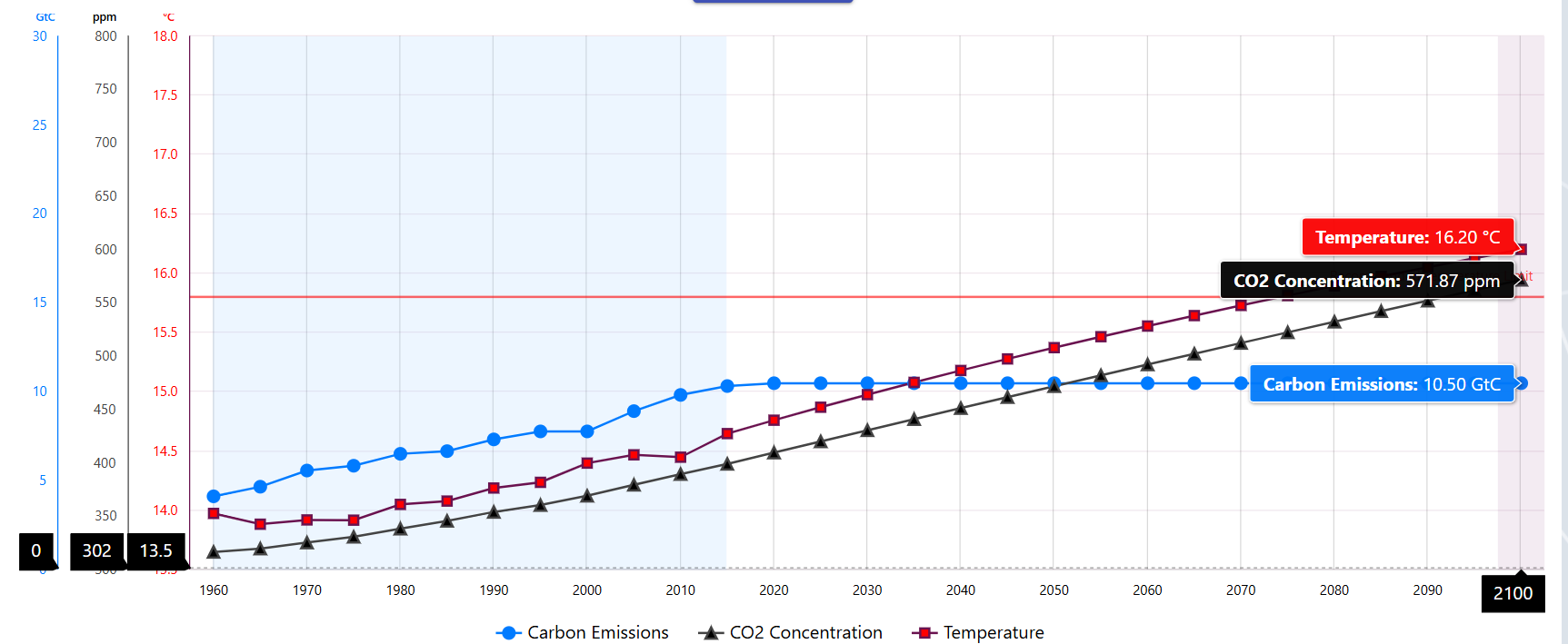


What might happen if we continue to release the same amount of carbon dioxide into the atmosphere as in the year 2015?

Observe the data at the year 2100 and record.

Temperature: _______ °C
CO2 Concentration: _______ ppm
Carbon Emissions: _______ GtC

How far over did the final temperature exceed the recommended temperature limit (15.81° C)? _______ °C
Question 3
3.

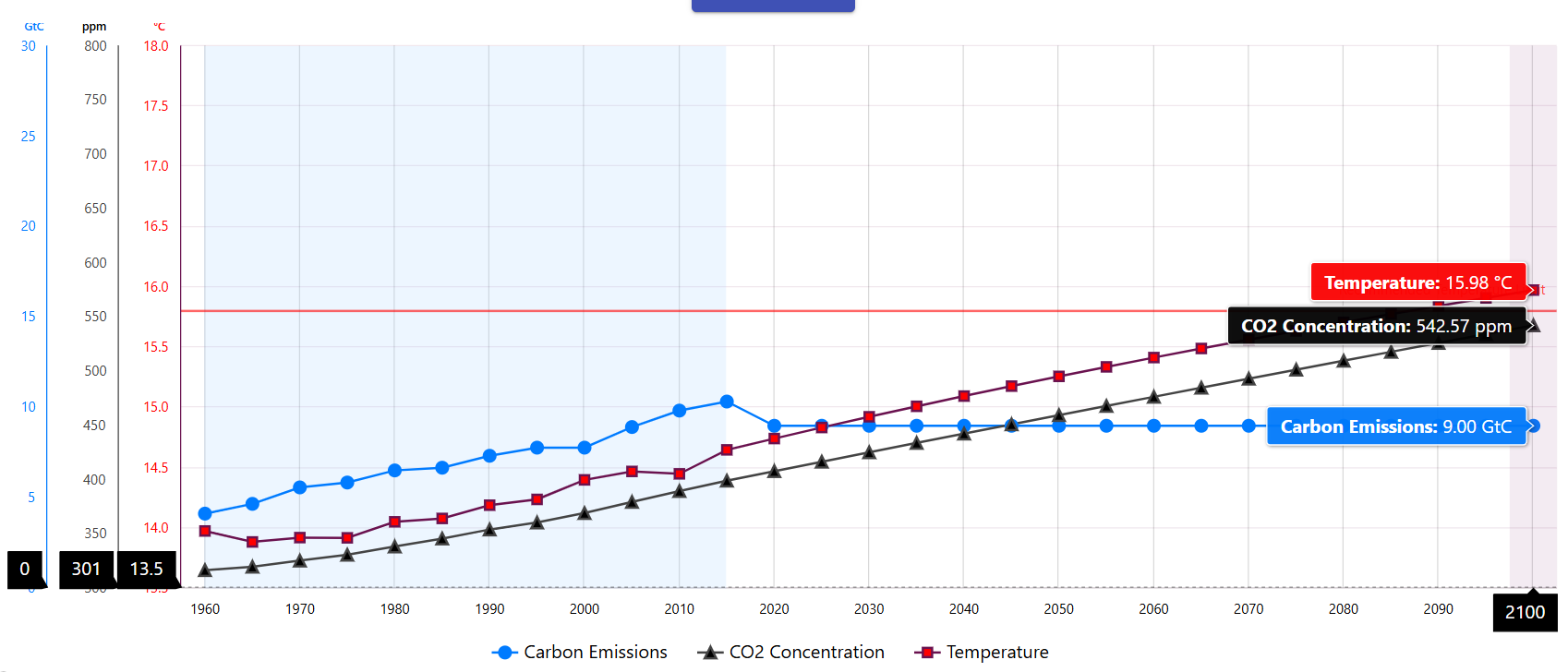
Scenario 2: What if we can reduce the rate that we add carbon dioxide to the atmosphere from 10.6 to 9 gigatons of carbon per year (9 GtC/yr)?

The model has been adjusted to lower the emissions rate to 9 GtC/yr.


What might happen if we reduce the amount of carbon dioxide into the atmosphere to 9 GtC/yr?

Observe the data at the year 2100 and record.

Temperature: _______ °C
CO2 Concentration: _______ ppm
Carbon Emissions: _______ GtC

How far over did the final temperature exceed the recommended temperature limit (15.81° C)? _______ °C
Question 4
4.

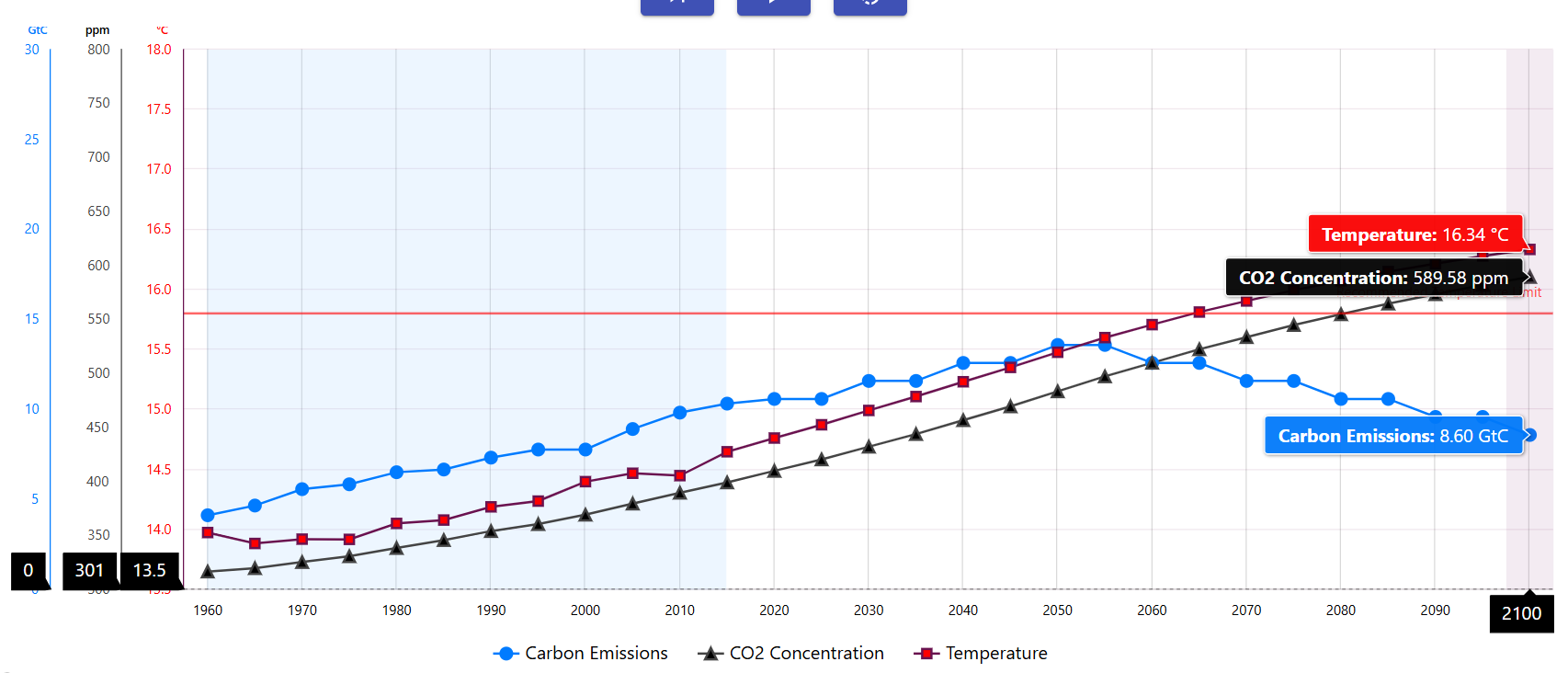
Scenario 3: What if our emissions get worse before they get better?

People will rise to the challenge and limit the emissions of greenhouse gases in the atmosphere. Sure, it might take some time, but we will have new technologies and policies in place to limit the amount of carbon dioxide released.

In this scenario, let’s assume that people will keep emitting carbon dioxide at an increasing rate until 2050, and then we will have figured out how to stop polluting and the rate will fall.


Record the year 2100 data from the above graph.

Temperature: _______ °C
CO2 Concentration: _______ ppm
Carbon Emissions: _______ GtC

How far over did the final temperature exceed the recommended temperature limit (15.81° C)? _______ °C
Question 5
5.
When emissions began to decrease in Scenario 3, what happened to the CO2 concentration? __________

When emissions began to decrease in Scenario 3, what happened to the temperature? __________
Question 6
6.

Question 7
00:59
keyboard_arrow_down
Required
0.5
Question 8
01:28
keyboard_arrow_down
Required
0.5
Question 9
02:06
keyboard_arrow_down
Required
0.5
Question 10
02:59
keyboard_arrow_down
Required
0.5
Question 11
05:36
keyboard_arrow_down
Required
0.5
What could be the consequences of waiting until 2050 to begin reducing carbon emissions?
Temperature and CO2 will continue rise to dangerous levels
Temperature and CO2 will immediately decrease
There will be no effect on temperature and CO2
Question 7
7.

Question 8
8.

Question 9
9.

Question 10
10.

Question 11
11.

If we stopped burning carbon tomorrow, what would happen to global temperatures?
Stay the same
Decrease
Continue to increase
Where has most of the extra warming from climate change gone over the last 50 years?
Into space
Into the oceans
Into the atmosphere
Which greenhouse gas stay in the atmosphere longer due to its chemical stability?
Nitrous oxide
Carbon dioxide
CFCs
If we cut all carbon emissions today, we would solve climate change.
True
False
According to the video, what is essential for future generations regarding climate change?
Continue using fossil fuel use
Ignore climate impacts
Halt emissions sooner rather than late