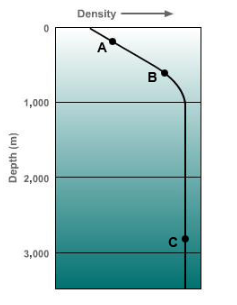
According to the density profile shown here, at which depth would you find the coolest, saltiest waters?
According to the density profile shown here, at which depth would you find the coolest, saltiest waters?
According to the density profile shown here, at which depth would you find the coolest, saltiest waters?
Ocean currents have an effect on which two things?
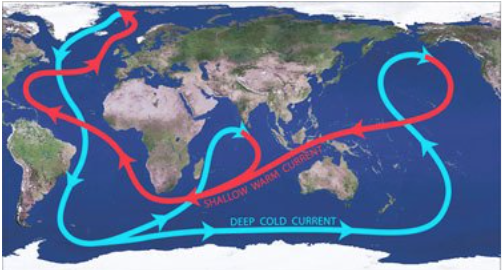
What do we call the constantly moving system of deep-ocean circulation driven by differences in temperature and salinity?
Salt water is _____________ fresh water.
As the temperature of ocean water changes from 10 to 30 degrees C, how does the density change?
What factors create deep ocean currents?

Which of the following drives global thermohaline (conveyor belt) circulation?
What is the upward movement of cold water from the ocean depths called?
As more carbon has been put into the atmosphere, the ocean's pH levels have decreased. This is known as...
In class we learned about the possibility of slowing of deep water currents. What would be the main cause of the slowing?
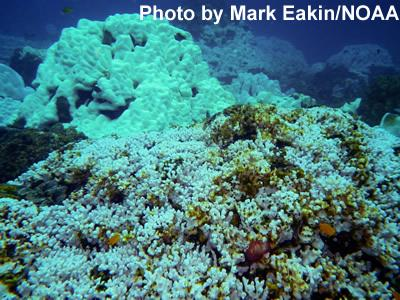
What is the most likely cause of the coral bleaching shown below?
Surface ocean temperatures of the eastern tropical Pacific are colder than average during an El Niño event.
Read the information and answer the questions.
A coral reef is made up of organisms called corals. Corals are marine animals whose skeletons form the structure of the reef. The bright colors of coral reefs are caused by algae that live inside the skeleteons of the corals and provide the corals with energy.
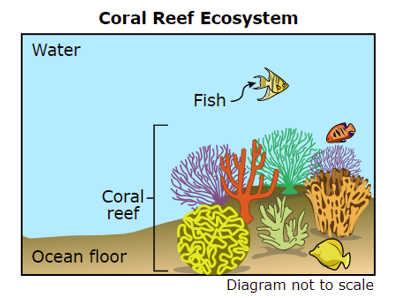
Coral reefs provide homes for about 25% of all marine species. The Coral Reef Ecosystem diagram shows some of the organisms found in a coral reef ecosystem.
When stressed, corals expel the algae, lose their bright colors, and become white. This is nown as a coral bleaching event. If the stress lasts for only a short time, the corals can recover. But if the stress lasts for a long time, the corals can starve.
A student claims that coral reef ecosystems are stable because they can recover after a bleaching event.
Which evidence should be collected to evaluate the student's claim?
An increase in the temperature of seawater is one possible cause of coral bleaching. The Global Coral Bleaching Events graph shows the relationship between the change in seawater temperature and three global coral bleaching events.
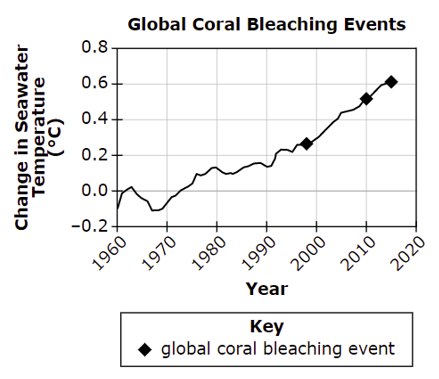
The change in seawater temperature is correlated with the amount of carbon dioxide in the atmosphere. The Atmospheric Carbon Dioxide graph shows how the amount of carbon dioxide in he atmosphere has changed since 1960.
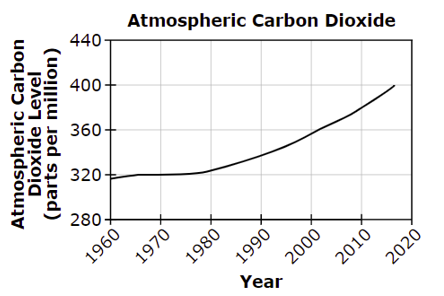
Scientists claim that an increase in carbon dioxide in the atmosphere destabilizes coral reef ecosystems. Which evidence from the Global Coral Bleaching Events and Atmospheric Carbon Dioxide graphs supports the claim?
Describe what could happen to a healthy coral reef ecosystem if atmospheric carbon dioxide levels continue to increase.
Be sure to include:
- Describe one way a healthy coral reef ecosystem could change if atmospheric carbon dioxide levels continue to increase.
- Describe how that change to a coral reef ecosystem could affect other organisms in the coral reef ecosystem.