If you need help with this assignment, click here to watch the class recording.
Predict how density, salinity, and temperature affect whether water floats or sinks
Describe the density, salinity, and temperature of rising water.
Describe the density, salinity, and temperature of sinking water.
If you need help with this assignment, click here to watch the class recording.
Predict how density, salinity, and temperature affect whether water floats or sinks
Describe the density, salinity, and temperature of rising water.
Describe the density, salinity, and temperature of sinking water.
Part 1: Density & Salinity (Saltiness)
Density is a measurement of the amount of mass in a specific volume.
Low density means the matter is not held closely together. There are less matter.
High density means the matter is packed closely together. There is more matter.
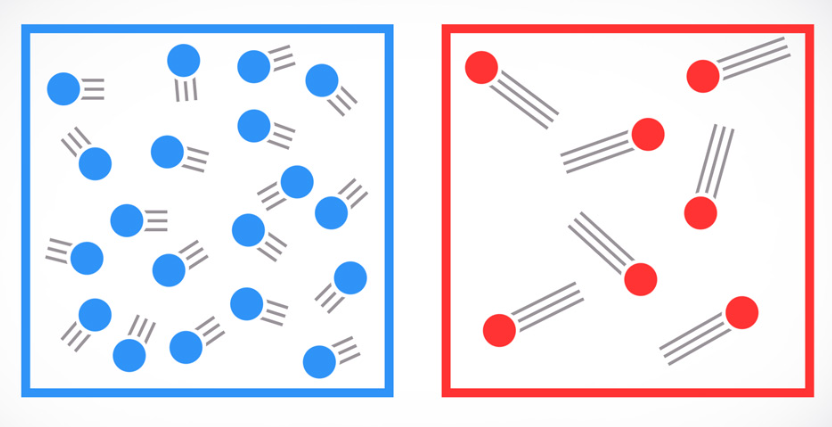
Identify the relative density of these models:
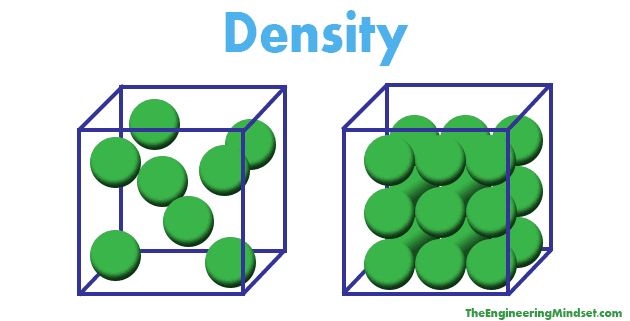
low density
high density
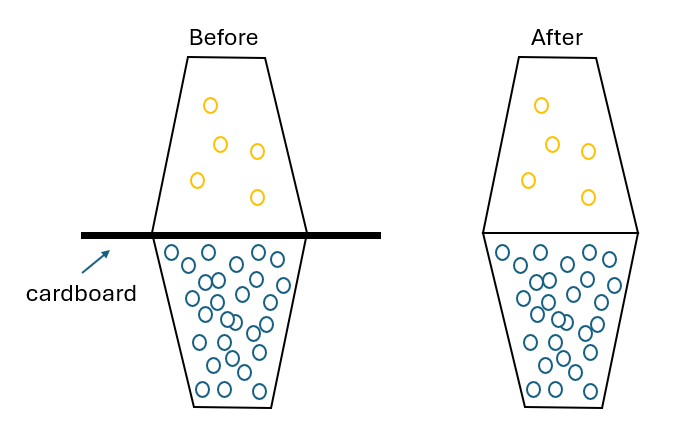
Consider this before and after model of the first demonstration with the yellow fresh water on top of the blue salt water:
What is the best explanation for why the colors stayed separated?
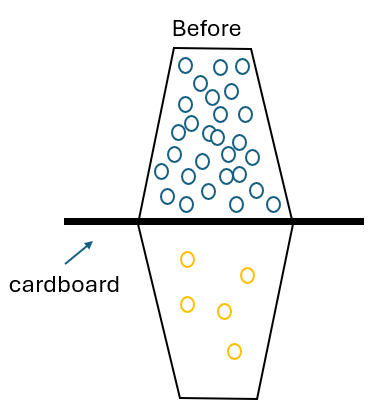
Consider this before model of the second demonstration where the blue salt water was on top of the yellow fresh water.

Which model best represents what happened after the cardboard was removed?
In the second demonstration, the blue salt water was dense than the fresh water, which is why the blue salt water and yellow fresh water
Part 2: Density & Temperature
Temperature is a measurement of energy. Adding energy to matter increases its temperature.
Matter with a low temperature has low energy, which allows the matter to be closer together (more dense).
Matter with a high temperature has high energy, which keeps the matter spread out (less dense).
Even in solids, all matter is moving a little bit unless the temperature is absolute zero.
How would you expect matter to be moving in cold water?
How would expect matter to be moving hot water?
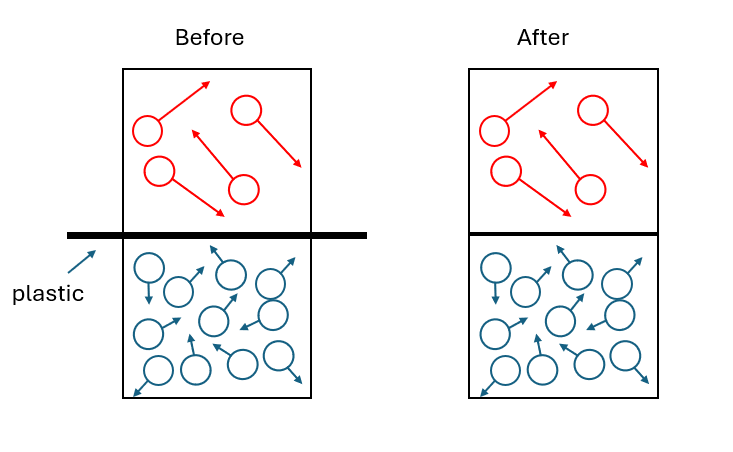
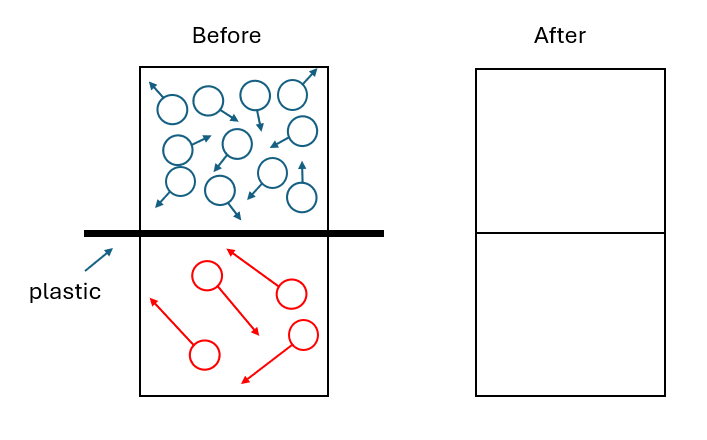
Consider this before and after model of the first demonstration with the red hot water on top of the cold blue water:
What is the best explanation for why the colors stayed separated?
Consider this model of the second demonstration with the hot red water on top of the blue cold water:
The arrows represent the amount of energy of each molecule.
The red water molecules have long arrows to represent energy.
The blue water molecules have short arrows to represent energy.
If you were asked to draw molecules in the "After" model, how would you draw their arrows to represent their energy?
The molecules should also be drawn
In the second demonstration, the blue cold water was dense than the red hot water, which is why the colors
Part 3: Salinity (Saltiness) & Temperature
Air temperate affects the amount of ice present in an area of the ocean.
When water freezes, the salt is left behind.
Predict:
When the air is cold and there is lots of ice, the salinity will
When the air is warm and there isn't a lot of ice, the salinity will
Observe the effect changing the temperate has on the salinity and the speed the water sinks due to density.
Watch the video above where the temperature increases. Make sure to notice the change in the salinity gauge and speed of sinking water. What conclusions can you form from your observations?
When the temperature increases, salinity and water sinks because it becomes dense.
Observe the effect changing the temperate has on the salinity and the speed the water sinks due to density.
Watch the video above where the temperature decreases. Make sure to notice the change in the salinity gauge and speed of sinking water. What conclusions can you form from your observations?
When the temperature decreases and more ice forms, salinity and water sinks because it becomes dense.
Part 4: Conclusion
In areas of the ocean where water sinks, the sinking water would have these characteristics:
Density:
Temperature:
Salinity:
Which of the following best re-states the lesson objective?
Reflect on your understanding of the learning objectives:
Predict how density and salinity affect whether water floats or sinks |
|---|
Reflect on your mastery of the success criteria:
Describe the density, salinity, and temperature of rising water. | |
|---|---|
Describe the density, salinity, and temperature of sinking water. |
Adding salt to the water would the amount of matter in the cup.
Predict: What will happen when the card stock is removed?
What happened when the card stock was removed?
Predict: What will happen when the card stock is removed?
What happened when the card stock was removed?
Predict: What will happen when the plastic is removed?
What happened when the plastic was removed?
Predict: What will happen when the card stock is removed?
What happened when the plastic was removed?
Did the infrared camera confirm that hot water on top doesn't mix with the cold water when the plastic is removed?
What happened to the hot water's energy when the plastic was removed?