Use the information in the illustration to answer the questions on the right
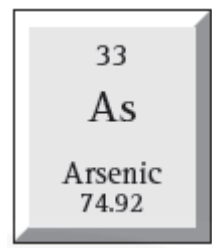
Ɛhia
1
Arsenic has an average
Ɛhia
1
Arsenic has a(n)
Use the information in the illustration to answer the questions on the right
Arsenic has an average
Arsenic has a(n)
Use this information to answer the questions on the right.

In the isotope symbols shown above, what does the number on the left above the “C” represent?
Calcium has an atomic number of 20. What is the correct isotope symbol for calcium-44?
For a given element, the average atomic mass is a "weighted" average of the atomic masses of the isotopes of that element. In calculating the average atomic mass, more "weight" is given to which isotopes?
Lithium, Li, is 7.6% lithium-6 and 92.4% lithium-7. Determine the average atomic mass of lithium.
Lithium has an atomic number of 3 and an average atomic mass of 6.941 amu. Predict the isotope you would find in the greatest abundance for lithium.
If potassium-40 undergoes beta decay, the result is
The diagram below shows the products of a nuclear reaction. What is the parent isotope?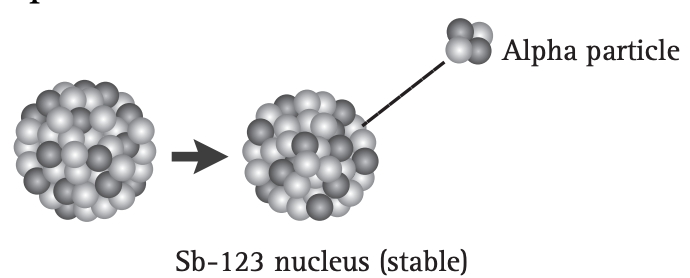
The equation below is an example of what kind of reaction?
What makes a nuclear reaction different from a chemical reaction? Select all that apply.
What element should replace the question mark in the following nuclear equation?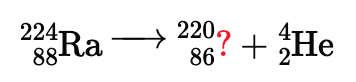
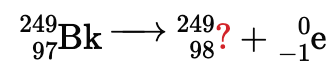
An atom changes its identity when the number of
Which of the following processes involve in a change of atomic identity.
An isotope with atomic number 84 undergoes alpha decay followed by beta decay. What is the atomic number of the daughter isotope following these two decays?
What is the radioactive particle that should be written after the + sign in the following equation?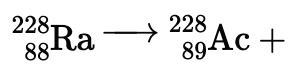
What process involves the combining of two atoms to form a bigger atom?
What process involves splitting an atom into two or more smaller particles?
The graph shows the amount of a radioactive isotope as a function of time. What is the half-life of the isotope?
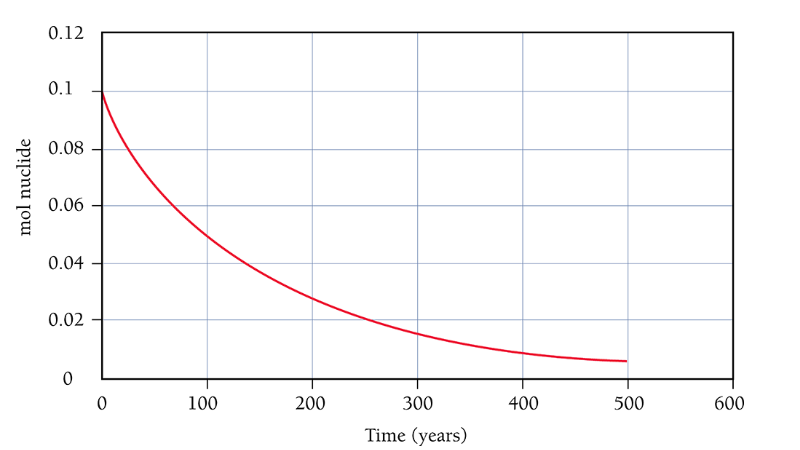
The half-life of carbon-14 is 5,715 years. Use the table below to answer the questions on the right
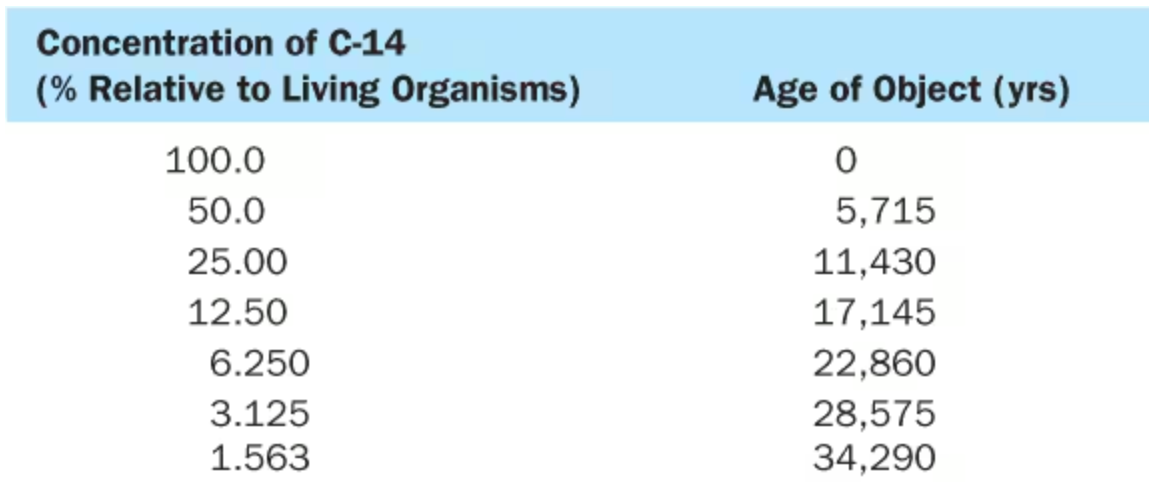
A skull believed to belong to an early human being is found to have a carbon-14 content of 3.125% of that found in living organisms. How old is the skull?
What is different about the three different isotopes shown?
How many half-lives does that correspond to?