Read the two selections, and choose the best answer to each question.
Selection 1: Buses and Dreams
This selection is from a Magical Realist story about a young executive who must make an important choice about his life.
1 The city express bus pulled up to the curb. “About time,” somebody muttered. In the brilliant but frigid winter sunlight, we clutched our cups of coffee tensely, nervously checked our cell phones for the hundredth time, and impatiently shuffled toward the folding doors.
2 As they opened, a single delicate sheet of paper bravely sailed forth and began slowly looping in earnest, elegant circles around the assembled passengers. Each of us, impatient to board, barely noticed the flyer, a blurry collection of lines and dots that approximated the shape of a face.
3 I mused for a moment. The face—was it male or female? Old or young? Unable to decide, I quickly returned to my morning preoccupations. I obsessively replayed yesterday’s conference call, dissecting everything that had gone wrong, even as I strategized ways to squeeze in the badly needed haircut that I couldn’t keep rescheduling. For a senior sales executive, the state of my hair had become alarming.
4 By the time I boarded the bus, the flyer was moving a little more shakily, fluttering from passenger to passenger, hovering unsteadily beside the ear of each one. “Have you seen my dream?” the indistinguishable face on the flyer kept asking. “It’s missing. Have you seen my dream?” But it’s hard even for a lost dream to compete with the inexorable pull of cell phone screens and day-to-day worries, their persistent, nagging tug on our attention.
5 Taking my seat, I plugged in my earbuds and logged in to Wizard. Back-to-back meetings, as usual. Looked like half my stock picks were going up and the other half were going down. I sighed. A little fire icon appeared, flickering, in the upper-left-hand corner of the screen. I sighed again, bracing myself for one more foray into the online world, and clicked on it. “What now?” I thought.
6 A pair of eyes, staring out of my screen, met my eyes. The face itself was indistinct, as indistinct as the face on that leaflet that had just floated by. A half-familiar voice rustled from the screen like autumn leaves skittering across an empty playground. “You cannot forget me. I am yours. Please help.”
7 I choked back my surprise. Ten years old again, back at summer camp, I saw the early morning sunlight dancing on the wall above my bed, smelled the pancakes cooking in the mess hall, heard the clatter of dishes, remembered—nothing, just the whisper of an echo of a dream as it vanished into the noise of the day.
8 The connection broke, and the face was replaced by a flashing alert: “WARNING: UNAUTHORIZED USE OF DEVICE. ANTIVIRUS ENGAGED. DELETING HISTORY.”
9 But I didn’t even know what the dream was. How could I find it again?
10 “Tenth and Wall,” said the synthetically soothing voice of the bus. My stop.
11 “Please,” I muttered to myself, pushing my way down through the doors and out onto the street. “Just let it go.” I didn’t sound that convincing, even to myself. All around me the morning rush was in full swing. I started to pick up my pace, but I couldn’t quite get my head back in the game.
The following question has two parts. Answer Part A first, and then Part B.
Part A Read the following sentence from paragraph 3 of Selection 1.
I obsessively replayed yesterday’s conference call, dissecting everything that had gone wrong, even as I strategized ways to squeeze in the badly needed haircut that I couldn’t keep rescheduling.
Which best describes the narrator’s tone in this sentence?
Part B How does syntax most clearly contribute to the tone identified in Part A?
Which is the best analysis of the narrator’s point of view and perspective in Selection 1?
The following question has two parts. Answer Part A first, and then Part B.
Part A Read these sentences from Selection 1.
Sentence 1: In the brilliant but frigid winter sunlight, we clutched our cups of coffee tensely, nervously checked our cell phones for the hundredth time, and impatiently shuffled toward the folding doors. (paragraph 1)
Sentence 2: As they opened, a single delicate sheet of paper bravely sailed forth and began slowly looping in earnest, elegant circles around the assembled passengers. (paragraph 3)
Which best analyzes the way diction creates tone in the two sentences?
Part B How do the contrasting tones analyzed in Part A contribute to the author’s Magical Realist style?
Read the following sentence from Selection 1.
By the time I boarded the bus, the flyer was moving a little more shakily, fluttering from passenger to passenger, hovering unsteadily beside the ear of each one. (paragraph 4)
The word shakily in this sentence is formed when the suffix -ily is added to the base word shake. What part of speech does the addition of -ily make shakily, and how do you know?
Read the following sentence from Selection 1.
But it’s hard even for a lost dream to compete with the inexorable pull of cell phone screens and day-to-day worries, their persistent, nagging tug on our attention. (paragraph 4)
What does inexorable most likely mean? Choose based on context.
Selection 2: A Great Fall
Humpty Dumpty sat on a wall,
Humpty Dumpty had a great fall.
All the king’s horses, and all the king’s men,
Couldn’t put Humpty together again.
— traditional nursery rhyme
1 Since I was a child, I have maintained a few habits that, while seemingly peculiar on their face, have a simple explanation. I grew up in our family’s decaying mansion, an orphan, watched over by a kindly elderly aunt and numerous servants. One day, as I huddled by the stove in the kitchen, warming myself against the ever-present damp, I witnessed the family cook carelessly knock a basket of eggs to the floor. All were instantly shattered, broken beyond repair.
2 I thought immediately of the family motto, written on our coat of arms: “Before a great fall goeth pride.” A great terror at the thought of my own fragility seized me, never to be assuaged by even the tenderest words of my aunt. Subsequently, I made sure to avoid heights whenever possible. I took to carrying a good length of rope with me whenever I ventured from home, braced by the knowledge that if ever a fall was imminent, I could use the rope to secure myself.
3 These habits persisted into my adult years, long after my aunt had perished and all the servants had left. One night, sitting in my damp study by a dying fire, poring over antique books of forgotten lore, a question struck me. What, in fact, is a fall?
4 I sat there, trembling, sweat pouring off my brow. Previously, I had been preoccupied with the prospect of, for example, falling while climbing a ladder in my library to reach a book. But what if other falls were intended by that prophetic childhood moment?
5 Only the other day, I had summoned the courage to visit a scholar in his lodgings, eager to peruse a rare manuscript in his keeping. Standing at his door, as I made my request, I stumbled over the author’s name. The scholar gave a dry laugh and corrected me.
6 Frozen with embarrassment, I stared at his smug face as waves of vertigo began radiating through my body. The horrible thought occurred to me—“I wish the Earth might open and swallow me up.” At that moment, I seemed to see a crack widening in the floor before me. I sensed then that innumerable falls might lie in wait, even on the most solid ground.
In Selection 2, how does the author’s diction help develop a mood suitable to a Gothic tale?
In Selection 2, which of the following are events and conditions that appear true from the narrator’s perspective but that readers can tell are illusions? Choose two answers.
Why is the author’s choice of first-person point of view in Selection 2 most clearly significant?
The nursery rhyme “Humpty Dumpty” appears at the beginning of Selection 2. Which option best explains how the author draws on this traditional rhyme?
In both Selection 1 and Selection 2, the theme is developed by the narrator’s reactions to events. Which best analyzes the theme in each selection and its development
Read the selection, and choose the best answer to each question.
from In Memoriam
by Alfred, Lord Tennyson
This selection comes from In Memoriam, an extended poem that Alfred, Lord Tennyson wrote about the death of a friend. The poem is divided into numbered sections. In this section, the speaker visits his friend’s home.
VII
Dark house, by which once more I stand
Here in the long unlovely street,
Doors, where my heart was used to beat
So quickly, waiting for a hand,
5 A hand that can be clasp’d no more—
Behold me, for I cannot sleep,
And like a guilty thing I creep
At earliest morning to the door.
He is not here; but far away
10 The noise of life begins again,
And ghastly thro’ the drizzling rain
On the bald street breaks the blank day.
Which option correctly identifies the meter in the selection and its effect?
The following question has two parts. Answer Part A first, and then Part B.
Part A What can you most reasonably infer about the speaker’s feelings as he returns to his friend’s home after his friend’s death?
Part B What evidence from the text best supports the inference in Part A?
What theme does the imagery in these lines most clearly develop?
Part B Which of the following claims about the text best supports the answer to Part A?
One theme of the poem is that the memory of a person may be strongly associated with physical objects. How does the tone of the poem support this theme?
In each stanza, the rhyme scheme is abba. In a sense, the rhyme between the second and third lines “delays” the rhyme in the fourth line. This “delay” creates—
Read the selection, and choose the best answer to each question
A Vehicle for Change
1 Can fiction change the world for the better? The most obvious purpose of fictional narratives is to entertain readers. However, for as long as stories have been told, they have also served instructive and transformative purposes in a society. Throughout history, authors from Charles Dickens to Upton Sinclair to Richard Wright have called attention to social ills by depicting sympathetic characters who experience these ills. These stories have led to greater awareness of real-world problems and feelings of empathy for the people affected by them. That awareness and empathy, in turn, have initiated change.
2 One novelist who spurred major social change in the United States was Harriet Beecher Stowe. Stowe was an abolitionist, and she and her husband participated in the Underground Railroad, housing fugitives from slavery on their agonizing journey to freedom. Her antislavery novel, Uncle Tom's Cabin, both launched the author to fame and helped bring the abolitionist cause into the mainstream. The book was enormously popular: From 1852, when it was first published in book form, until 1900, only the Bible outsold it. Simon Legree, the brutal exploiter of the enslaved who serves as the story’s chief villain, became a familiar object of fear, revulsion, and contempt. Some readers today criticize the novel for its stereotypes of enslaved people, pointing to ways it belittled the victims of slavery. However, the book played a significant role in their eventual liberation.
It forced a public confrontation with the issue of slavery that helped make a final resolution inevitable. Stowe’s novel contributed to the national crisis that, through the Civil War, led to the abolition of slavery.
3 It is true that people usually do not pick up a work of fiction in order to change the world, or even to change themselves; they start reading in order to be carried away by a story—one of the oldest human instincts. But whatever impulse gets readers reading, and whatever artistry keeps them reading, stories also have an impact on their views and actions. Social protest novels like Stowe’s bring issues into the public forum, compelling a society to face its demons. These stories accuse and condemn the bad and celebrate and applaud the good. The discussions that result may be difficult. Historically, they have even opened the way to further conflict. But that conflict has led to change. Fiction has been—and continues to be—an integral part of the healthy public debate that propels a society forward.
Part A Which sentence best expresses the central idea of the article?
Part B Which detail best supports the central idea in Part A?
Part A Which statement explains the diction, or word choice, and tone of the article?
Part B Which sentence from the article provides the best example of the tone identified in Part A?
Read the dictionary entry.
stereotype (ster ee uh TAYP) [< French stéréotype, “printed from a printer’s plate” < Greek stereos, “solid” with French type, “type (characters) used in printing”] n. 1. in printing, a plate, generally made of metal, etched with characters or images; to print the characters, the plate is inked and applied to paper. 2. something that fits a pattern 3. a biased idea of or assumption about the members of a specific group
stereotyped adj.1. in biology, concerning an instinctual, standard response to the environment 2. in psychology, of meaningless repetitive movements or behavior.
Which is true of the word stereotypes as it is used in paragraph 2 of the essay? Base your answer on the dictionary entry and context.
Read the sentence from paragraph 3 of the essay.
It is true that people usually do not pick up a work of fiction in order to change the world, or even to change themselves; they start reading in order to be carried away by a story—one of the oldest human instincts. But whatever impulse gets readers reading, and whatever artistry keeps them reading, stories also have an impact on their views and actions.
Based on context, choose the best explanation of the nuances in meaning
of instincts.
How does paragraph 3 develop the author’s claim about the effects of social protest fiction?
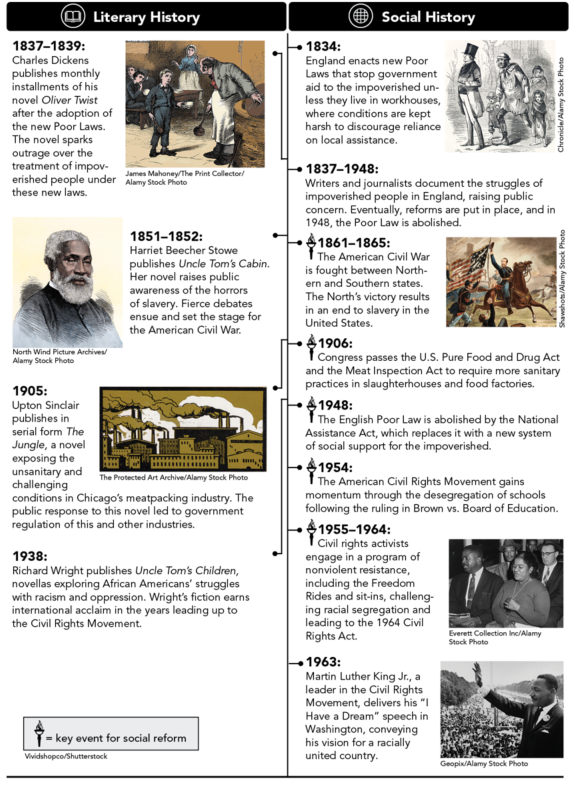
In the timeline, how does the author use icons to organize information?
Follow the directions below to complete this section.
Cameron is writing an argumentative essay about video games. In his essay, several sections of text have been underlined. In each instance, the underlined text may require a correction or revision. Read Cameron’s essay, paying special attention to the underlined text, and then answer the questions that follow.
Video Games Are a Method of Storytelling
(1) Video games represent the next level in the evolution of storytelling. (2) Instead of merely representing a story via words and images, video games offer a firsthand experience, transforming players into characters immersed in the world of the game. (3) Players interact with other characters, including some played by other players. (4) Participants’ choices even determine the course of events. (5) From the moment a player logs in, he or she is fully involved with each twist and turn of the plot, a player experiences emotions ranging from fear to sadness to joy to frustration. (6) In fact, a good video game maintains interest using the same time-honored strategies found in books and films, first, introduce characters the player can care about; next, spin a plot that keeps the player wondering how things will turn out; and finally, offer a resolution that the player will find profoundly satisfying.
(7) Critics who dispute that video games are a legitimate form of storytelling prove only one thing.
(8) They have an incomplete or inaccurate understanding of the genre. (9) A non-player may think the sole purpose of video games is to compete against an opponent, but there is much more to them than just playing to win. (10) Simply put, if games lacked story lines, they wouldn’t hold the interest of players. (11) What keeps players coming back for more is the alternate reality that they become a part of. (12) In video games, people can craft whole new identities in entirely unique and original settings with both realistic and fantastical characters. (13) Unlike readers of fiction, video game players assume a role in the story, directly experience the action, and they even affect its outcome! (14) How many books or films can offer this type of participation to their audiences?
(15) Video games should be counted as a legitimate art form. (16) They allow their audience to spin a yarn in a way no other medium can.
Which revision of sentence 5 corrects the punctuation to create one or more complete sentences?
Which revisions should Cameron make to sentence 6?
Which revision combines sentences 7 and 8 effectively by rephrasing sentence 8 as a dependent clause?
Which revision should Cameron make to use parallel construction in sentence 13?