An isotope of an unknown element has 17 neutrons and a mass number of 32. What is the symbol of this isotope?
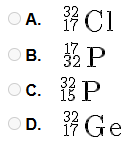
An isotope of an unknown element has 17 neutrons and a mass number of 32. What is the symbol of this isotope?
Create a Bohr model of Carbon on the sheet provided (2 marks)
An atomic ion has 3 protons and 1 electron.
What is the charge of the ion?
Create a Lewis dot structure of oxygen using the handout provided (2 marks)
Which subatomic particle has a positive charge?
An isotope of an unknown element has 17 neutrons and a mass number of 32. What is the symbol of this isotope?
The net charge on a sulfur (S) ion is 2-. The ion has
Where are protons and neutrons located in an atom?
What is the overall charge of an atom that has an equal number of protons and electrons?
What are valence electrons?
How many valence electrons does an atom of oxygen (O) have?
Which of the following elements has 1 valence electron?
Which statement about valence electrons is true?
Which of the following elements has a full outer electron shell and is chemically stable?
According to the Bohr model, how are electrons arranged in an atom?
Which of the following statements about isotopes is true?
What property of isotopes is always the same for a given element?
What is an ion?
What is a cation?
How does an atom become an anion?
Which of the following represents an ion?
Elements in the same group of the periodic table have:
What is the name of the elements in Group 18 of the periodic table?
What are the horizontal rows on the periodic table called?
Which element is in Group 17 and Period 2?
What type of elements are located to the left of the periodic table?
What trend is observed as you move down a group in the periodic table?
Which of the following is a general property of metals?
Which property makes metals suitable for use in electrical wires?
Which of the following is a general property of non-metals?
Which of the following is NOT a property of non-metals?
Use the periodic table to determine which of the following contains 20 protons and 19 electrons.
The elements neon and argon are not reactive. Which hypothesis BEST explains this?
The table lists the number of protons and neutrons contained in four different atoms.
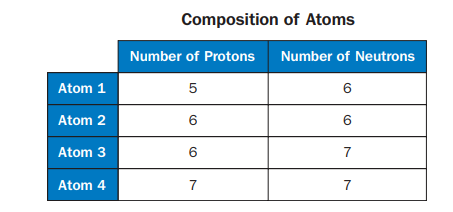
Which two atoms are isotopes of the same element?
Elements within the same group in the periodic table have similar properties because they have the same number of
Which statement about the alkali metals is correct?
Two atoms of the same element have different mass numbers but identical chemical properties. Which statement best explains this observation?
Which change occurs when a neutral magnesium atom forms a Mg²⁺ ion?
Which element would be expected to have chemical properties most similar to sulfur?
Which isotope of lithium has 3 neutrons?
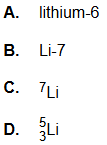
 The number of protons, called the atomic number, is shown, but the mass number is missing from the symbol above.
If the element has 8 neutrons, what is the missing mass number?
If an element has a mass number of 232 and an atomic number of 93, how many neutrons does the element have?
There are three naturally occurring isotopes of hydrogen. Study the table of isotopic information below.
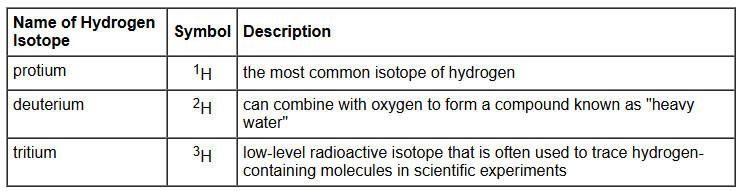
Which isotope contains the greatest number of protons?
Helium is placed in group 18 on the periodic table because
A particular element has the following set of properties:
It has a low melting point.
It has a low boiling point
It exists as a two-atom molecule in the gas phase.
It has seven outer electrons.
It readily reacts with metals to produce a salt.
Which element does the list describe?
Antimony is like a nonmetal and is also like a metal.
Which of the following statements best describes antimony?
Which of the following elements is likely the best conductor of electricity?
Brandon is trying to remember how the physical and chemical properties of metals, nonmetals, and metalloids compare. He wrote some notes down, then looked in his textbook to see which notes were correct.
Which of Brandon's notes, listed below, are correct?
I. | Metals are the best at conducting heat, and nonmetals are the worst. |
II. | Metals are the worst at conducting electricity, and nonmetals are the best. |
III. | The shape of nonmetals is easy to change, but the shape of metals or metalloids is difficult to change. |
IV. | Nonmetals are dull in appearance while metals are usually shiny. |
V. | Metals tend to have a high density, and nonmetals tend to have a low density. |
The table below shows the symbols of some elements, the common ions they produce, and their group number in the periodic table.
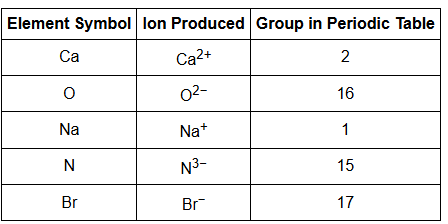
Which statement is supported by the information in the table?