Core Sampling Lab
star
star
star
star
star
Last updated 8 months ago
11 Nsɛmmisa
1
1
1
1
1
Ɛhia
1
Ɛhia
1
Geologists often cannot determine the exact (numerical) age of rock layers, but they can determine their relative age—whether one layer is older or younger than another. This process is called relative dating. Relative dating relies on patterns and principles observed in rock layers.
Relative Dating: A method used to determine the order of events in Earth’s history without knowing the exact age in years.
Law of Superposition: In undisturbed rock layers, the oldest layers are at the bottom, and the youngest layers are at the top.
Stratigraphy: The study of rock layers (strata) and how they are arranged. Stratigraphy helps scientists interpret Earth’s history by analyzing the sequence and composition of layers.
In this lab, you will model stratigraphy by examining a cupcake made of layers. By taking core samples, you will analyze the order of layers and apply the law of superposition to determine relative ages.
To model how geologists use core samples to study rock layers and determine relative age using the law of superposition.
1 layered cupcake (do not eat until instructed)
3 plastic straws
Paper towel or napkin
Colored pencils or crayons
Lab report sheet
Observe the Cupcake
Look carefully at the top and sides of the cupcake.
Note any visible layers of cake, filling, or frosting.
Prepare for Core Sampling
Hold the cupcake steady on your desk.
Insert the straw straight down through the cupcake until it reaches the bottom.
Collect Core Sample #1
Gently cover the top of the straw with your finger.
Pull the straw out carefully to keep the layers intact.
Place the sample on a paper towel.
Draw and label the layers in the correct order (top to bottom).
Collect Core Sample #2
Choose a different location on the cupcake.
Repeat the same process used for Core Sample #1.
Draw and label the layers.
Collect Core Sample #3
Take a third core sample from another location.
Draw and label the layers.
Analyze the Layers
Compare all three core samples.
Identify similarities and differences in the layers.
Determine which layers are oldest and youngest using the law of superposition.
Clean Up
Dispose of straws and paper towels as instructed.
Eat the cupcake only after teacher approval.
In procedure one what do you notice about cupcake. Note any visible layers, filling, or frosting, what do you think the middle will look like?
Now that you have collected three samples, compare the three samples. How are they alike and different?
Which layer do you think is the oldest?
Which layer do you think is the youngest?
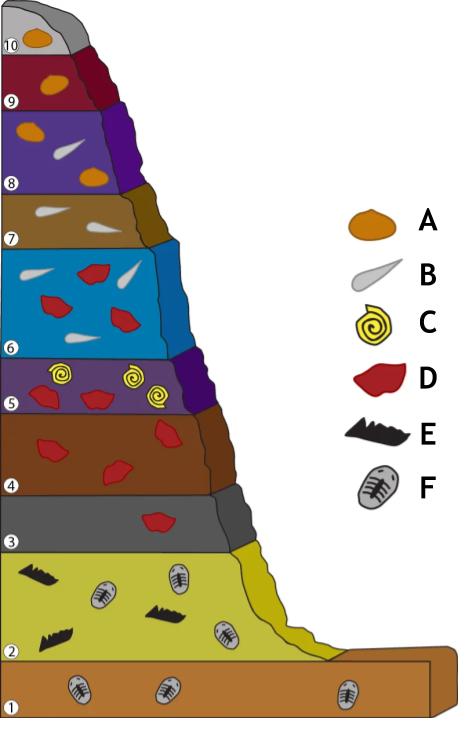
Which fossil is the youngest?
Which fossil is the oldest?
Fossil C is older than fossil E.
Fossil A is younger than fossil B.
Fossil D is older than fossil B.
Scientists are able to gather evidence about Earth's history through-
According to the Law of Superposition-