Ɛhia
1
DOK 2
11.1.b.i
Ɛhia
1
DOK 3
11.1.b.i
This examination has three parts. You are to answer all questions in all parts.
Part I contains 28 multiple-choice questions.
Part II contains two short-essay questions.
Part III is based on several documents:
Part III A contains the documents. Each document is followed by one question.
Part III B contains one essay question based on the documents.
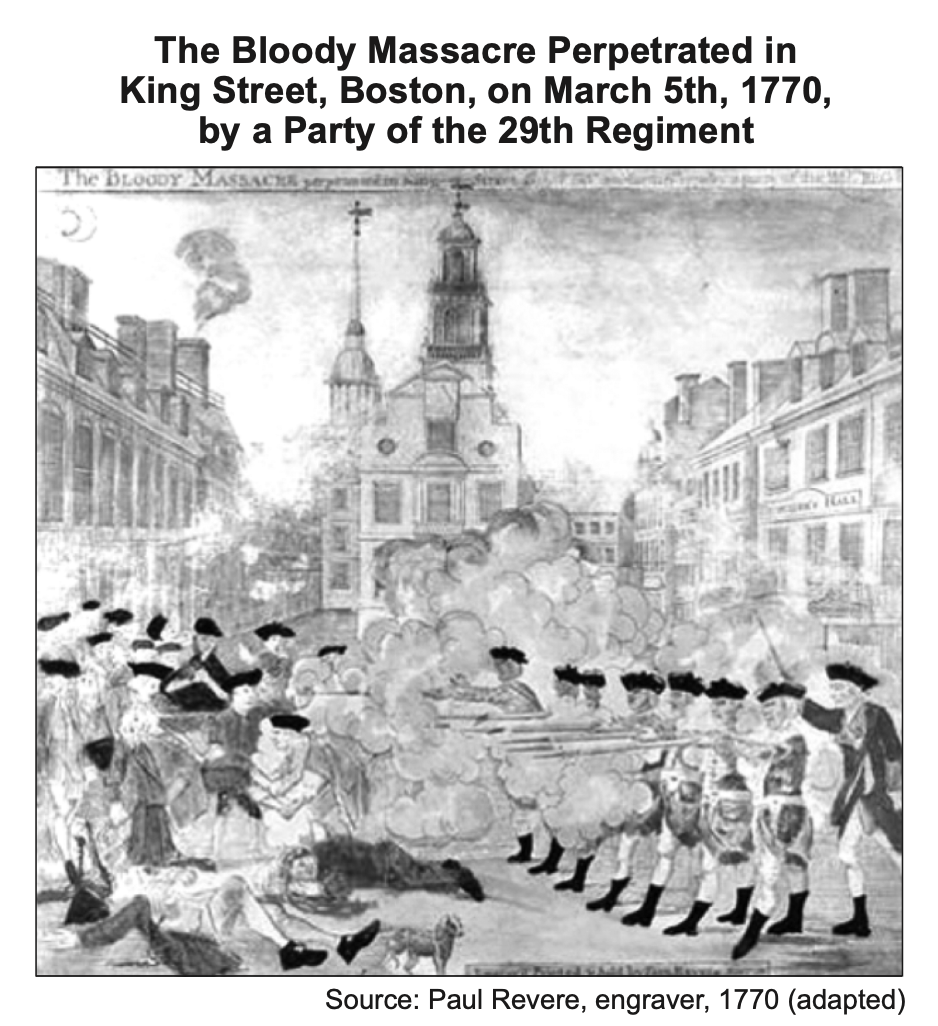
Paul Revere created this engraving to
Base your answers to questions 5 and 6 on the passage and on your knowledge of social studies.
To the Hebrew [Jewish] Congregation in Newport, Rhode Island
[August 18, 1790]
Gentlemen:
. . . The Citizens of the United States of America have a right to applaud themselves for having given to mankind examples of an enlarged and liberal policy: a policy worthy of imitation. All possess alike liberty of conscience and immunities [protections] of citizenship. It is now no more that toleration is spoken of, as if it was by the indulgence of one class of people, that another enjoyed the exercise of their inherent natural rights. For happily the Government of the United States, which gives to bigotry no sanction, to persecution no assistance, requires only that they who live under its protection should demean themselves as good citizens, in giving it on all occasions their effectual support. . . .
May the Children of the Stock of Abraham, who dwell in this land continue to merit and enjoy the good will of the other inhabitants. . . . G. Washington
Source: President George Washington, Letter to the Hebrew Congregation of Newport, Rhode Island, August 18, 1790 (adapted)
Base your answers to questions 7 and 8 on the excerpt below and on your knowledge of social studies.
SEC. 8. And be it further enacted. That in all that territory ceded by France to the United States, under the name of Louisiana, which lies north of thirty-six degrees and thirty minutes north latitude, not included within the limits of the state, contemplated by this act, slavery and involuntary servitude, otherwise than in the punishment of crimes, whereof the parties shall have been duly convicted, shall be, and is hereby, forever prohibited: Provided always, That any person escaping into the same, from whom labour or service is lawfully claimed, in any state or territory of the United States, such fugitive may be lawfully reclaimed and conveyed to the person claiming his or her labour or service as aforesaid.
Source: Missouri Compromise, 1820
Base your answers to questions 11 and 12 on the excerpt below and on your knowledge of social studies.
. . . Save our children in their infancy from being forced into the maelstrom [turmoil] of wage slavery. See to it that they are not dwarfed in body and mind or brought to a premature death by early drudgery. Give them the sunshine of the school and playground instead of the factory, the mine and the workshop. . . .
Source: Samuel Gompers, Address to the International Labor Congress, September 1893
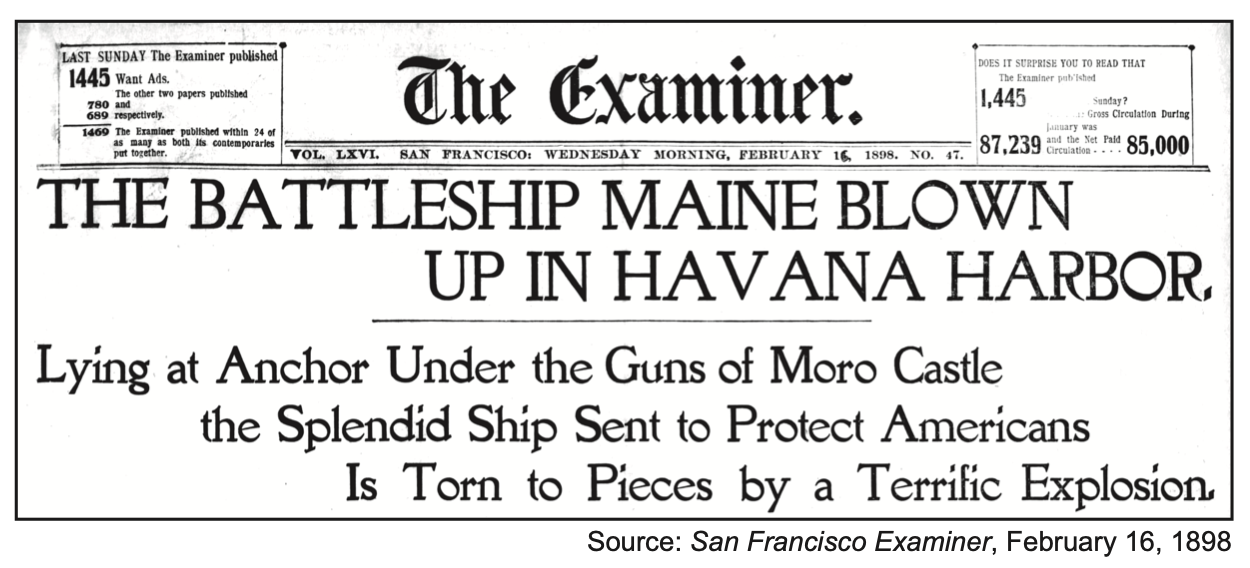
This newspaper headline is an example of
Base your answer to question 15 on the passage below and on your knowledge of social studies.
. . . A general association of nations must be formed under specific covenants for the purpose of affording mutual guarantees of political independence and territorial integrity to great and small States alike. . . .
Source: President Woodrow Wilson, 1918 (adapted)
In this statement, President Woodrow Wilson is proposing the
Base your answers to questions 16 and 17 on the passage below and on your knowledge of social studies.
. . . Let us, then, hear the conclusion of the whole matter. Science is a magnificent material force, but it is not a teacher of morals. It can perfect machinery, but it adds no moral restraints to protect society from the misuse of the machine. It can also build gigantic intellectual ships, but it constructs no moral rudders for the control of storm-tossed human vessels. It not only fails to supply the spiritual element needed but some of its unproven hypotheses rob the ship of its compass and thus endangers its cargo. . . .
Source: William Jennings Bryan, State of Tennessee v. Scopes, 1925
Which statement best describes the author’s point of view during the Scopes trial?
Base your answers to questions 18 and 19 on the excerpt below and on your knowledge of social studies.
. . . All citizens alike, both in and out of uniform, feel the impact of war in greater or lesser measure. Citizenship has its responsibilities, as well as its privileges, and, in time of war, the burden is always heavier. Compulsory [mandatory] exclusion of large groups of citizens from their homes, except under circumstances of direst emergency and peril, is inconsistent with our basic governmental institutions. But when, under conditions of modern warfare, our shores are threatened by hostile forces, the power to protect must be commensurate with [equal to] the threatened danger. . . .
Source: Supreme Court Justice Hugo Black, Majority Opinion, Korematsu v. United States, 1944 (adapted)
Base your answers to questions 20 and 21 on the statement below and on your knowledge of social studies.
. . . I believe that it must be the policy of the United States to support free peoples who are resisting attempted subjugation [domination] by armed minorities or by outside pressures.
I believe that we must assist free peoples to work out their own destinies in their own way.
I believe that our help should be primarily through economic and financial aid which is essential to economic stability and orderly political processes. . . .
The seeds of totalitarian regimes are nurtured by misery and want. They spread and grow in the evil soil of poverty and strife. They reach their full growth when the hope of a people for a better life has died.
We must keep that hope alive.
The free peoples of the world look to us for support in maintaining their freedoms.
If we falter in our leadership, we may endanger the peace of the world— and we shall surely endanger the welfare of this Nation.
Great responsibilities have been placed upon us by the swift movement of events.
I am confident that the Congress will face these responsibilities squarely.
Source: President Harry Truman, Message to Congress, March 12, 1947 (adapted)
Base your answers to questions 22 and 23 on the excerpt below and on your knowledge of social studies.
SEC. 703. (a) It shall be an unlawful employment practice for an employer—
(1) to fail or refuse to hire or to discharge any individual, or otherwise to discriminate against any individual with respect to his compensation, terms, conditions, or privileges of employment, because of such individual’s race, color, religion, sex, or national origin; or
(2) to limit, segregate, or classify his employees in any way which would deprive or tend to deprive any individual of employment opportunities or otherwise adversely affect his status as an employee, because of such individual’s race, color, religion, sex, or national origin. . . .
Source: Civil Rights Act, 1964
These provisions in the 1964 Civil Rights Act are intended to
Base your answers to questions 24 and 25 on the passage below and on your knowledge of social studies.
. . . You have the right to remain silent. Anything you say can and will be used against you in a court of law. You have the right to an attorney. If you cannot afford an attorney, one will be provided for you. Do you understand the rights I have just read to you? . . .
Source: Miranda v. Arizona, 1966
The Supreme Court ruling in this case
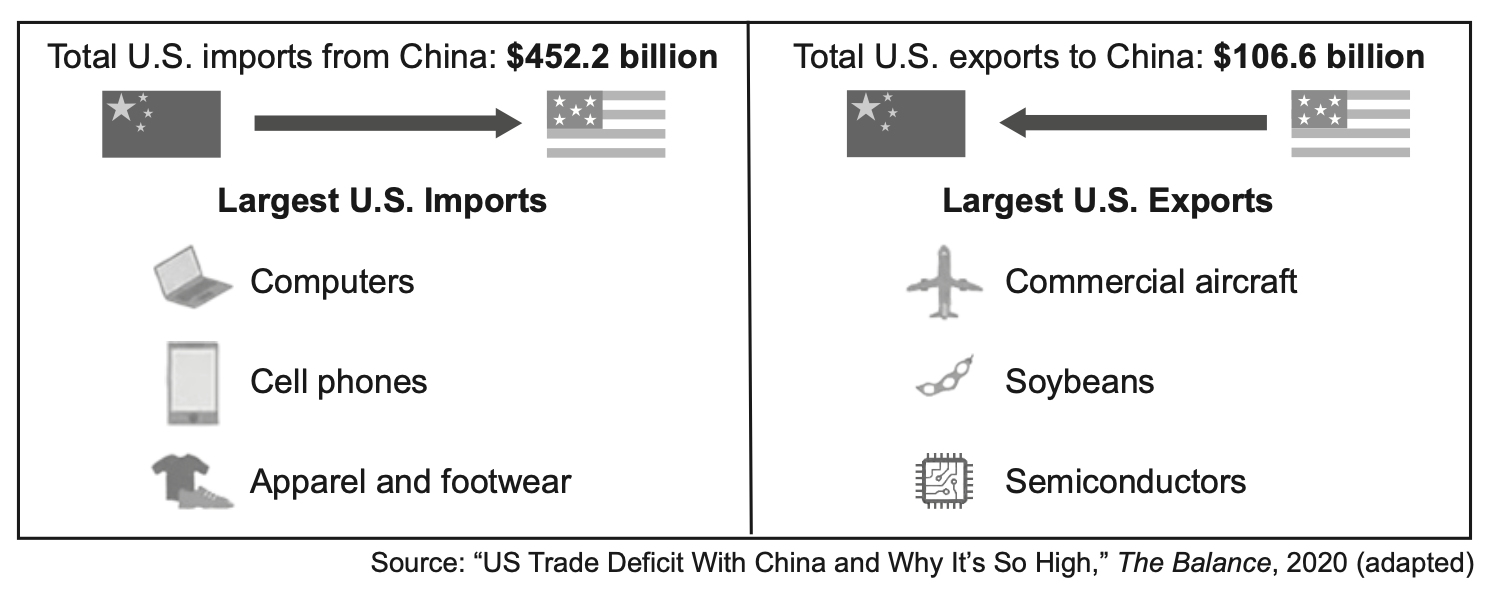
What is one reason for the conditions illustrated in this graphic?
SEQ Set 1 (Question 29)
Task: Read and analyze the following documents, applying your social studies knowledge and skills to write a short essay of two or three paragraphs in which you:
Describe the historical context surrounding these documents
Identify and explain the relationship between the events and/or ideas found in these documents (Cause and Effect, or Similarity/Difference, or Turning Point)
In developing your short-essay answer of two or three paragraphs, be sure to keep these explanations in mind:
Describe means “to illustrate something in words or tell about it.”
Historical Context refers to “the relevant historical circumstances surrounding or connecting the events, ideas, or developments in these documents.”
Identify means “to put a name to or to name.”
Explain means “to make plain or understandable; to give reasons for or causes of; to show the logical development or relationship of.”
Types of Relationships:
Cause refers to “something that contributes to the occurrence of an event, the rise of an idea, or the bringing about of a development.”
Effect refers to “what happens as a consequence (result, impact, outcome) of an event, an idea, or a development.”
Similarity tells how “something is alike or the same as something else.”
Difference tells how “something is not alike or not the same as something else.”
Turning Point is “a major event, idea, or historical development that brings about significant change. It can be local, regional, national, or global.”
SEQ Set 1 Directions (Question 29): Read and analyze the following documents before writing your short essay in the box.
Document 1
. . . We hold these truths to be self-evident, that all men are created equal, that they are endowed by their Creator with certain unalienable Rights, that among these are Life, Liberty and the pursuit of Happiness.—That to secure these rights, Governments are instituted among Men, deriving their just powers from the consent of the governed,— That whenever any Form of Government becomes destructive of these ends, it is the Right of the People to alter or to abolish it, and to institute new Government, laying its foundation on such principles and organizing its powers in such form, as to them shall seem most likely to effect their Safety and Happiness. Prudence, indeed, will dictate that Governments long established should not be changed for light and transient [fleeting] causes. . . . But when a long train of abuses and usurpations, pursuing invariably the same Object evinces [demonstrates] a design to reduce them under absolute Despotism, it is their right, it is their duty, to throw off such Government, and to provide new Guards for their future security. . . .
Source: Declaration of Independence, July 4, 1776 (adapted)
Document 2
We the People of the United States, in Order to form a more perfect Union, establish Justice, insure domestic Tranquility, provide for the common defence, promote the general Welfare, and secure the Blessings of Liberty to ourselves and our Posterity, do ordain and establish this Constitution for the United States of America. . . .
Source: Preamble, United States Constitution, 1787
SEQ Set 1 (Question 29)
Task: Based on your reading and analysis of these documents, apply your social studies knowledge and skills to write a short essay of two or three paragraphs in which you:
Describe the historical context surrounding these documents
Identify and explain the relationship between the events and/or ideas found in these documents (Cause and Effect, or Similarity/Difference, or Turning Point)
Guidelines: In your short essay, be sure to
Develop all aspects of the task
Incorporate relevant outside information
Support the task with relevant facts and examples
You are not required to include a separate introduction or conclusion in your short essay of two or three paragraphs.
SEQ Set 2 (Question 30)
Task: Read and analyze the following documents, applying your social studies knowledge and skills to write a short essay of two or three paragraphs in which you:
Describe the historical context surrounding Documents 1 and 2
Analyze Document 1 and explain how audience, or purpose, or bias, or point of view affects this document’s use as a reliable source of evidence
In developing your short-essay answer of two or three paragraphs, be sure to keep these explanations in mind:
Describe means “to illustrate something in words or tell about it.”
Historical Context refers to “the relevant historical circumstances surrounding or connecting the events, ideas, or developments in these documents.”
Analyze means “to examine a document and determine its elements and its relationships.”
Explain means “to make plain or understandable; to give reasons for or causes of; to show the logical development or relationship of.”
Reliability is determined by how accurate and useful the information found in a source is for a specific purpose.
SEQ Set 2 Directions (Question 30): Read and analyze the following documents before writing your short essay in the box.
Document 1
Bruce Craven is responding to one of President Franklin D. Roosevelt’s fireside chats.
July 25, 1933
Dear Mr. President;
. . . The forgotten man has been forgotten, if he was ever really remembered. I happen to be an approved attorney for the Federal Land Bank, and on publication of the information about the new loan legislation, the little man came to see me vainly hoping that at last he had been remembered. He is representative of thousands of farmers in North Carolina, owning maybe 50 acres of land and doing all of his own work, and about to lose his farm under a mortgage. But to get the loan he is obliged to pay $20 in advance for appraisals, and another $10 for a survey, and he no more has that much cash than he has the moon. I have written to everyone from Mr. [Treasury Secretary Henry] Morgenthau on down about this, and no one is interested. The prevailing idea seems to be that if a man is that poor, he should stay poor.
Before any of this loan and public works legislation was enacted, I wrote you that you ought to put at least one human being in each supervising body, and by that I meant a man who actually knows there is a “little man” in this nation and that he never has had a fair chance, and that he deserves one. I hope yet that somehow you may remember this forgotten little man, who has no one in high places to befriend him.
Respectfully yours,
Bruce Craven
Trinity, North Carolina
Source: Levine and Levine, The People and the President: America’s Conversation with FDR,
Beacon Press, 2002
Document 2
"Yes, You Remembered Me"
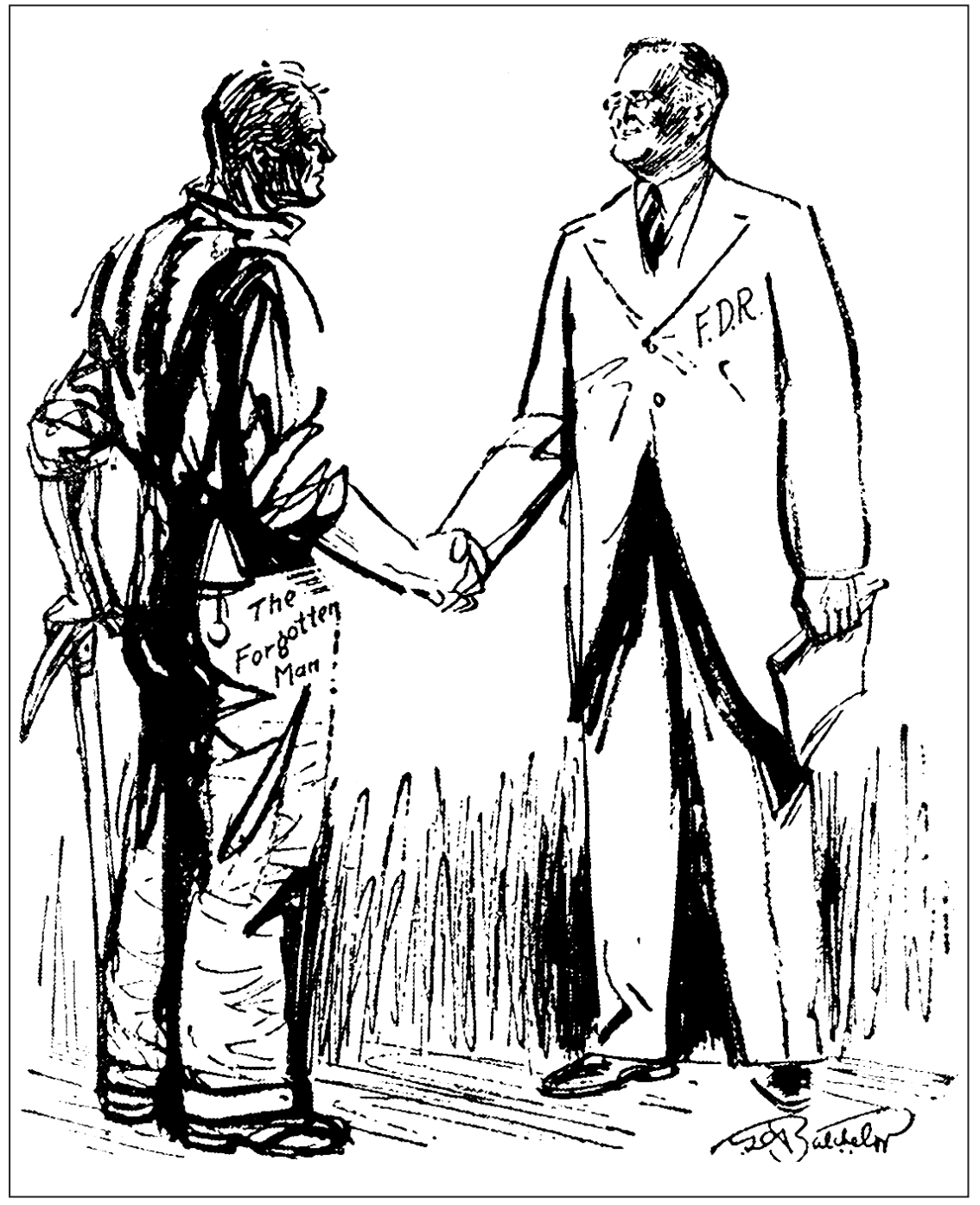 Source: C. D. Batchelor, New York Daily News, October 11, 1936
SEQ Set 2 (Question 30)
Task: Based on your reading and analysis of these documents, apply your social studies knowledge and skills to write a short essay of two or three paragraphs in which you:
Describe the historical context surrounding Documents 1 and 2
Analyze Document 1 and explain how audience, or purpose, or bias, or point of view affects this document’s use as a reliable source of evidence
Guidelines: In your short essay, be sure to
Develop all aspects of the task
Incorporate relevant outside information
Support the task with relevant facts and examples
You are not required to include a separate introduction or conclusion in your short essay of
two or three paragraphs.
Document 1a
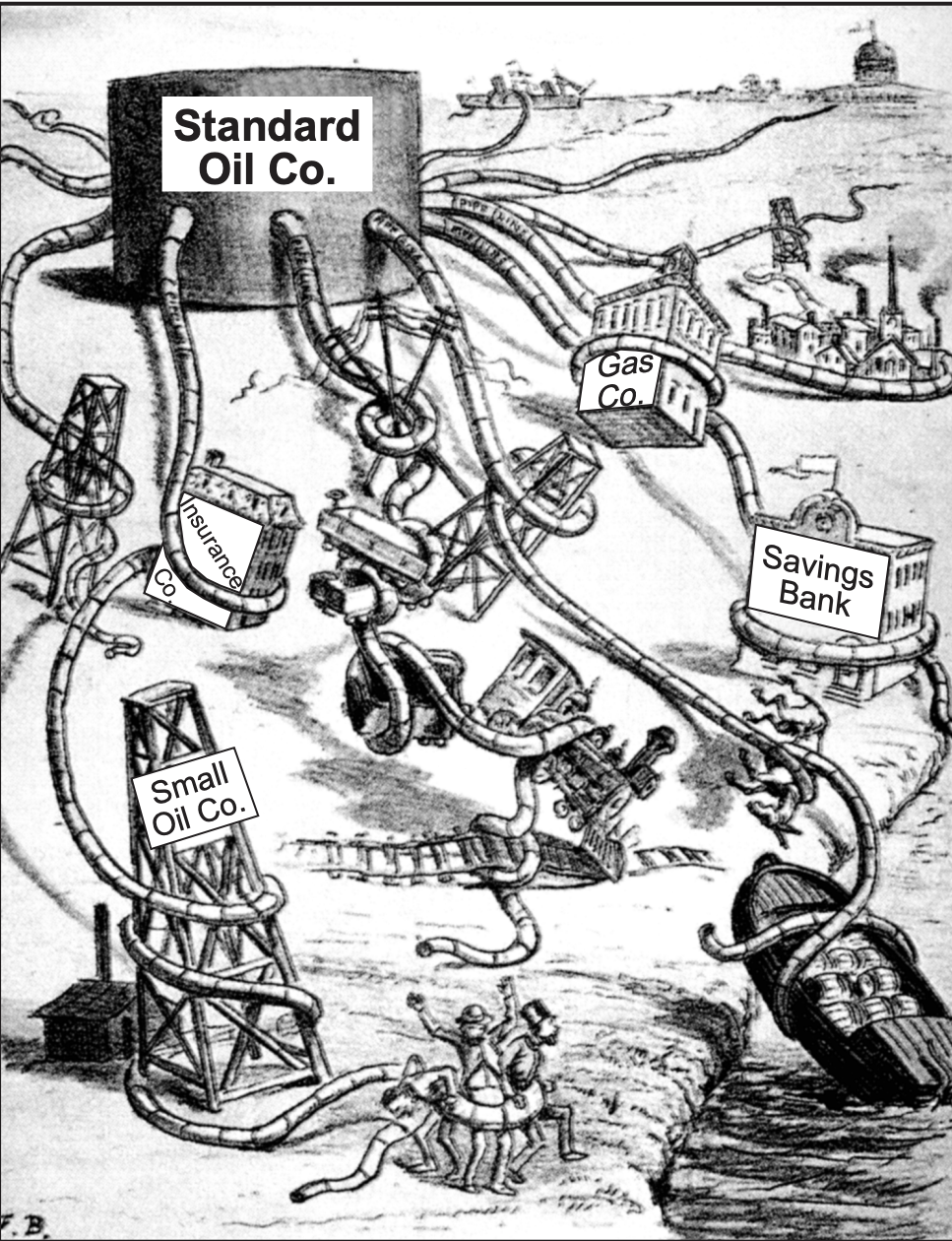 Source: Frank Beard, The Judge, July 19, 1884 (adapted)
Document 1b
. . . In my Message to the present Congress at its first session I discussed at length the question of the regulation of those big corporations commonly doing an interstate business, often with some tendency to monopoly, which are popularly known as trusts. . . . We can do nothing of good in the way of regulating and supervising these corporations until we fix clearly in our minds that we are not attacking the corporations, but endeavoring to do away with any evil in them. We are not hostile to them; we are merely determined that they shall be so handled as to subserve [serve] the public good. We draw the line against misconduct, not against wealth. . . .
No more important subject can come before the Congress than this of the regulation of interstate business. . . The power of the Congress to regulate interstate commerce is an absolute and unqualified grant, and without limitations other than those prescribed by the Constitution. The Congress has constitutional authority to make all laws necessary and proper for executing this power, and I am satisfied that this power has not been exhausted by any legislation now on the statute books. It is evident, therefore, that evils restrictive of commercial freedom and entailing restraint upon national commerce fall within the regulative power of the Congress, and that a wise and reasonable law would be a necessary and proper exercise of Congressional authority to the end that such evils should be eradicated. . . .
Source: President Theodore Roosevelt, Second Annual Message to Congress, December 2, 1902
Based on these documents, what is one historical circumstance surrounding the government regulation of business?
Document 2
. . . I deny emphatically the assertion that opportunity has been restricted or individual effort stifled by reason of the growth of the trusts. On the contrary, the trusts have opened wider avenues and greater opportunities to the young men of to-day than those of any other generation ever enjoyed. In the old days, before the union of interests, murderous competition made any business venture precarious; but aside from that, through lack of time, opportunity, and capital, the young man was kept within a very restricted field. It is combination that has produced the capital to open up mines and factories, to build great industrial plants and the monster wholesale and retail establishments. It is combination and capital that have sent the railroads shooting in a hundred different directions all over the continent. . . .
Yes, decidedly, the opportunities for the young American boy are greater to-day than they have ever been before; and no boy, however lowly—the barefoot country boy, the humble newsboy, the child of the tenement—need despair. I see in each of them infinite possibilities. They have but to master the knack of economy, thrift, honesty, and perseverance, and success is theirs.
Source: J. D. Rockefeller, “Opportunity in America,” Cosmopolitan, September 1, 1907
What is one reason John D. Rockefeller believed that trusts were good for the country?
Document 3
. . . Journalism and publicity played important roles in promoting the goals of the progressives, especially with regard to corruption in government and the monopolistic practices of business and industry. During the period, scores of articles appeared in magazines—revealing the truth, as the reformers saw it—about the way America was really ruled. Novels were also written to expose evil. The use of journalism to further a social cause was made possible by new magazines of mass circulation, a number of them counting their readers in the hundreds of thousands. Such magazines included McClure’s, Munsey’s, Everybody’s, Cosmopolitan, Collier’s, and the American Magazine. The men and women who wrote these articles were called muckrakers, although the name was applied some time after they began their work. It was applied to them in 1906 by Theodore Roosevelt who, while basically on their side, feared their revelations would get people too worked up and indignant. . . .
Source: Fon Boardman, America and the Progressive Era, 1900–1917, Henry Z. Walck, Inc., 1970
Based on this document, what was one effort made to address the government regulation of business?
Document 4
The Northern Securities Company was a combination of three railroads that monopolized transportation in several western states. Theodore Roosevelt considered the company to be in violation of the Sherman Antitrust Act and, in 1904, the Supreme Court agreed.
. . . More sophisticated than most Progressives, Roosevelt recognized that the large corporation was a fact of modern economic life and that a general rise in the standard of living depended far more on increased productivity than on radical redistribution of existing wealth. Rather than follow the common Progressive line that by their nature all trusts were inherently evil, he divided them into “good” and “bad” trusts. If a trust was charging fair prices and offering good service, he favored allowing it to continue. If it was restraining trade and jacking up prices, then it was evil. The line was to be drawn on conduct, not bigness. Roosevelt and Roosevelt alone decided which trust was good and which was bad, however. Northern Securities, he decided, was bad—and should be broken up. Roosevelt also advocated selective prosecutions because the government did not have enough lawyers to prosecute all monopolies and because he realized that the conservatism of the courts would make all prosecutions difficult. . . .
Specifically, Roosevelt called for the establishment of a Bureau of Corporations in a Cabinet-level Department of Commerce to determine if regulation was warranted—a program he had advocated as governor of New York. The bureau would provide the president with information on the trusts, which he could at his own discretion make public and present to the Justice Department as a basis for indictments. . . .
Source: Nathan Miller, Theodore Roosevelt: A Life, William Morrow and Company, 1992
According to Nathan Miller, what was one effort made to address the government regulation of business?
Document 5
. . . Roosevelt’s brand of progressivism put him foursquare in the middle of the national mood: for while people wanted change, they did not want radical change, and while Roosevelt’s reforms were progressive, they were a conservative sort of progressivism that policed more by threat than by action (it was TR who declared the presidency as a “bully pulpit”), more by regulation than by prosecution, and used power more symbolically and rhetorically than in fact. In a very public confrontation, Roosevelt did prosecute John D. Rockefeller and J. P. Morgan, two of the most celebrated titans of American business, for their railroad monopoly in the Northwest; he righteously took the side of labor and the consumer in the great coal strike of 1902; and by 1906, two years after he had been elected in his own right, TR increased the pace of reform by creating standards for food and drugs, tackling the corruption in the meat industry (in response to novelist Upton Sinclair’s best-selling The Jungle), and, in the cause that he perhaps held dearest, aggressively limiting development of public lands (he would double the number of national parks and establish fifty-one wild bird refuges). . . .
Source: Jennings and Brewster, The Century, Doubleday, 1998
Based on this document, what is one result of efforts to address the government regulation of business?
Document 6
. . . America’s prosperity is built on hard work, open markets, and fair competition. But right now we’re facing a monopoly problem as dominant digital platforms like Amazon increasingly use their power to increase prices, preference their own products and services, and harm small businesses. These anticompetitive practices are bad for consumers, entrepreneurs, and businesses, and I commend the Federal Trade Commission for taking action. The case for reinvigorating competition policy and putting in place rules of the road for Big Tech companies is clear. I will continue to push for updates to the antitrust laws, including the bipartisan American Innovation and Choice Online Act, to strengthen our economy and make sure consumers can get the fair treatment they deserve.
Source: Senator Amy Klobuchar, Statement on the Antitrust Lawsuit Against Amazon, September 26, 2023
According to this document, what is one result of efforts to address the government regulation of business?
Part B
Civic Literacy Essay Question (37)
Directions: Write a well-organized essay that includes an introduction, several paragraphs, and a conclusion. Use evidence from at least four documents in the body of the essay. Support your response with relevant facts, examples, and details. Include additional outside information.
Historical Context: Government Regulation of Business
Throughout United States history, many constitutional and civic issues have been debated by Americans. These debates have resulted in efforts by individuals, groups, and governments to address these issues. These efforts have achieved varying degrees of success. One of these constitutional and civic issues is the government regulation of business.
Task: Using information from the documents and your knowledge of United States history, write an essay in which you
Describe the historical circumstances surrounding this constitutional or civic issue
Explain efforts by individuals, groups, and/or governments to address this constitutional or civic issue
Discuss the extent to which the efforts were successful
Guidelines: In your essay, be sure to
Develop all aspects of the task
Explain at least two efforts to address the issue
Incorporate information from at least four documents
Incorporate relevant outside information
Support the theme with relevant facts, examples, and details
Use a logical and clear plan of organization, including an introduction and a conclusion
that are beyond a restatement of the theme
Civic Literary Essay
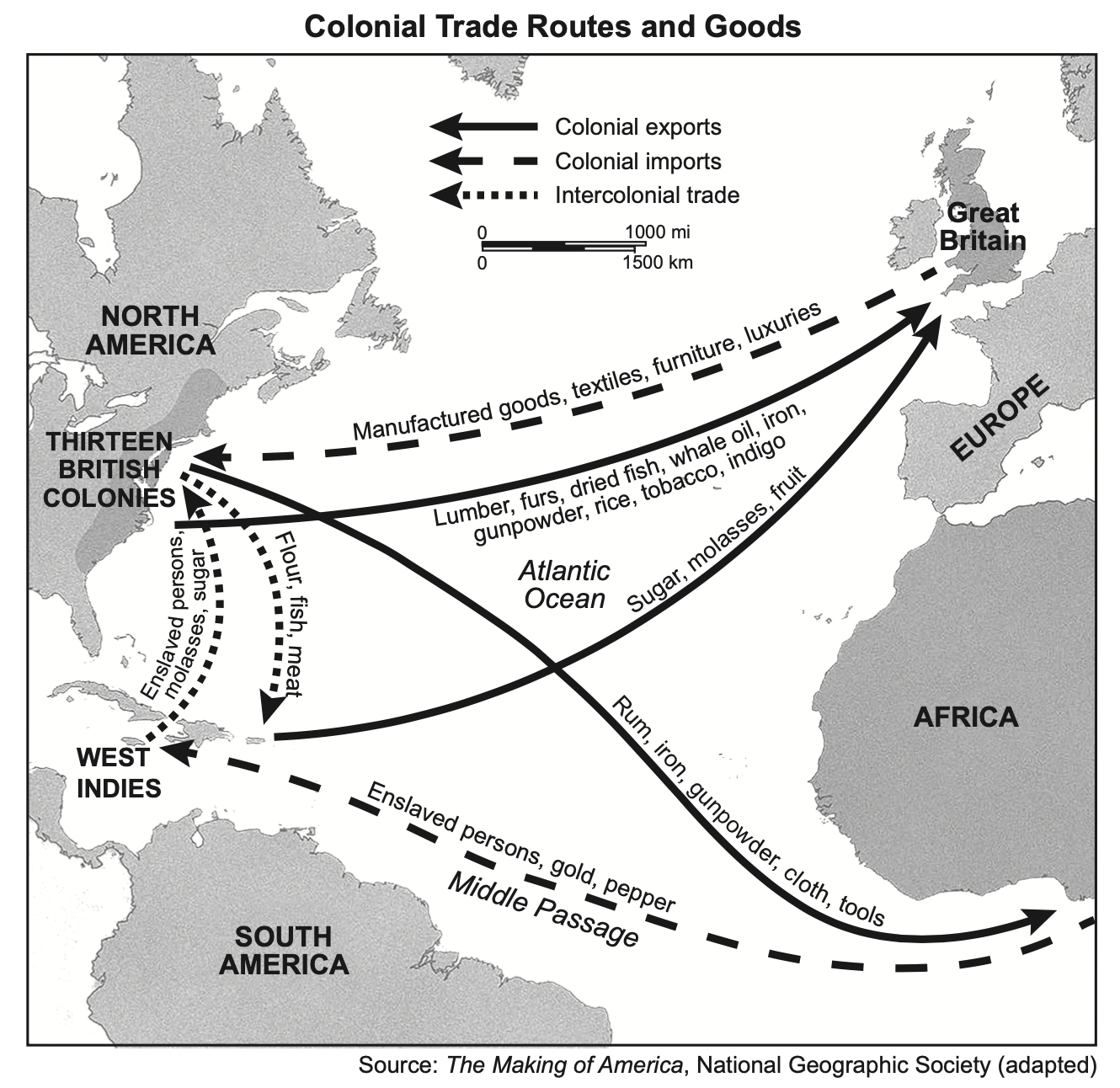
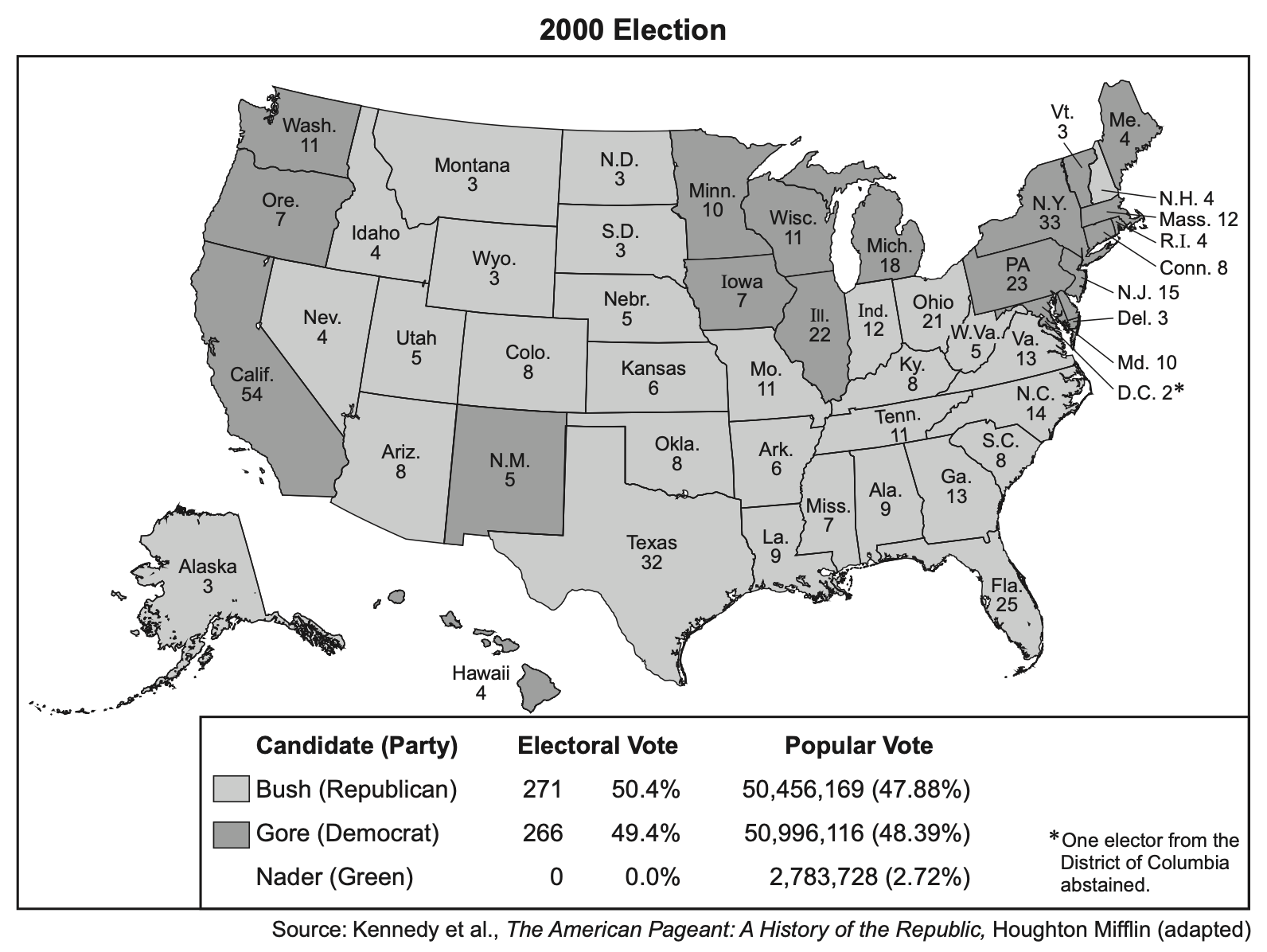
Which conclusion is best supported by the information on this map?
Which claim is best supported by the information on this map?
Which historical circumstance led to the event depicted in this engraving?
This passage would be most useful to a historian studying
The ideas expressed in this passage were guaranteed by the
According to this excerpt, what would be the status of slavery in the Louisiana Territory?
Which government action repealed the Missouri Compromise?
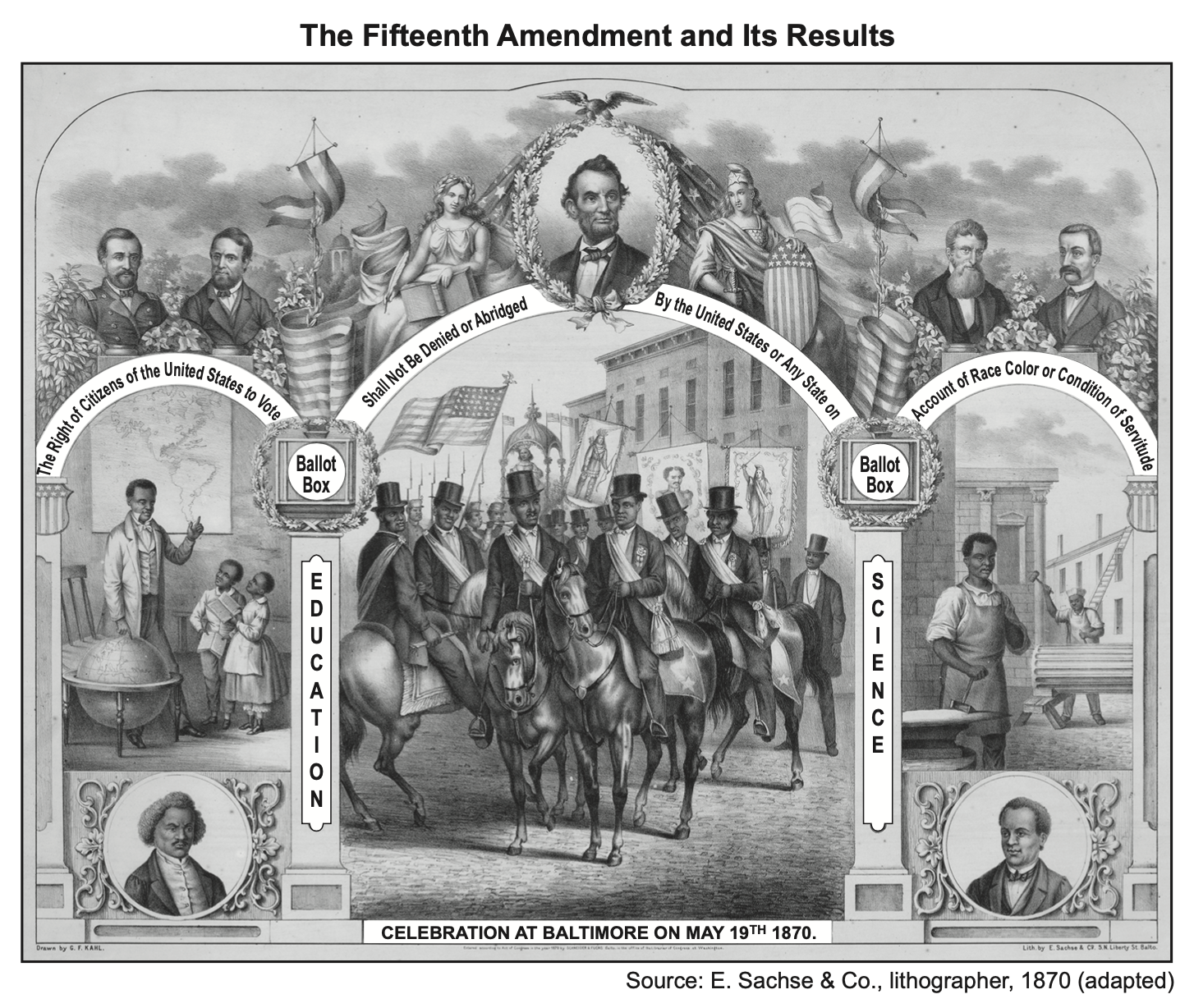
This poster was created to celebrate
Which method was used after Reconstruction to deny African Americans the right illustrated in this poster?
The problem that Samuel Gompers is discussing resulted from
Which action did Samuel Gompers support to correct the problem described in the excerpt?
As a result of the event described in this headline, what action was taken by President William McKinley?
Which conclusion can be drawn from the Scopes trial?
Which policy is being discussed in this excerpt?
Which statement is best supported by the opinion of Justice Black?
President Harry Truman made this statement in response to
Which United States foreign policy is supported by Truman’s message to Congress?
The Civil Rights Act of 1964 was part of which federal program?
Critics of this decision argued that it
According to this map, the results of the 2000 election indicate that
The results of the 2000 election led directly to a national debate over
Document 1a
Source: Frank Beard, The Judge, July 19, 1884 (adapted)
Document 1b
. . . In my Message to the present Congress at its first session I discussed at length the question of the regulation of those big corporations commonly doing an interstate business, often with some tendency to monopoly, which are popularly known as trusts. . . . We can do nothing of good in the way of regulating and supervising these corporations until we fix clearly in our minds that we are not attacking the corporations, but endeavoring to do away with any evil in them. We are not hostile to them; we are merely determined that they shall be so handled as to subserve [serve] the public good. We draw the line against misconduct, not against wealth. . . .
No more important subject can come before the Congress than this of the regulation of interstate business. . . The power of the Congress to regulate interstate commerce is an absolute and unqualified grant, and without limitations other than those prescribed by the Constitution. The Congress has constitutional authority to make all laws necessary and proper for executing this power, and I am satisfied that this power has not been exhausted by any legislation now on the statute books. It is evident, therefore, that evils restrictive of commercial freedom and entailing restraint upon national commerce fall within the regulative power of the Congress, and that a wise and reasonable law would be a necessary and proper exercise of Congressional authority to the end that such evils should be eradicated. . . .
Source: President Theodore Roosevelt, Second Annual Message to Congress, December 2, 1902
Document 2
. . . I deny emphatically the assertion that opportunity has been restricted or individual effort stifled by reason of the growth of the trusts. On the contrary, the trusts have opened wider avenues and greater opportunities to the young men of to-day than those of any other generation ever enjoyed. In the old days, before the union of interests, murderous competition made any business venture precarious; but aside from that, through lack of time, opportunity, and capital, the young man was kept within a very restricted field. It is combination that has produced the capital to open up mines and factories, to build great industrial plants and the monster wholesale and retail establishments. It is combination and capital that have sent the railroads shooting in a hundred different directions all over the continent. . . .
Yes, decidedly, the opportunities for the young American boy are greater to-day than they have ever been before; and no boy, however lowly—the barefoot country boy, the humble newsboy, the child of the tenement—need despair. I see in each of them infinite possibilities. They have but to master the knack of economy, thrift, honesty, and perseverance, and success is theirs.
Source: J. D. Rockefeller, “Opportunity in America,” Cosmopolitan, September 1, 1907
Document 3
. . . Journalism and publicity played important roles in promoting the goals of the progressives, especially with regard to corruption in government and the monopolistic practices of business and industry. During the period, scores of articles appeared in magazines—revealing the truth, as the reformers saw it—about the way America was really ruled. Novels were also written to expose evil. The use of journalism to further a social cause was made possible by new magazines of mass circulation, a number of them counting their readers in the hundreds of thousands. Such magazines included McClure’s, Munsey’s, Everybody’s, Cosmopolitan, Collier’s, and the American Magazine. The men and women who wrote these articles were called muckrakers, although the name was applied some time after they began their work. It was applied to them in 1906 by Theodore Roosevelt who, while basically on their side, feared their revelations would get people too worked up and indignant. . . .
Source: Fon Boardman, America and the Progressive Era, 1900–1917, Henry Z. Walck, Inc., 1970
Document 4
The Northern Securities Company was a combination of three railroads that monopolized transportation in several western states. Theodore Roosevelt considered the company to be in violation of the Sherman Antitrust Act and, in 1904, the Supreme Court agreed.
. . . More sophisticated than most Progressives, Roosevelt recognized that the large corporation was a fact of modern economic life and that a general rise in the standard of living depended far more on increased productivity than on radical redistribution of existing wealth. Rather than follow the common Progressive line that by their nature all trusts were inherently evil, he divided them into “good” and “bad” trusts. If a trust was charging fair prices and offering good service, he favored allowing it to continue. If it was restraining trade and jacking up prices, then it was evil. The line was to be drawn on conduct, not bigness. Roosevelt and Roosevelt alone decided which trust was good and which was bad, however. Northern Securities, he decided, was bad—and should be broken up. Roosevelt also advocated selective prosecutions because the government did not have enough lawyers to prosecute all monopolies and because he realized that the conservatism of the courts would make all prosecutions difficult. . . .
Specifically, Roosevelt called for the establishment of a Bureau of Corporations in a Cabinet-level Department of Commerce to determine if regulation was warranted—a program he had advocated as governor of New York. The bureau would provide the president with information on the trusts, which he could at his own discretion make public and present to the Justice Department as a basis for indictments. . . .
Source: Nathan Miller, Theodore Roosevelt: A Life, William Morrow and Company, 1992
Document 5
. . . Roosevelt’s brand of progressivism put him foursquare in the middle of the national mood: for while people wanted change, they did not want radical change, and while Roosevelt’s reforms were progressive, they were a conservative sort of progressivism that policed more by threat than by action (it was TR who declared the presidency as a “bully pulpit”), more by regulation than by prosecution, and used power more symbolically and rhetorically than in fact. In a very public confrontation, Roosevelt did prosecute John D. Rockefeller and J. P. Morgan, two of the most celebrated titans of American business, for their railroad monopoly in the Northwest; he righteously took the side of labor and the consumer in the great coal strike of 1902; and by 1906, two years after he had been elected in his own right, TR increased the pace of reform by creating standards for food and drugs, tackling the corruption in the meat industry (in response to novelist Upton Sinclair’s best-selling The Jungle), and, in the cause that he perhaps held dearest, aggressively limiting development of public lands (he would double the number of national parks and establish fifty-one wild bird refuges). . . .
Source: Jennings and Brewster, The Century, Doubleday, 1998
Document 6
. . . America’s prosperity is built on hard work, open markets, and fair competition. But right now we’re facing a monopoly problem as dominant digital platforms like Amazon increasingly use their power to increase prices, preference their own products and services, and harm small businesses. These anticompetitive practices are bad for consumers, entrepreneurs, and businesses, and I commend the Federal Trade Commission for taking action. The case for reinvigorating competition policy and putting in place rules of the road for Big Tech companies is clear. I will continue to push for updates to the antitrust laws, including the bipartisan American Innovation and Choice Online Act, to strengthen our economy and make sure consumers can get the fair treatment they deserve.
Source: Senator Amy Klobuchar, Statement on the Antitrust Lawsuit Against Amazon, September 26, 2023