Long History of Russia
star
star
star
star
star
Last updated 7 months ago
7 Nsɛmmisa
What was Russia's state identity during its rise to power?
What was the main religion in Russia?
What was Russia originally?
By Big History Project, adapted by Newsela staff on 12.14.21
Word Count 960
Level 940L
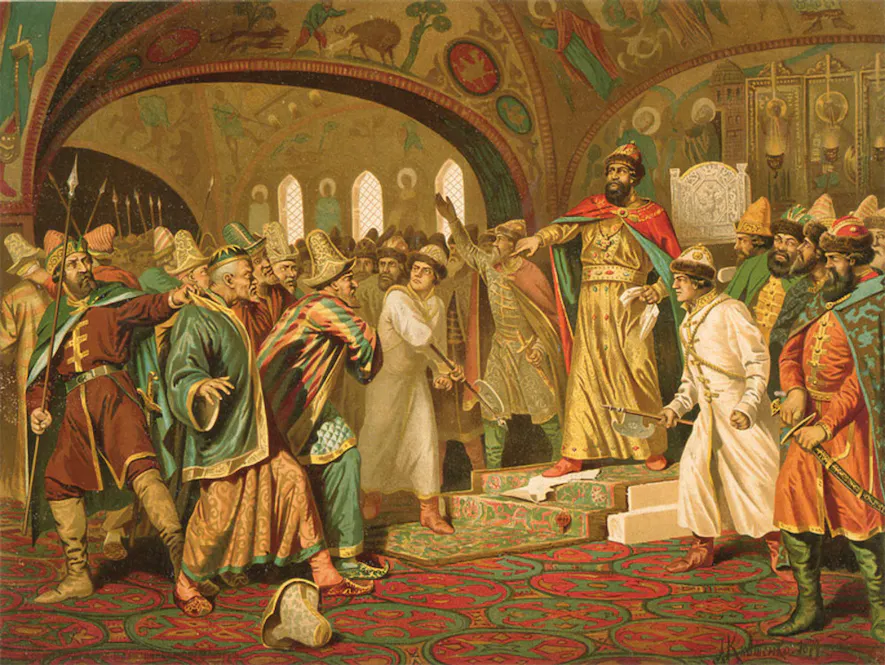
A nineteenth century image of Ivan III, figuratively illustrating his fights against the Mongols, or Tatars, of the Golden Horde. This confrontation in the throne room never really happened. By Aleksey D. Kivshenko (1851-96), public domain. By Aleksey D. Kivshenko (1851-96), public domain.
As Mongol power declined in northern Eurasia, Russia emerged as a world power. It was an intensely centralized state with a national identity, and a multi-ethnic empire of many religions spread over a vast territory.
Russia is the largest country in the world today, but it was once a group of small royal states in northern Eurasia. Eurasia is the combined landmass of Asia and Europe. Northern Eurasia was mostly made up of marshes, thick forests and grasslands. It had poor soil and low rainfall, which made it difficult to grow food. It was from here that the Mongol Empire emerged to conquer all of Eurasia in the 1200s.
Many other groups also lived in these vast lands. Many spoke Slavic languages, a language group that includes Russian, Serbian and Croatian. Slavs settled in the forested regions of the north where they traded furs with other groups. This attracted Greek-speaking merchants and settlers from the Balkan Peninsula and Vikings from Scandinavia. The Balkan Peninsula is in southern Europe.
In the eleventh century, a series of minor principalities began to emerge. A principality is a region run by princes or dukes. These were centered around the cities of Novgorod and Moscovy (Moscow) and Kiev. Many principalities adopted the Orthodox Christianity brought by the Greek-speaking community.
In the thirteenth century, Mongol invaders conquered these northern states. The leaders of the principalities were forced to pay tributes to the Mongols. This meant they had to give the Mongol rulers gifts such as gold or animals. In return, locals benefited from many of the technologies the Mongols brought. Some local rulers, like the Dukes of Muscovy, passed on tributes in return for a share of the power. However, they did not like living under Mongol rule.
The Mongol Empire fell apart in the fourteenth century. After more than 100 years of Mongol control, Moscow's Grand Dukes could take back their lands. They could also think about expanding outside of the Muscovy region.
For the next hundred years, Moscow and its neighbors fought over land ownership. Finally, in 1478, Moscow's Grand Duke Ivan III defeated the state of Novgorod. He unified the region and claimed to rule all Russians.
The next generation of Russian leaders turned to the south, conquering areas where people weren't Slavic or Christian Orthodox. Grand Duke Ivan IV took over the Muslim-led areas of Kazan and Astrakhan. This expansion turned Russia into a multi-religious and multi-ethnic empire. However, by the early seventeenth century the state had broken into civil war. It was also being attacked by armies from Europe.
Russia would not be a unified state again until 1613. At this time, noblemen elected Michael Romanov as the Russian emperor, or czar. Romanov and his descendants would rule the empire for 300 years until the Russian Revolution of 1917.
Romanov modernized the Russian military, increasing their use of gunpowder weapons. He also created alliances with the Cossacks in Ukraine. The Cossacks were a group of independent armed communities. With the Cossacks on his side, Russia had a safety zone with European states to its west. Internally, the Romanovs demanded loyalty and service from the class of nobles known as the boyars. In return, the boyars wanted the right to totally control the peasants who lived on their land.
The Romanov rulers agreed to these conditions. They helped the boyars by creating the role of serf. Serfs were peasants who were forced to work the boyars' lands. The little money they were paid was heavily taxed. Any serf who ran away was breaking the law, and the state allowed noblemen to hunt them down. Many serfs pushed back against these living conditions, but these uprisings were squashed by Romanov armies.
The Romanovs and the boyars were also helped by the Orthodox Church. Most of its leaders lived in Moscow and received money from the Romanovs. The Church generally told the serfs that it was virtuous for them to obey the boyars.
With the full support of their nobility, the Romanovs created a large gunpowder empire. With gunpowder, the newly organized army could take over more lands. The Romanovs were helped by large companies who wanted access to Siberia and Central Asia. These lands were rich in fur. The Romanovs were also helped by Orthodox priests who went into these areas to teach people about Christianity. Still, the Romanovs were careful not to upset their Muslim subjects in the south.
The Russian Empire continued to expand quickly. Under Czar Peter, often called Peter the Great, Russia was victorious in a long war with Sweden. The victory finally gave Russia access to the Baltic coast in 1721. This secured the western boundaries and allowed future czars to push eastward. In the early nineteenth century, Russian forces raced across Siberia to the Pacific Ocean and pushed up against the Ottoman Empire to the south.
By 1750, Russia was set to expand into Siberia and Central Asia. It would also soon come up against European states and Qing Dynasty China. Russia would benefit from ideas and new technologies coming from these neighboring states. However, it would have to figure out how to control them while developing its internal identity.
In 1750, Russia was a bridge between two worlds. On one hand, Russia was an Orthodox Christian nation ruled by a powerful family. At the same time, it was developing two internal identities. One, as a Slavic, Orthodox Christian nation with a central leadership. And second, as a vast empire made up of peoples from many ethnicities and religions.
Image 1. Map of the expansion of Russia, 1533–1896. By MIA, CC BY-SA 2.
What was one effect of Mongol control over northern Eurasia?
Who was elected as Russian emperor in 1613?
What were serfs in Russia required to do?
What helped Russia expand its empire under the Romanovs?
