Preskoči na glavni sadržaj
Prijava
Sign up for FREE
arrow_back
Biblioteka

2023 (Jun.): NY Regents - ELA

star
star
star
star
star
Posljednje ažuriranje 4 months ago
26

Part 1

Directions (1–24): Closely read each of the three passages below. After each passage, there are several multiple-choice questions. Select the best suggested answer to each question and record your answer on the separate answer sheet provided for you.

Part 2

Argument

Directions: Closely read each of the four texts provided and write a source-based argument on the topic below. You may use scrap paper to plan your response. Write your argument where indicated in this formative.

Topic: Should solar geoengineering be used to reduce global warming?

Your Task: Carefully read each of the four texts provided. Then, using evidence from at least three of the texts, write a well-developed argument regarding whether or not solar geoengineering should be used to reduce global warming. Clearly establish your claim, distinguish your claim from alternate or opposing claims, and use specific, relevant, and sufficient evidence from at least three of the texts to develop your argument. Do not simply summarize each text.

Guidelines:

Be sure to:

  • Establish your claim regarding whether or not solar geoengineering should be used to reduce global warming

  • Distinguish your claim from alternate or opposing claims

  • Use specific, relevant, and sufficient evidence from at least three of the texts to develop your argument

  • Identify each source that you reference by text number and line number(s) or graphic (for example: Text 1, line 4 or Text 2, graphic)

  • Organize your ideas in a cohesive and coherent manner

  • Maintain a formal style of writing

  • Follow the conventions of standard written English

Texts:

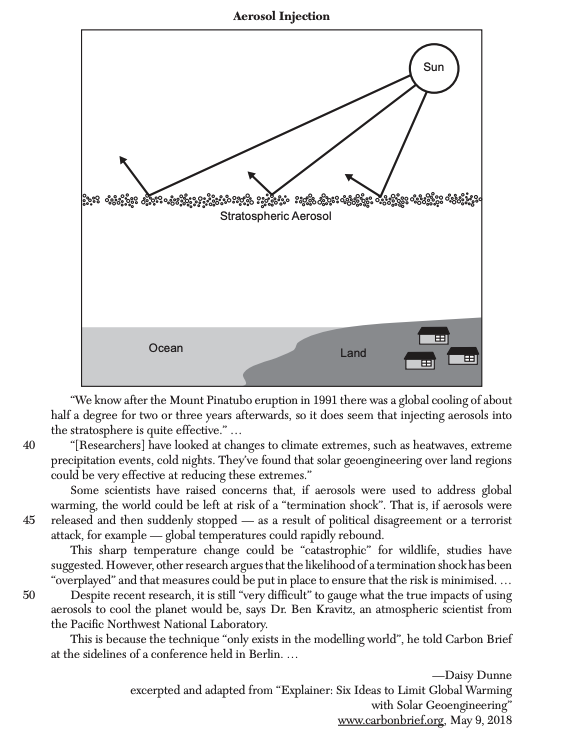
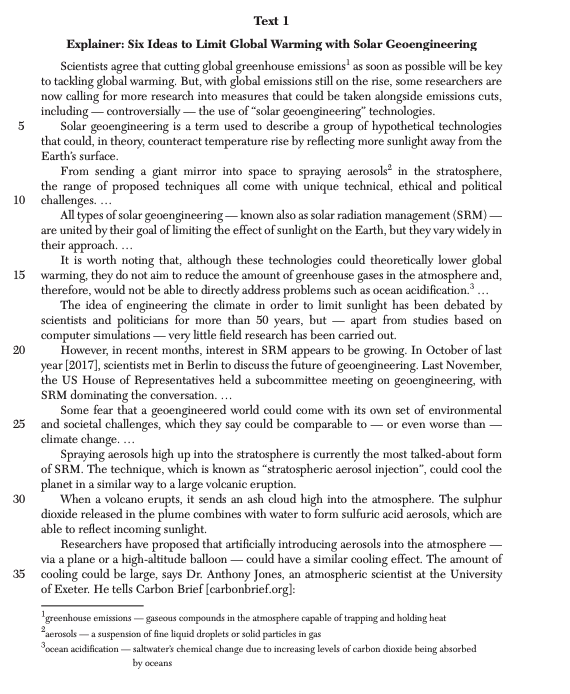
Text 1 – Explainer: Six Ideas to Limit Global Warming with Solar Geoengineering
Text 2 – Solar Geoengineering: Weighing Costs of Blocking the Sun’s Rays
Text 3 – Will the World Ever Be Ready for Solar Geoengineering?
Text 4 – Toward a Responsible Solar Geoengineering Research Program

1
RL.11-12.4
1
RL.11-12.3
1
RL.11-12.3
1
RL.11-12.5
1
11-12L5a
1
RL.11-12.4
1
RL.11-12.3
1
RL.11-12.6
1
RL.11-12.2
1
RL.11-12.2

Reading Comprehension Passage B

At the Crossroads

You to the left and I to the right,
For the ways of men must sever —
And it well may be for a day and a night,
And it well may be forever.

[5] But whether we meet or whether we part
(For our ways are past our knowing),
A pledge from the heart to its fellow heart
On the ways we all are going!
Here’s luck!
[10] For we know not where we are going.

We have striven1 fair in love and war,
But the wheel was always weighted;
We have lost the prize that we struggled for,
We have won the prize that was fated.
[15] We have met our loss with a smile and a song,
And our gains with a wink and a whistle, —
For, whether we’re right or whether we’re wrong,
There’s a rose for every thistle.

[20] Here’s luck —
And a drop to wet your whistle!

Whether we win or whether we lose
With the hands that life is dealing,
It is not we nor the ways we choose
[25] But the fall of the cards that’s sealing.
There’s a fate in love and a fate in fight,
And the best of us all go under —
And whether we’re wrong or whether we’re right,
[30] We win, sometimes, to our wonder.
Here’s luck —
That we may not yet go under!

With a steady swing and an open brow
We have tramped the ways together,
[35] But we’re clasping hands at the crossroads now
In the Fiend’s own night for weather;
And whether we bleed or whether we smile
In the leagues that lie before us,
The ways of life are many a mile
[40] And the dark of Fate is o’er us.
Here’s luck!
And a cheer for the dark before us!

You to the left and I to the right,
For the ways of men must sever,
[45] And it well may be for a day and a night,
And it well may be forever!
But whether we live or whether we die
(For the end is past our knowing),
Here’s two frank hearts and the open sky,
[50] Be a fair or an ill wind blowing!
Here’s luck!
In the teeth of2 all winds blowing.

—Richard Hovey
“At the Crossroads”
from Last Songs from Vagabondia
Small, Maynard & Company, 1900

1striven — struggled

2In the teeth of — in defiance of
1
RL.11-12.5
1
L.11-12.5.a
1
RL.11-12.4
1
L.11-12.5.a
1
RI.11-12.3
1
L.11-12.4.a
1
RI.11-12.2
1
RI.11-12.5
1
RI.11-12.3
1
L.11-12.5.a
1
RI.11-12.3
1
RI.11-12.3
1
RI.11-12.4
1
RI.11-12.2

24
Pitanje 25
25.

Carefully read each of the four texts provided. Then, using evidence from at least three of the texts, write a well-developed argument regarding whether or not solar geoengineering should be used to reduce global warming.

Clearly establish your claim, distinguish your claim from alternate or opposing claims, and use specific, relevant, and sufficient evidence from at least three of the texts to develop your argument. Do not simply summarize each text.

L.11-12.1.a
L.11-12.2.a
…

Part 3

Text-Analysis Response

Your Task: Closely read the text provided and write a well-developed, text-based response of two to three paragraphs. In your response, identify a central idea in the text and analyze how the author’s use of one writing strategy (literary element or literary technique or rhetorical device) develops this central idea. Use strong and thorough evidence from the text to support your analysis. Do not simply summarize the text. You may use the margins to take notes as you read and scrap paper to plan your response. Write your response in the space provided.

Guidelines:

Be sure to:

  • Identify a central idea in the text

  • Analyze how the author’s use of one writing strategy (literary element or literary technique or rhetorical device) develops this central idea. Examples include: characterization, conflict, denotation/connotation, metaphor, simile, irony, language use, point-of-view, setting, structure, symbolism, theme, tone, etc.

  • Use strong and thorough evidence from the text to support your analysis

  • Organize your ideas in a cohesive and coherent manner

  • Maintain a formal style of writing

  • Follow the conventions of standard written English

16
Pitanje 26
26.

Closely read the text provided on pages and write a well-developed, text-based response of two to three paragraphs. In your response, identify a central idea in the text and analyze how the author’s use of one writing strategy (literary element or literary technique or rhetorical device) develops this central idea. Use strong and thorough evidence from the text to support your analysis. Do not simply summarize the text. You may use scrap paper to plan your response. Write your response in the space provided.

L.11-12.1.a
L.11-12.3.a
…

Reading Comprehension Passage A

Someone

Pitanje 1
1.

The question “Why?” in line 7 creates a mood of

Pitanje 2
2.

The details in lines 9 through 12 reflect the narrator’s recognition of her mother’s

Pitanje 3
3.

Lines 37 through 40 characterize the mother as

Pitanje 4
4.

The dialogue in lines 45 through 54 contributes to a central idea by depicting the

Pitanje 5
5.

The figurative language in lines 68 through 70 emphasizes

Pitanje 6
6.

Lines 79 through 81 reveal the mother’s realization of Marie’s

Pitanje 7
7.

Which quote best illustrates the narrator’s “reluctance” (line 7)?

Pitanje 8
8.

Marie’s language in lines 84 through 87 conveys an attitude of

Pitanje 9
9.

Based on the passage, it can be inferred that the mother and daughter’s relationship is

Pitanje 10
10.

Which quotation best supports a central idea in the passage?

Pitanje 11
11.

In lines 1 through 4, the narrator acknowledges the inevitability of

Pitanje 12
12.

The figurative language in lines 11 through 14 suggests that fortune is a result of

Pitanje 13
13.

The statement “But we’re clasping hands at the crossroads now” (line 35) creates a sense of

Pitanje 14
14.

The figurative language in line 40 reflects

Reading Comprehension Passage C

In Deep

Pitanje 15
15.

The description in lines 4 and 5 suggests that caving requires

Pitanje 16
16.

As used in line 14, “cannibalizing” most nearly means

Pitanje 17
17.

Lines 19 through 23 support a central idea by depicting the cavers as

Pitanje 18
18.

Lines 24 through 30 serve to

Pitanje 19
19.

The details in lines 38 through 43 stress the

Pitanje 20
20.

The reference to the “lopping off redundant parts and vestigial limbs” (lines 49 and 50) implies that caving

Pitanje 21
21.

The details in lines 54 through 62 emphasize that the development of caving technology requires

Pitanje 22
22.

Lines 66 through 68 suggest that cavers should interpret a surge in adrenaline as a signal to

Pitanje 23
23.

The figurative language in line 70 supports a central idea that cavers

Pitanje 24
24.

Which statement best illustrates a central idea in the text?