Preskoči na glavni sadržaj
Prijava
Sign up for FREE
arrow_back
Biblioteka

Catalyst: 01/08/26

star
star
star
star
star
Posljednje ažuriranje 2 months ago
23 questions

You may use your notes and your book to complete this photosynthesis extended catalyst.

Obavezno
2
LS-H-E1
Obavezno
2
LS-H-E1
Obavezno
2
LS-H-E1
Obavezno
2
LS-H-E1
Obavezno
2
LS-H-E1
Obavezno
2
LS-H-E1
Obavezno
2
LS-H-E1
Obavezno
2
LS-H-E1
Obavezno
2
LS-H-E1
Obavezno
2
LS-H-E1
Obavezno
2
LS-H-E1
Obavezno
2
LS-H-E1
Obavezno
2
LS-H-E1
Obavezno
2
LS-H-E1
Obavezno
2
LS-H-E1
Obavezno
2
LS-H-E1
Obavezno
2
LS-H-E1
Obavezno
2
LS-H-E1
Obavezno
2
LS-H-E1
Obavezno
2
LS-H-E1
Obavezno
2
LS-H-E1
Obavezno
5
Obavezno
13
Pitanje 1
1.

What are the products of the light-dependent reactions?

Pitanje 2
2.

Which pathway represents the flow of electrons during photosynthesis?

Pitanje 3
3.

Which of the following is NOT a step in the light-dependent reactions?

Pitanje 4
4.

What happens when chlorophyll is struck by sunlight?

Pitanje 5
5.

Photosynthesis uses sunlight to convert water and carbon dioxide into

Pitanje 6
6.

What is the role of NADP+ in photosynthesis?

Pitanje 7
7.

Organisms, such as plants, that make their own food are called

Pitanje 8
8.

What action contributes to the inside of the thylakoid membrane becoming positively charged during the light-dependent reactions?

Pitanje 9
9.

The light-independent reactions of photosynthesis need __________.

Pitanje 10
10.

The function of the light-dependent reactions is to __________.

Pitanje 11
11.

Which of these is not true regarding the dark reactions of photosynthesis?

Pitanje 12
12.

NADPH is important in photosynthesis because it __________.

Pitanje 13
13.

Which process would bacteria living near a heat vent on the ocean floor use to build carbon-based molecules, such as sugars?

Pitanje 14
14.

How many ATP and NADPH does it take to make one glucose molecule?

Pitanje 15
15.

carbon dioxide :: fixation

Pitanje 16
16.

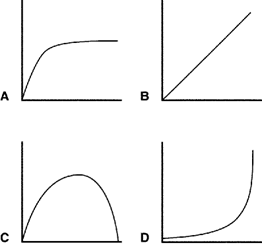
Figure 8-6

Imagine that y-axis of each graph in Figure 8–6 describes the rate of photosynthesis. Which of the graphs represents the effect of temperature on the rate of photosynthesis?

Pitanje 17
17.

Figure 8-6

Imagine that y-axis of each graph in Figure 8–6 describes the rate of photosynthesis. Which of the graphs represents the effect of light intensity on the rate of photosynthesis?

Pitanje 18
18.

What makes certain molecules good electron carriers?

Pitanje 19
19.

Water vapor exits and CO2 enters a leaf through the

Pitanje 20
20.

What energy-rich organic compound is produced as a result of the light-independent reaction?

Pitanje 21
21.

During photosynthesis, photons raise electrons to higher energy levels. These excited electrons belong to what compound?

Pitanje 22
22.

Explain the importance of producers and photosynthesis for all life on Earth.

Pitanje 23
23.

Put the following steps in correct order from the start of photosynthesis to the end of photosynthesis. Place your cursor on the selection to move it intothe right place in the sequence.

  1. High energy electrons move to NADP reductase to make NADPH

  2. Sunlight excites electrons in PS II

  3. 3 more CO2 enter the Calvin cycle, produce the 2nd G3P and a glucose molecule is made

  4. High energy electrons move across the electron transport chain and pump hydrogen ions against the concentration gradient to the inside of the thylakoid space.

  5. 6 ATP and 6 NADPH are used to reduce 3 carbon molecules into 6 G3Ps

  6. 5 G3P are reduced using 3 ATP to make RuBP

  7. 1 G3P exits the Calvin cycle to make part of the glucose molecule

  8. Hydrogen ions move down the concentration gradient and diffuse through ATP synthase to make ATP

  9. Water is split and electrons replace the electrons that exited PS II in a process called photolysis

  10. Sunlight excites electrons in PS I

  11. 3 carbon dioxides from the atmosphere enter the Calvin cycle by attaching to RuBP and the enzyme rubisco and undergo fixation.

  12. Low energy electrons from PS II move to PS I to replace electrons that exited after they were excited.

  13. ATP and NADPH enter the Calvin cycle to be used in reduction phase