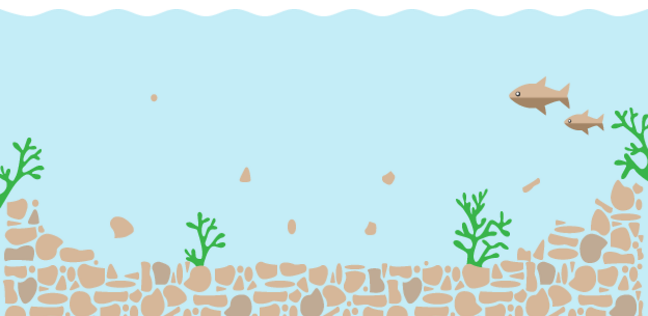
Scientists are able to ‘read’ layers of sedimentary rock by using a technique called relative dating. This animated video demonstrates how sedimentary rock features, like the cliffs near Whanganui, were formed, stacked, eroded and tilted by tectonic movement before new rocks were formed on top.
Sedimentary rocks are one of the three main types of rocks on Earth, and they form right on or near Earth’s surface. These rocks begin their journey as tiny pieces of other rocks. Over long periods of time, these pieces are moved, dropped, and pressed together until they become solid rock again.
Sediments are small bits of rock that break off larger rocks. This happens through a process called weathering, which means rocks are broken down by wind, water, ice, or even changes in temperature. Once the pieces break off, they don’t just stay in one place. They are carried, or transported, by natural forces such as wind, flowing rivers, ocean waves, or moving glaciers.
Eventually, the moving sediments slow down and settle in a new place. This is called deposition. Sediments can be deposited:
On dry land
Along riverbanks
At the bottom of lakes
On the seabed
On top of older layers of rock
Over time, more and more layers build up.
Sedimentary rocks form in layers, which scientists call strata. Each layer may contain different sizes or types of sediments depending on where they came from. When you look at a cliff or canyon wall, you can often see these layers stacked like pages in a book. Each layer tells a story about what Earth was like when that layer formed.
As new layers pile on top of older ones, the weight pushes down on the sediments below. This pressure squeezes the sediments together in a process called compaction. Then, minerals in water seep between the tiny pieces and act like glue. This “glue” hardens and cements the sediments together. This process is called cementation. Together, compaction and cementation turn loose sediments into solid sedimentary rock.
A river can carry sediments of all sizes—from tiny grains of sand to larger pebbles. These sediments come from weathered rocks upstream. As the river flows, it transports the sediments until they settle somewhere else.
When sediments reach the ocean, they may sink to the bottom and collect on the seabed. Over millions of years, these layers can harden into sedimentary rock.
A glacier is a slow‑moving river of ice. As it moves, it picks up rocks and sediments and carries them long distances. When the glacier melts, it drops the sediments in new locations.
The Colorado Plateau was lifted many thousands of feet, mostly straight up, from an ancient sea bed. After that, millions of years of weathering (breaking down) and erosion (moving) by the Colorado River left high river cliffs. The exposed surface of the cliffs shows the formation of many layers of sedimentary rock.
On a hard bedrock, layers of sediments (matter that settles to the bottom) built up over millions of years. Each layer of sediment depends on whether the area was covered with a sea, dry land, or shallow muddy shore. The layers are: greenish shale from seas, tan sandstone from sandy shores, yellow-gray limestone from the remains of sea creatures, red iron- rich layers of left by muddy flood zones, and more greenish sandstone when the area was covered by a deep sea. Between wet times, a sandy desert blew across wide areas, laying down the Coconino Sandstone layer. Great pressure from layers above pressed the layers together. Along the Colorado River, you can see that deposition (laying down) of
sediments, compaction (pressing together), and cementation (sticking together) forms sedimentary rock.
What changes did you observe?
Sedimentary rock is formed over a long period of . Small pieces of rocks called are carried away and deposited in .
Over time, more and more layers of sediments form, on the layers below.
The weight of the layers squeezes the sediments together during the process known as . As the water is squeezed out, crystals form. The sediments stick together. This process is called .
Sedimentary rock is formed.
What is the first step in forming sedimentary rock?
What is the process called when sediments are dropped or settle in a new place?
What do scientists call the layers found in sedimentary rocks?
Which natural force can transport sediments?
What happens during cementation?
What caused the Colorado Plateau to rise thousands of feet?
What natural forces helped create the high river cliffs seen today?
What determines the type of sediment layer that forms in an area?
What three processes along the Colorado River form sedimentary rock?
Read the text and view the images about sedimentary rocks.
Pay attention about deposition, compaction, and cementation.
Sedimentary rocks
The grains in sedimentary rocks are arranged in layers. The oldest layers are at the bottom and the youngest layers are at the top.
Chalk, limestone, shale, and sandstone are all examples of sedimentary rocks. All these different sedimentary rocks are formed from the broken remains of other rocks that become joined together.
There are five processes that make a sedimentary rock:
transport → deposition → sedimentation → compaction → cementation
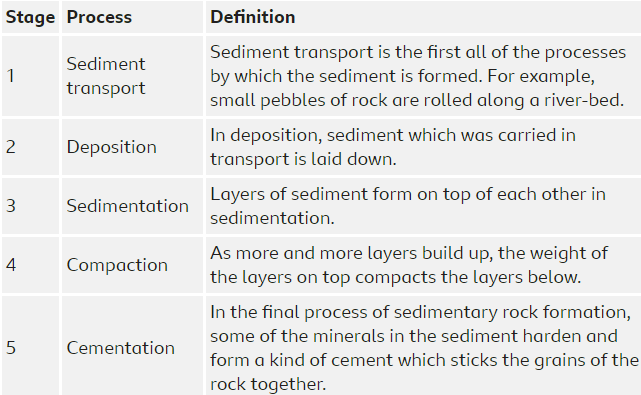
Sedimentary rocks are formed by the action of water. A river carries pieces of broken rock as it flows along. This is transport.
Deposition and sedimentation
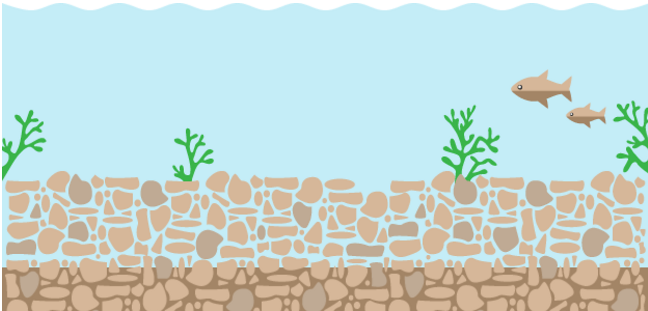
When the river reaches a lake or the sea, these rocks settle to the bottom - the rocks are deposited. Layers of rocks build up in a process called deposition. These layers are called sediments. This process is called sedimentation.
The weight of the sediments on top squashes the sediments at the bottom in a process called compaction. This squeezes out the water from between the pieces of rock and crystals of different salts form. The crystals stick the pieces of rock together. This process is called cementation.
Sedimentary rocks are often used as building materials.
For example:
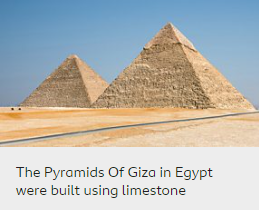
sandstone is easy to shape into blocks so has been used to make building stones for walls for centuries
limestone is also used for building stones for walls because it is hard and lasts for many years without being worn away
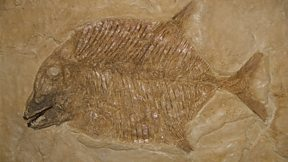
Sedimentary rock may contain fossils of animals and plants trapped in the sediments as the rock was formed.
How are the layers in sedimentary rocks arranged?
Which list shows examples of sedimentary rocks?
What happens during the process of deposition?
What is compaction?
What causes cementation to occur?
Why are sandstone and limestone often used as building materials?