Climate Forcing
Key Points
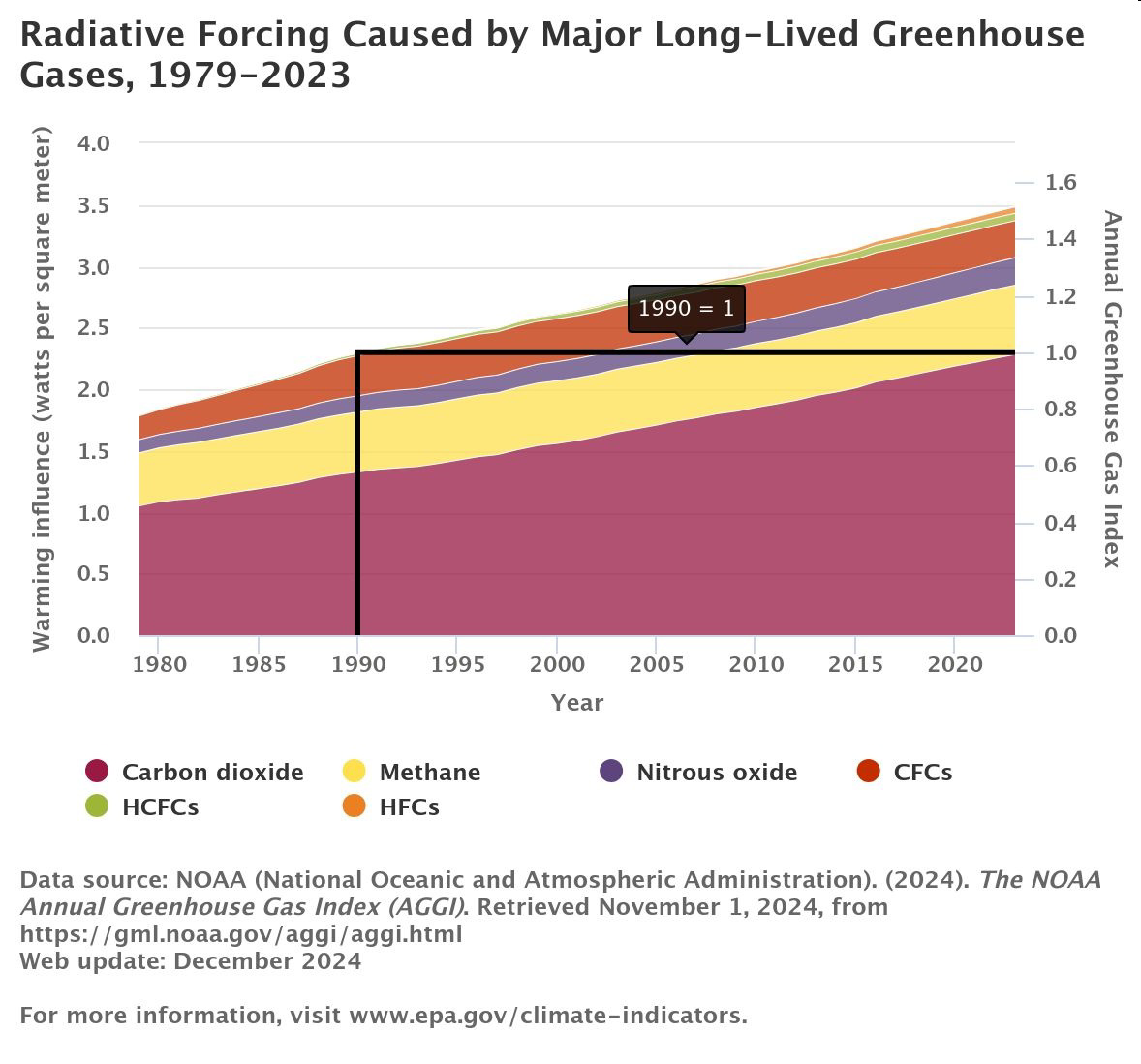
In 2023, the Annual Greenhouse Gas Index was 1.51, which represents a 51 percent increase in radiative forcing (a net warming influence) since 1990 (see Figure 1).
Of the greenhouse gases shown in Figure 1, carbon dioxide accounts for by far the largest share of radiative forcing since 1990, and its contribution continues to grow at a steady rate. Carbon dioxide alone would account for a 42 percent increase in radiative forcing since 1990.
Although the overall Annual Greenhouse Gas Index continues to rise, the rate of increase has slowed somewhat since the baseline year 1990. This change has occurred in part because chlorofluorocarbon (CFC) concentrations have been declining, as production of CFCs has been phased out globally due to the harm they cause to the ozone layer (see Figure 1).
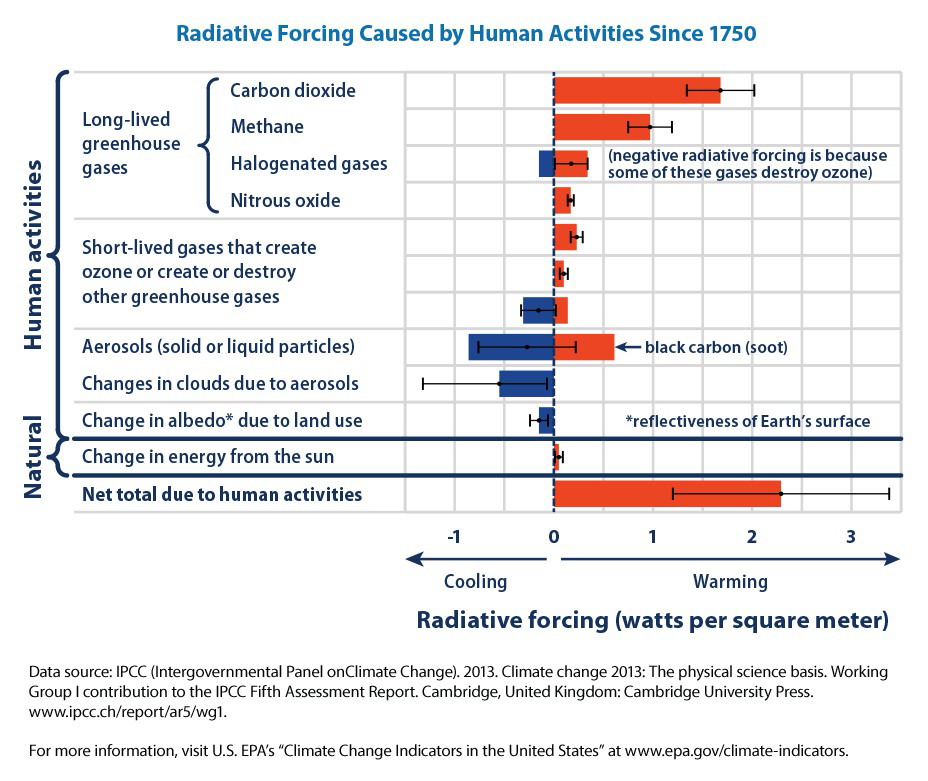
Greenhouse gases produced by human activities have caused an overall warming influence on the Earth’s climate since 1750. The largest contributor to warming has been carbon dioxide, followed by methane and black carbon. Although aerosol pollution and certain other activities have caused cooling, the net result is that human activities on the whole have warmed the Earth (see Figure 2).
Background
When energy from the sun reaches the Earth, the planet absorbs some of this energy and radiates the rest back to space as heat. The Earth’s surface temperature depends on this balance between incoming and outgoing energy. Average conditions tend to remain stable unless the Earth experiences a force that shifts the energy balance. A shift in the energy balance causes the Earth’s average temperature to become warmer or cooler, leading to a variety of other changes in the lower atmosphere, on land, and in the oceans.
A variety of physical and chemical changes can affect the global energy balance and force changes in the Earth’s climate. Some of these changes are natural, while others are influenced by humans. These changes are measured by the amount of warming or cooling they can produce, which is called “radiative forcing.” Changes that have a warming effect are called “positive” forcing, while changes that have a cooling effect are called “negative” forcing. When positive and negative forces are out of balance, the result is a change in the Earth’s average surface temperature.
Changes in greenhouse gas concentrations in the atmosphere affect radiative forcing. Greenhouse gases absorb energy that radiates upward from the Earth’s surface, re-emitting heat to the lower atmosphere and warming the Earth’s surface. Human activities have led to increased concentrations of greenhouse gases that can remain in the atmosphere for decades, centuries, or longer, so the corresponding warming effects will last for a long time.
Graph of Information - Figure 1.
This figure shows the amount of radiative forcing caused by various greenhouse gases, based on the change in concentration of these gases in the Earth’s atmosphere since 1750. Radiative forcing is calculated in watts per square meter, which represents the size of the energy imbalance in the atmosphere. On the right side of the graph, radiative forcing has been converted to the Annual Greenhouse Gas Index, which is set to a value of 1.0 for 1990.
Graph of Information - Figure 2.
This figure shows the total amount of radiative forcing caused by human activities - including indirect effects - between 1750 and 2011. Radiative forcing is calculated in watts per square meter, which represents the size of the energy imbalance in the atmosphere. Each colored bar represents scientists’ best estimate, while the thin black bars indicate the likely range of possibilities. The natural change in the energy received from the sun over this time period is provided for reference.