Global Greenhouse Gases
Key Points
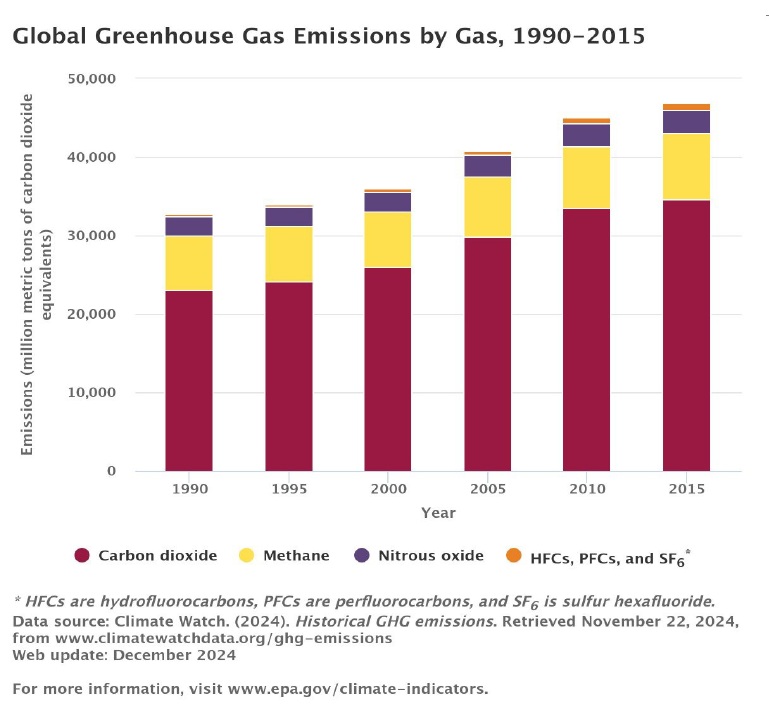
In 2015, estimated worldwide emissions from human activities totaled nearly 47 billion metric tons of greenhouse gases, expressed as carbon dioxide equivalents. This represents a 44 percent increase from 1990 (see Figures 1 and 2). These numbers represent net emissions, which include the effects of land use and forestry.
Between 1990 and 2015, global emissions of all major greenhouse gases increased (see Figure 1). Net emissions of carbon dioxide increased by 50 percent, which is particularly important because carbon dioxide accounts for about three-fourths of total global emissions. Methane emissions increased the least - 19 percent - while emissions of nitrous oxide increased by 26 percent. Emissions of fluorinated gases more than tripled.
Graph of Information - Figure 1.
This figure shows worldwide emissions of carbon dioxide, methane, nitrous oxide, and several fluorinated gases from 1990 to 2015. For consistency, emissions are expressed in million metric tons of carbon dioxide equivalents. These totals include emissions and sinks due to land-use change and forestry.
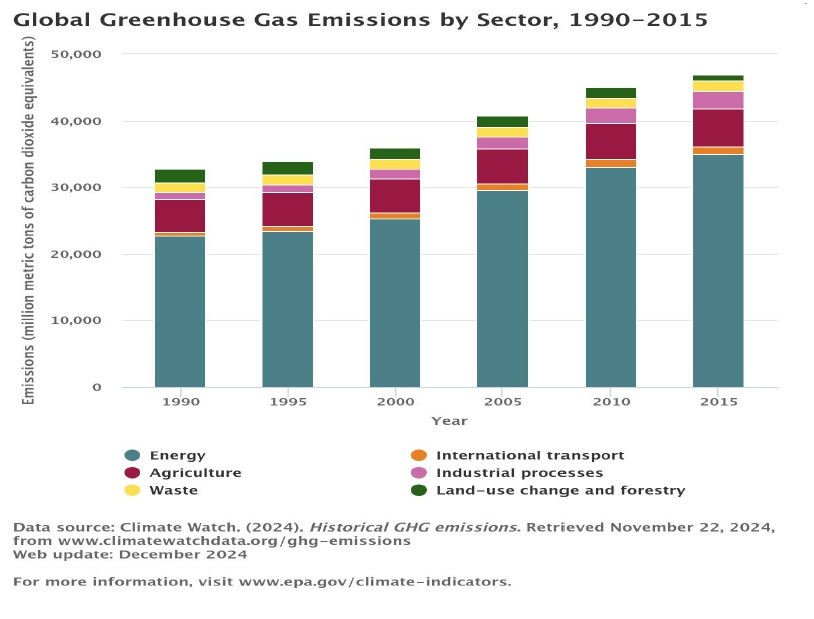
Energy production and use (including fuels used by vehicles and buildings) represent the largest source of greenhouse gas emissions worldwide (about 74 percent of the total in 2015), followed by agriculture (12 percent in 2015) (see Figure 2). While land-use change and forestry represent a net sink for emissions in the United States, absorbing carbon dioxide and offsetting emissions from other sources, these activities are a net source of emissions on a global scale, largely because of deforestation.
Graph of Information from Figure 2.
This figure shows worldwide greenhouse gas emissions by sector from 1990 to 2015. For consistency, emissions are expressed in million metric tons of carbon dioxide equivalents. These totals include emissions and sinks due to land-use change and forestry.
Note that the sectors shown here are different from the economic sectors used in U.S. emissions accounting. Emissions from international transport (aviation and marine) are separate from the energy sector because they are not part of individual countries’ emissions inventories. The energy sector includes all other transportation
activities.
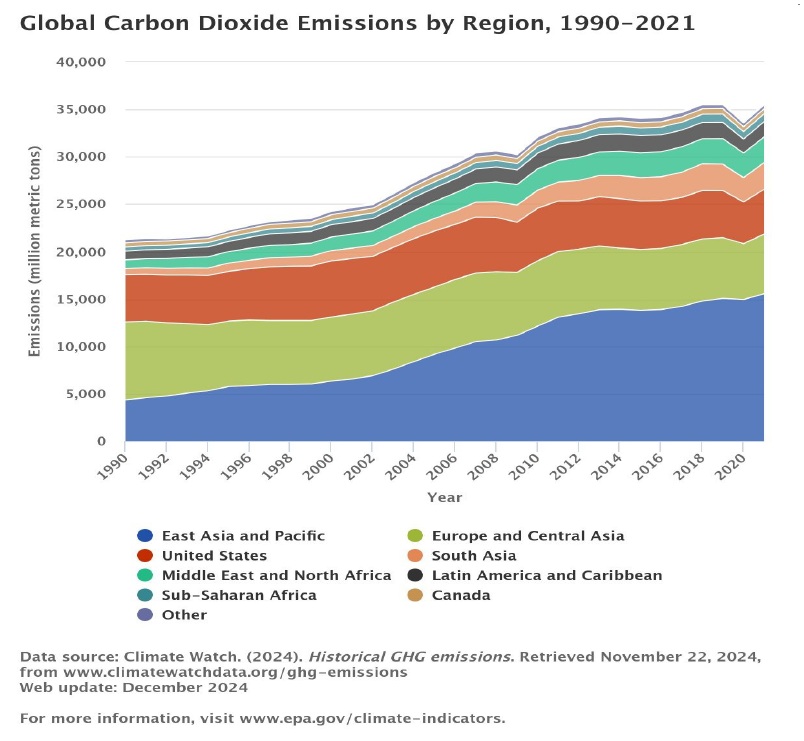
Carbon dioxide emissions are increasing faster in some parts of the world (for example, East Asia and the Pacific) than in others (see Figure 3). The majority of emissions come from three regions: East Asia and Pacific, Europe and Central Asia, and the United States, which together accounted for 75 percent of total global emissions in 2021. The apparent downturn in 2020 likely reflects the worldwide reduction in travel and economic activity during the COVID-19 pandemic, as reported in the U.S. Greenhouse Gas Emissions indicator.
Graph of Information from Figure 3.
This figure shows carbon dioxide emissions from 1990 to 2021 for different regions of the world. These totals do not include emissions or sinks related to land-use change or forestry. Inclusion of land-use change and forestry would increase the apparent emissions from some regions while decreasing the emissions from others.
Background
Increasing emissions of greenhouse gases due to human activities worldwide, especially burning of fossil fuels, have led to a substantial increase in atmospheric concentrations of long-lived and other greenhouse gases. Every country around the world emits greenhouse gases into the atmosphere, meaning the root cause of climate change is truly global in scope. Some countries produce far more greenhouse gases than others, and several factors - such as economic activity (including the composition and efficiency of the economy), population, income level, land use, and climatic conditions - can influence a country’s emissions levels. Tracking greenhouse gas emissions worldwide provides a global context for understanding the United States’ and other nations’ roles in climate change.