The Lighthouse Lamp
by Margaret E. Sangster
“The Lighthouse Lamp” by Margaret E. Sangster—Public Domain
The winds came howling down from the north,
Like a hungry wolf for prey,
And the bitter sleet went hurtling forth,
In the pallid face of the day.
5 And the snowflakes drifted near and far,
Till the land was whitely fleeced,
And the light-house lamp, a golden star,
Flamed over the waves’ white yeast.
In the room at the foot of the lighthouse
10 Lay mother and babe asleep,
And little maid Gretchen was by them there,
A resolute watch to keep.
There were only the three on the lighthouse isle,
But father had trimmed the lamp,
15 And set it burning a weary while
In the morning’s dusk and damp.
“Long before night I’ll be back,” he said,
And his white sail slipped away;
Away and away to the mainland sped,
20 But it came not home that day.
The mother stirred on her pillow’s space,
And moaned in pain and fear,
Then looked in her little daughter’s face
Through the blur of a starting tear.
25 “Darling,” she whispered, “it’s piercing cold,
And the tempest is rough and wild;
And you are no laddie strong and bold,
My poor little maiden child.
“But up aloft there’s the lamp to feed,
30 Or its flame will die in the dark,
And the sailor lose in his utmost need
The light of our islet’s ark.”
“I’ll go,” said Gretchen, “a step at a time;
Why, mother, I’m twelve years old,
35 And steady, and never afraid to climb,
And I’ve learned to do as I’m told.”
Then Gretchen up to the top of the tower,
Up the icy, smooth-worn stair,
Went slowly and surely that very hour,
40 The sleet in her eyes and hair.
She fed the lamp, and she trimmed it well,
And its clear light glowed afar,
To warn of reefs, and of rocks to tell,
This mariner’s guiding star.
45 And once again when the world awoke
In the dawn of a bright new day,
There was joy in the hearts of the fisher folks
Along the stormy bay.
When the little boats came sailing in
50 All safe and sound to the land,
To the haven the light had helped them win,
By the aid of a child’s brave hand.
PART A: What word best emphasizes the tone in stanza one as the speaker describes the weather? (RL.4)
PART B: Which lines best convey the same tone emphasized in the answer to Part A? (RL.1)
PART A: Which of the following best clarifies Gretchen’s response to the conflict or challenge presented in the poem? (RL.3)
PART B: Which line from the poem supports the answer to Part A? (RL.1)
PART A: Which sentence communicates the best summary of the poem? (RL.2)
PART B: Which lines from the poem best support the answer to Part A? Select TWO answers. (RL.1)
Text 2:
The Old Sailor
by Margaret E. Sangster
I've crossed the bar at last, mates,
My longest voyage is done;
And I can sit here, peaceful,
And watch th' setting sun
5 A-smilin' kind of glad like
Upon the waves so free.
My longest voyage is done, mates,
But oh, the heart of me,
Is out where sea meets skyline!
10 My longest voyage is done. . . .
But - can I sit, in peace, mates,
And watch the settin' sun?
For what's a peaceful life, mates,
When every breeze so free,
15 When every gale a-blowin',
Brings messages to me?
And is the sky so shinin',
For all it's golden sun,
To one who loves the sea, mates,
20 And knows his voyage is done?
And, can a year on land, mates,
Match with one day - at sea?
Ah, every wind a-singin'
Brings memory to me!
25 I've crossed the bar at last, mates,
My longest voyage is past,
And I must watch the sunset,
Must see it fade, at last.
My steps are not so light, mates,
30 As they were, years ago;
And sometimes, when I'm tired,
My head droops kind of low -
Yet, though I'm old and - weary,
The waves that dance so free,
35 Keep callin' to my soul, mates,
And thrill the heart of me!
What does the series of rhetorical questions reveal about the speaker’s thoughts? (RL.4, RL.3)
PART A: What is the speaker’s mindset about the sea? (RL.6)
PART B: Which lines from the poem support the answer to Part A? (RL.1)
PART A: What is the central message conveyed in the poem? (RL.2)
PART B: Which lines from the poem supports the answer to Part A? (RL.1)
PART A: How do the poets treat the subject of the sea? (RL.9, RL.3, RL.6)
PART B: Select one line from “The Lighthouse Lamp” and one line from “The Old Sailor” that supports the answer to Part A. (RL.1)
Sojourner Truth
Adapted from information on Sojourner Truth found in the public domain.
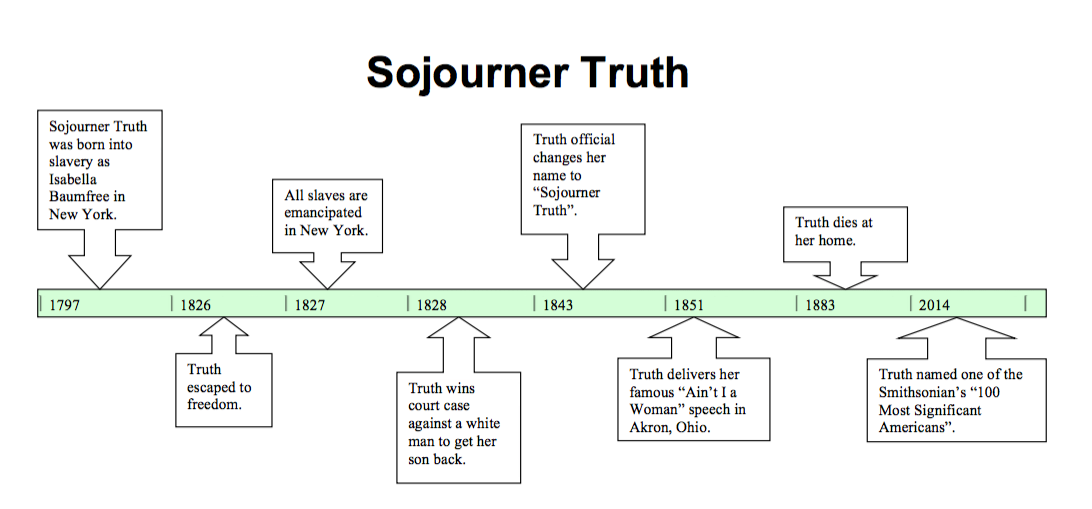
Sojourner Truth, born in 1797 as Isabella Baumfree, was an African American abolitionist and women’s rights activist. Truth was one of ten or twelve children born to James and Elizabeth Baumfree. Her family belonged to Colonel Hardenbergh, who bought her parents from slave traders and kept the family on his estate in Swartekill, New York. After some time, Truth married an older slave named Thomas, and the two of them had five children: James, Diana, Peter, Elizabeth, and Sophia.
In 1799, the state of New York began to legislate the abolition of slavery, although the process of emancipating those enslaved was not complete until 1827. Dumont, the man who owned Truth then, promised to grant her freedom a year before the state emancipation if she obeyed him and was faithful. He changed his mind, however, claiming a hand injury had made her less productive. She was infuriated but continued working. Late in 1826, Truth took it upon herself to escape to freedom with her infant daughter, Sophia. She had to leave her other children behind because they were not legally freed in the emancipation order until they had served into their twenties. Truth found her way to the home of Isaac and Maria Van Wagenen in New Paltz, who took her and her baby in. Isaac offered to buy her services for the remainder of the year, which her former owner, Dumont, accepted for $20. She lived with the Van Wagenens until the New York State Emancipation Act was approved a year later.
Truth learned that her son Peter, then five years old, had been sold illegally by Dumont to an owner in Alabama. With the help of the Van Wagenens, she took the issue to court, and in 1828, after months of legal proceedings, she got her son back. Truth became one of the first black women to go to court against a white man and win the case.
Truth had a life-changing religious experience during her stay with the Van Wagenens and became a devout Christian. 1843 was a turning point for Truth, as this was when she changed her name to Sojourner Truth. She told her friends: “The Spirit calls me, and I must go,” and left to make her way, traveling and preaching about the abolition of slavery.
In 1851, Truth joined George Thompson, an abolitionist and speaker, on a lecture tour through central and western New York State. In May, she attended the Ohio Women’s Rights Convention in Akron, Ohio, where she delivered her famous speech on women’s rights, later known as “Ain’t I a Woman”. Her speech demanded equal human rights for all women as well as for all blacks. Advocating for women and African Americans was dangerous and challenging enough, but being one and doing so was far more difficult. The pressures and severity of her speech did not get to Truth, however. Truth took to the stage with a demanding and composed presence. Audience members were baffled by the way she carried herself and were hesitant to believe that she was even a woman.
Over the next 10 years, Truth spoke before dozens, perhaps hundreds, of audiences. During the Civil War, she helped recruit black troops for the Union Army. Truth spoke about abolition, women’s rights, prison reform, and preached against capital punishment. Not everyone welcomed her preaching and lectures, but she had many friends and staunch support among many influential people at the time.
Truth’s legacy lives on, as many work to pay respects and honor her contributions. A larger-than-life sculpture of Truth, dedicated in 1999, was erected to commemorate her life and accomplishments. In 2014, she was included in the Smithsonian magazine’s list of the “100 Most Significant Americans of All Time”. The US Treasury announced in 2016 that an image of Sojourner Truth would appear on the back of the newly designed $10 bill.
PART A: What does the phrase “demanding and composed presence,” as used in paragraph 5, reveal about the author’s point of view regarding Sojourner Truth? (RI.4, RI.6)
PART B: Which statement best supports the answer to Part A? (RI.1)
What information about Sojourner Truth is included in the timeline but not the text? (RI.7)
PART A: What is the central idea of the text? (RI.2)
PART B: Select the 4 sentences that are most important to include in a summary. (RI.1)