Great Lakes Ice Cover
Key Points
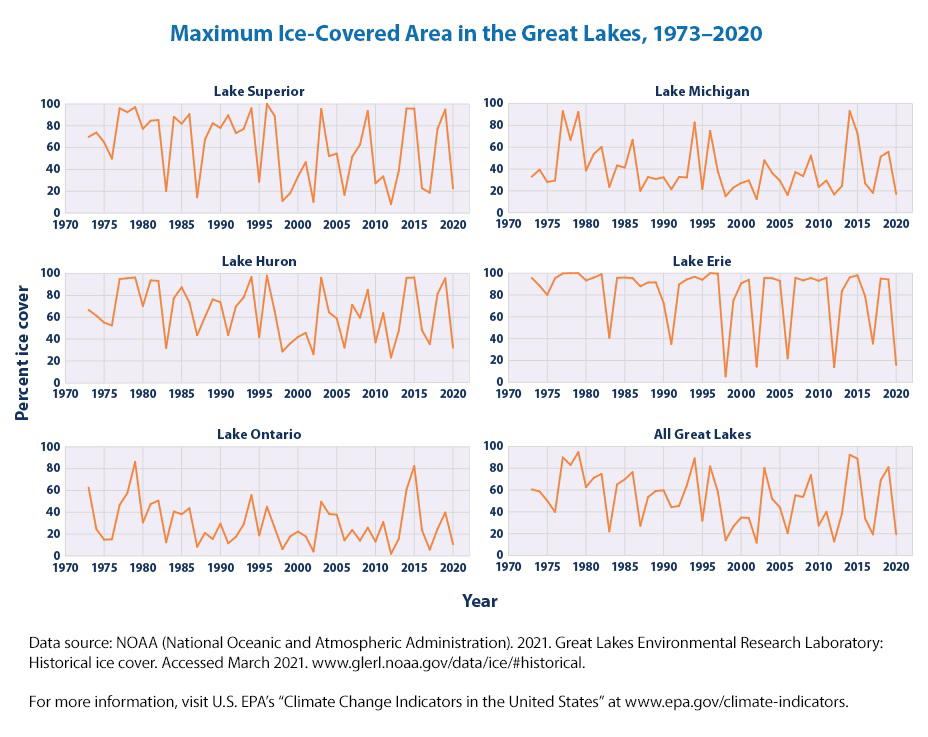
Since 1973, the maximum area covered in ice on the Great Lakes has varied considerably from year to year. Adding the five Great Lakes together, maximum frozen area has ranged from less than 20 percent in some years to more than 90 percent in others (see Figure 1). All five lakes have experienced some degree of long-term decrease, but the decrease is only statistically significant in one lake (Superior). Years with much-lower-than-normal ice cover appear to have become more frequent during the past two decades, especially in lakes like Erie and Superior that have a history of freezing almost completely.
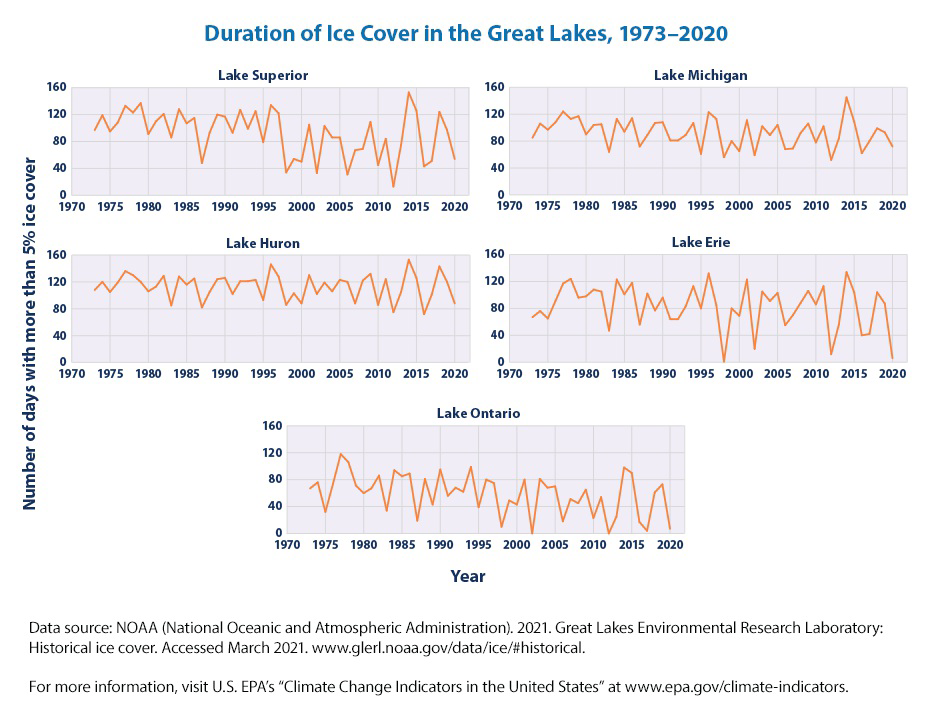
Since 1973, the number of frozen days (duration) on all five Great Lakes has declined. Ice duration on these lakes has decreased at rates ranging from approximately one-fifth of a day per year in Lake Huron to almost a full day per year in Lakes Ontario and Superior (see Figure 2). Overall, this means the Great Lakes are frozen for eight to 46 fewer days now than they were in the early 1970s. The decreases in Lakes Ontario and Superior are statistically significant.
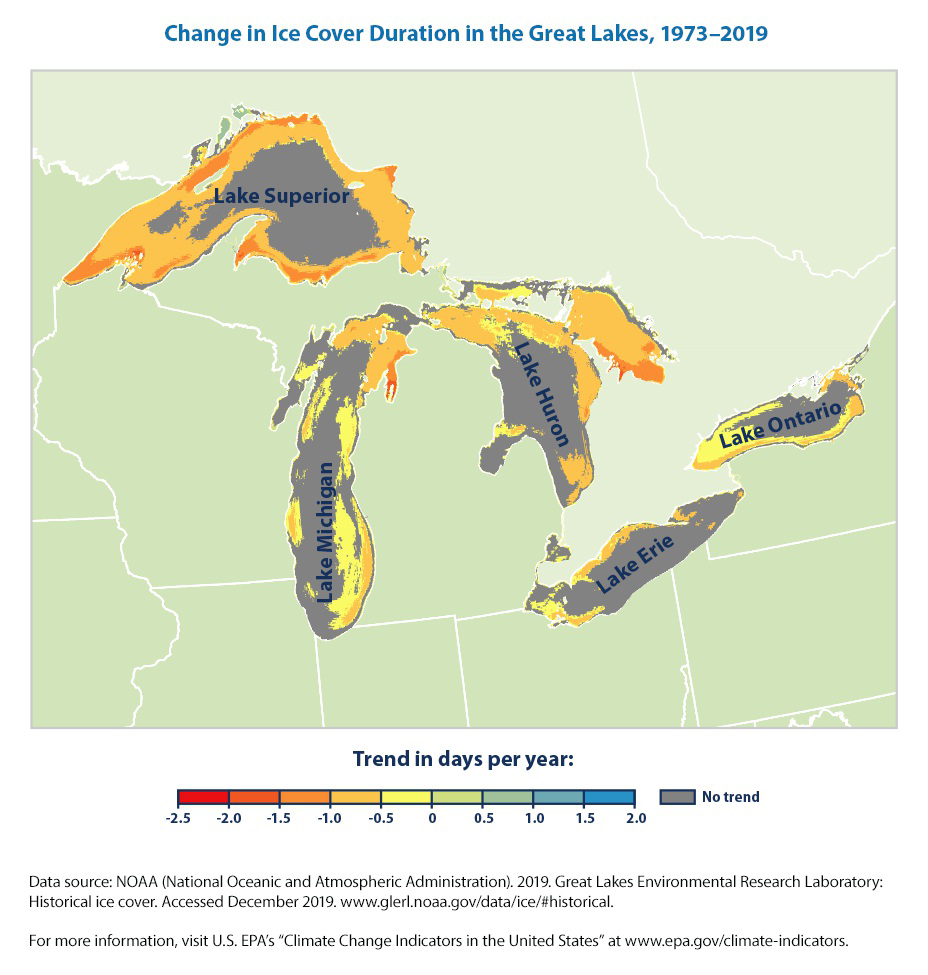
A detailed map (see Figure 3) shows that many areas of the Great Lakes have experienced significant decreases in ice cover duration, but other parts of the lakes have not changed significantly. Duration has decreased the most in areas near the shore.
Background
The Great Lakes - Lake Superior, Lake Michigan, Lake Huron, Lake Erie, and Lake Ontario - form the largest group of freshwater lakes on Earth. These lakes support a variety of ecosystems and play a vital role in the economy of the eight neighboring states and the Canadian province of Ontario, providing drinking water, shipping lanes, fisheries, recreational opportunities, and more.
Parts of the Great Lakes typically freeze every winter. As the Earth’s climate changes, though, rising air temperatures and water temperatures have led to less ice cover on many lakes in North America, including the Great Lakes. Ice cover is expected to decline further as the climate continues to warm.
The area that freezes and the length of time that the lakes remain frozen can have a wide range of effects on people and ecosystems. As with other lakes, ice cover on the Great Lakes can affect aquatic ecosystems, as well as recreational opportunities such as ice fishing. Due to the size of the Great Lakes, ice cover also plays an important role in regional weather patterns and the shipping industry. While reduced ice cover could lengthen the shipping season, it also allows more water to evaporate from the lakes, which can lead to lower water levels and restrict shipping channels. More evaporation can also lead to an increase in precipitation over nearby land, especially “lake effect” snow.
Graph of Information - Figure 1.
These graphs show the percentage of surface area in each of the Great Lakes that froze on the maximum day (the “most frozen” day) of each year since 1973. The graph at the lower right is an area-weighted average of all five lakes.
Graph of Information - Figure 2.
These graphs show the number of frozen days per year in each of the Great Lakes since 1973. A frozen day is defined here as a day when at least 5 percent of the lake’s surface area was covered with ice.
Graph of Information - Figure 3.
This map shows the average annual rate of change in the duration of ice cover in the Great Lakes from 1973 to 2019. Duration is measured as the number of days in which each pixel on the map was at least 10 percent covered by ice. Gray areas are labeled “no trend” because the change over time is not statistically significant (using a 90-percent confidence level).