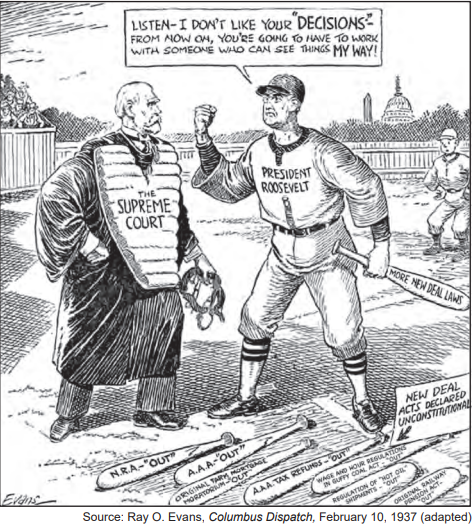
 What was the reason for president Franklin D. Roosevelt's reaction to the Supreme Court as shown in this cartoon?
What was the reason for president Franklin D. Roosevelt's reaction to the Supreme Court as shown in this cartoon?
Who succeeded Herbert Hoover as president of the United States in the 1932 election?
. . . So, first of all, let me assert my firm belief that the only thing we have to fear is fear itself—nameless, unreasoning, unjustified terror which paralyzes needed efforts to convert retreat into advance. In every dark hour of our national life a leadership of frankness and vigor has met with that understanding and support of the people themselves which is essential to victory. I am convinced that you will again give that support to leadership in these critical days. . . .
– President Franklin D. Roosevelt, First Inaugural Address, March 4, 1933
What issue is being addressed by President Franklin D. Roosevelt in this speech?
. . . So, first of all, let me assert my firm belief that the only thing we have to fear is fear itself—nameless, unreasoning, unjustified terror which paralyzes needed efforts to convert retreat into advance. In every dark hour of our national life a leadership of frankness and vigor has met with that understanding and support of the people themselves which is essential to victory. I am convinced that you will again give that support to leadership in these critical days. . . .
– President Franklin D. Roosevelt, First Inaugural Address, March 4, 1933
What program was created in response to this speech?
What was the goal of FDR’s fireside chats?
. . . Our greatest primary task is to put people to work. This is no unsolvable problem if we face it wisely and courageously. It can be accomplished in part by direct recruiting by the Government itself, treating the task as we would treat the emergency of a war, but at the same time, through this employment, accomplishing greatly needed projects to stimulate and reorganize the use of our natural resources. . . .
Finally, in our progress toward a resumption of work we require two safeguards against a return of the evils of the old order: there must be a strict supervision of all banking and credits and investments, so that there will be an end to speculation with other people’s money; and there must be provision for an adequate but sound currency. . . .
–President Franklin D. Roosevelt, First Inaugural Address, March 4, 1933
How did FDR attempt to accomplish the task he describes in this quote?
. . . Our greatest primary task is to put people to work. This is no unsolvable problem if we face it wisely and courageously. It can be accomplished in part by direct recruiting by the Government itself, treating the task as we would treat the emergency of a war, but at the same time, through this employment, accomplishing greatly needed projects to stimulate and reorganize the use of our natural resources. . . .
Finally, in our progress toward a resumption of work we require two safeguards against a return of the evils of the old order: there must be a strict supervision of all banking and credits and investments, so that there will be an end to speculation with other people’s money; and there must be provision for an adequate but sound currency. . . .
–President Franklin D. Roosevelt, First Inaugural Address, March 4, 1933
Which of the following New Deal programs met the need for "direct recruiting by the government...accomplishing greatly needed projects to stimulate and reorganize the use of our natural resources?" (pick 2)
. . . Our greatest primary task is to put people to work. This is no unsolvable problem if we face it wisely and courageously. It can be accomplished in part by direct recruiting by the Government itself, treating the task as we would treat the emergency of a war, but at the same time, through this employment, accomplishing greatly needed projects to stimulate and reorganize the use of our natural resources. . . .
Finally, in our progress toward a resumption of work we require two safeguards against a return of the evils of the old order: there must be a strict supervision of all banking and credits and investments, so that there will be an end to speculation with other people’s money; and there must be provision for an adequate but sound currency. . . .
–President Franklin D. Roosevelt, First Inaugural Address, March 4, 1933
Which of the following New Deal programs met the need for "a strict supervision of all banking?"
How did President Roosevelt change the role of the federal government during his first Hundred Days?
"Long ago we... said... that a single employee was helpless in dealing with an employer; that he was dependent... on his daily wage for the maintenance of himself and family; that, if the employer refused to pay him the wages that he thought fair, he was ... unable to leave the employ and resist arbitrary and unfair treatment; that union was essential to give laborers opportunity to deal on an equality with their employer."
-U.S. Supreme Court, 1937
Which of the following New Deal programs does the Supreme Court support in this quote?
Why did conflict develop between the Supreme Court and other branches of government over aspects of the New Deal?
Over what aspect of the New Deal did conservative and liberal critics differ?
What was the reason for president Franklin D. Roosevelt's reaction to the Supreme Court as shown in this cartoon?
Why did Roosevelt launch a second Hundred Days?
. . . This social security measure gives at least some protection to thirty millions of our citizens who will reap direct benefits through unemployment compensation, through old-age pensions and through increased services for the protection of children and the prevention of ill health. . . .
This law, too, represents a cornerstone in a structure which is being built but is by no means complete. It is a structure intended to lessen the force of possible future depressions. It will act as a protection to future Administrations against the necessity of going deeply into debt to furnish relief to the needy. The law will flatten out the peaks and valleys of deflation and of inflation. It is, in short, a law that will take care of human needs and at the same time provide the United States an economic structure of vastly greater soundness. . . .
– President Franklin D. Roosevelt, statement on signing the Social Security Act, August 14, 1935
According to president Roosevelt, a major purpose of the Social Security Administration was to...?
. . . This social security measure gives at least some protection to thirty millions of our citizens who will reap direct benefits through unemployment compensation, through old-age pensions and through increased services for the protection of children and the prevention of ill health. . . .
This law, too, represents a cornerstone in a structure which is being built but is by no means complete. It is a structure intended to lessen the force of possible future depressions. It will act as a protection to future Administrations against the necessity of going deeply into debt to furnish relief to the needy. The law will flatten out the peaks and valleys of deflation and of inflation. It is, in short, a law that will take care of human needs and at the same time provide the United States an economic structure of vastly greater soundness. . . .
– President Franklin D. Roosevelt, statement on signing the Social Security Act, August 14, 1935
By signing the Social Security Act into law, president Roosevelt would be keeping his promise that the federal government would...?
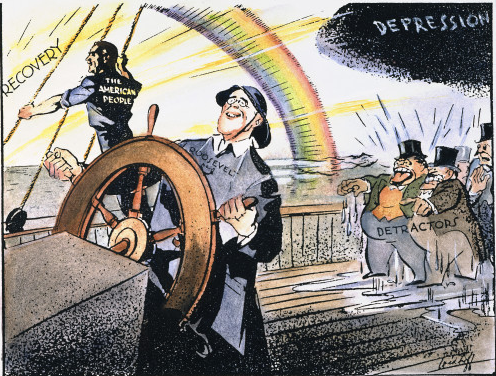 What interpretation of Roosevelt’s leadership is most strongly conveyed by this cartoon?
The presence of “detractors” in the cartoon reflects which reality of New Deal policies?
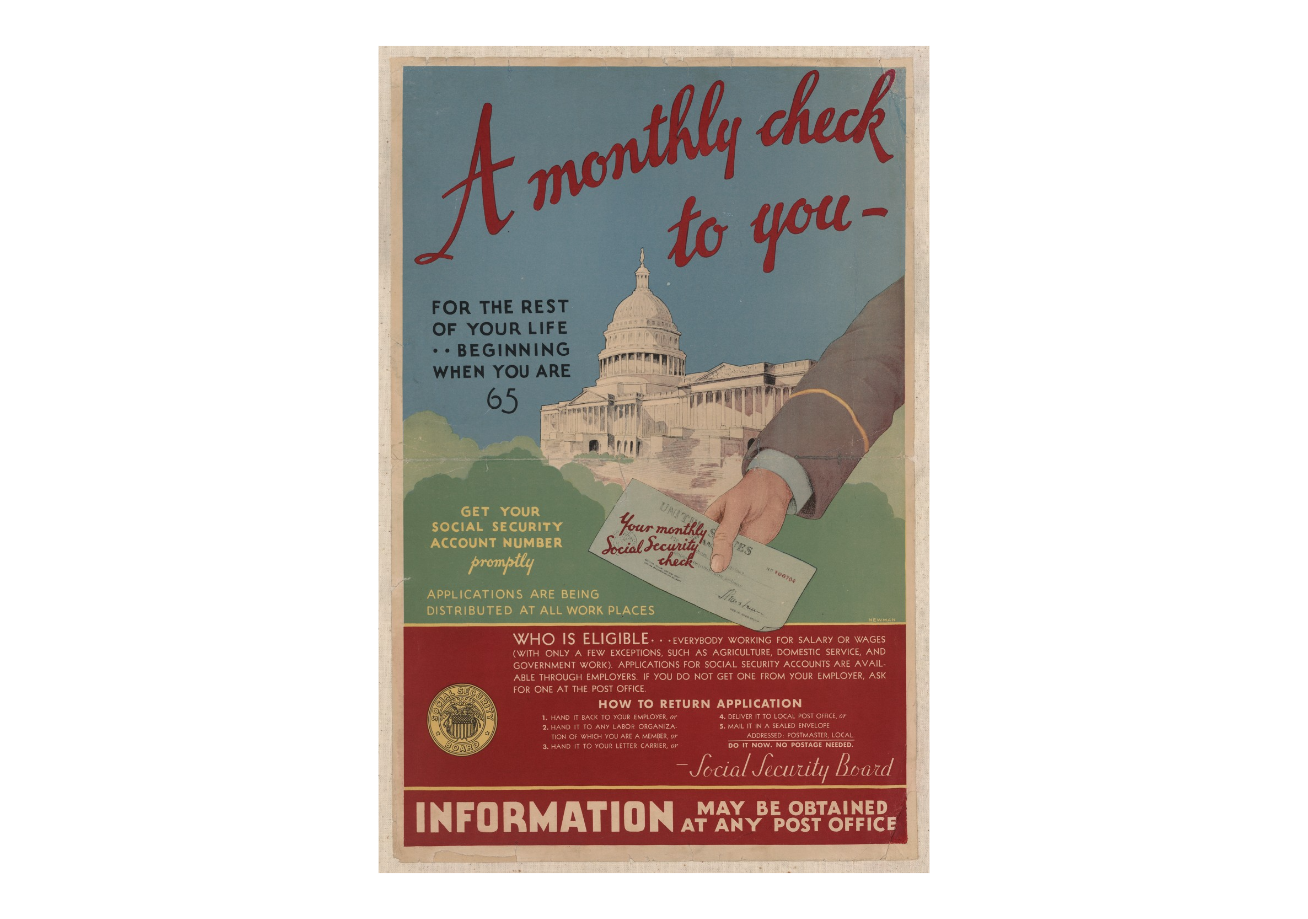 This poster suggests that Social Security aimed to address which economic problem?
Liberal critics of the New Deal made the argument that...
Conservative critics of the New Deal made the argument that...
Which of the following led to the end of the Great Depression?