Antarctic Sea Ice
Key Points
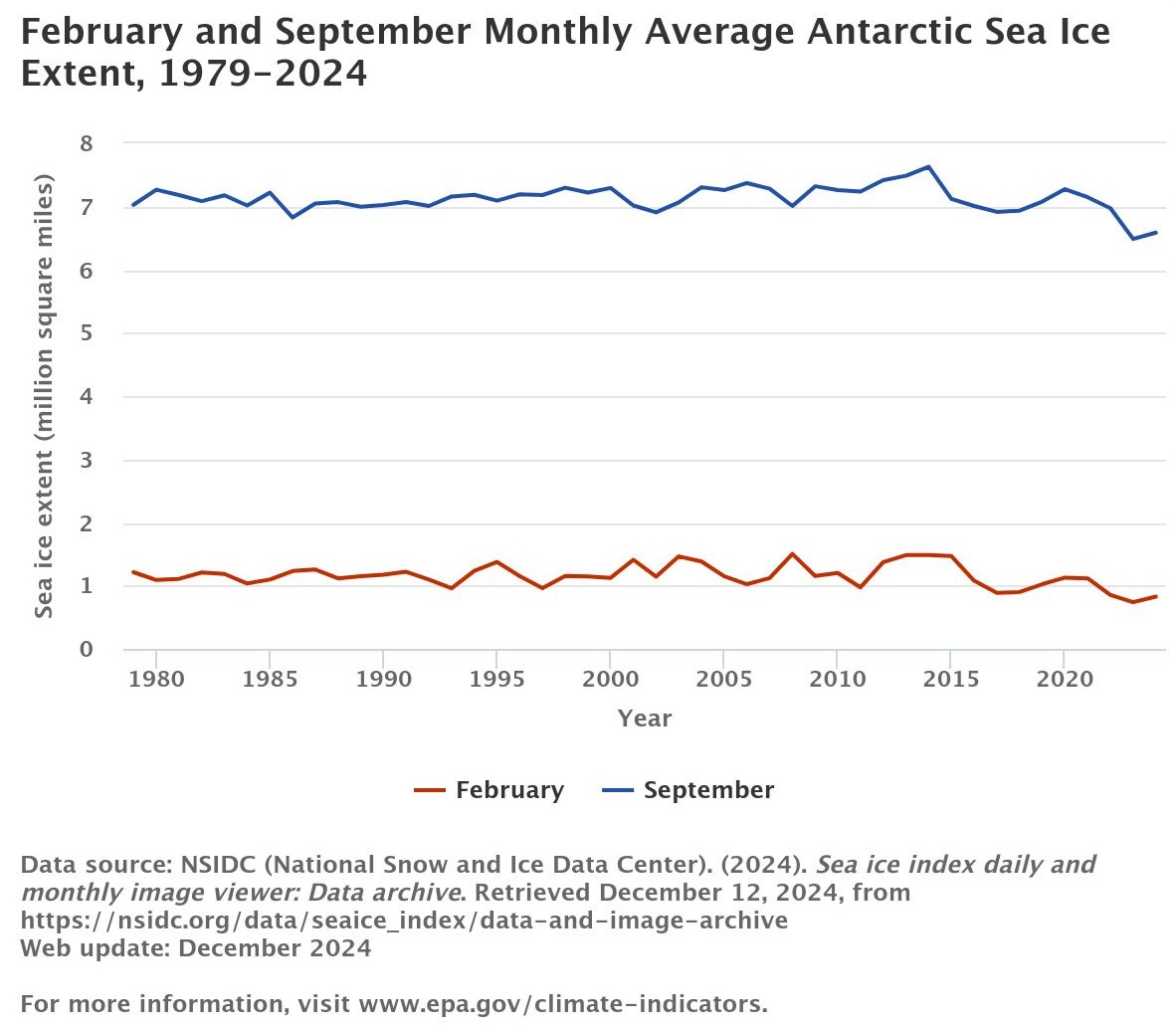
Antarctic sea ice extent in September and February increased slightly over much of the period shown in Figure 1, but decreased in the last few years. The most recent measurements for September and February have been mostly below average (see Figure 1).
The September maximum extent reached the lowest level on record in 2023, followed by 2024 and 1986; the highest level was in 2014. The February minimum extent reached a record low in 2023, followed by 2024 and 2022 (see Figure 1).
Observed changes in Antarctic sea ice are small in comparison to the amount of sea ice that the Arctic has lost during the same period. Worldwide, the Earth lost sea ice at an average rate of 13,500 square miles per year from 1979 to 2014 - equivalent to losing an area larger than the state of Maryland every year - and EPA’s indicators show that net loss has continued since then. This decrease affects the Earth’s energy balance.
Background
The Southern Ocean around Antarctica freezes to form sea ice every year. This sea ice typically reaches its maximum extent in September or early October, around the end of winter in the Southern Hemisphere. At that point, virtually the entire continent of Antarctica is surrounded by a ring of sea ice (see the following images). The ice melts in the summer months (December to February) because of warmer temperatures and long hours of sunlight. Unlike the Arctic, where a large area of sea ice lasts year-round, the sea ice around Antarctica is thinner and nearly all of it melts in a typical summer. This happens because no landmass is present to stop Antarctic sea ice from breaking up and drifting northward into warmer waters, where it eventually melts.
Like Arctic sea ice, Antarctic sea ice affects global climate, regional climate, and ecosystems. Because ice is more reflective than liquid water, it plays a significant role in maintaining the Earth’s energy balance and helping to keep polar regions cool. Sea ice also keeps the air cool by forming a barrier between the cold air above and the warmer water below. Antarctic sea ice is an important part of the habitat for penguins, seals, and other animals.
Warmer air and ocean temperatures are generally expected to reduce the amount of sea ice present worldwide. While warming has already driven a noticeable decline in sea ice in the Arctic, extent in the Antarctic as a whole has not yet shown a long-term decline, which may reflect influences of wind patterns, ocean currents, and precipitation around the continent.
Graph of Information - Figure 1.
This figure shows Antarctic sea ice extent for the months of February and September of each year from 1979 through 2024. The minimum and maximum sea ice extent typically occur in February and September each year.