Lake Ice
Key Points
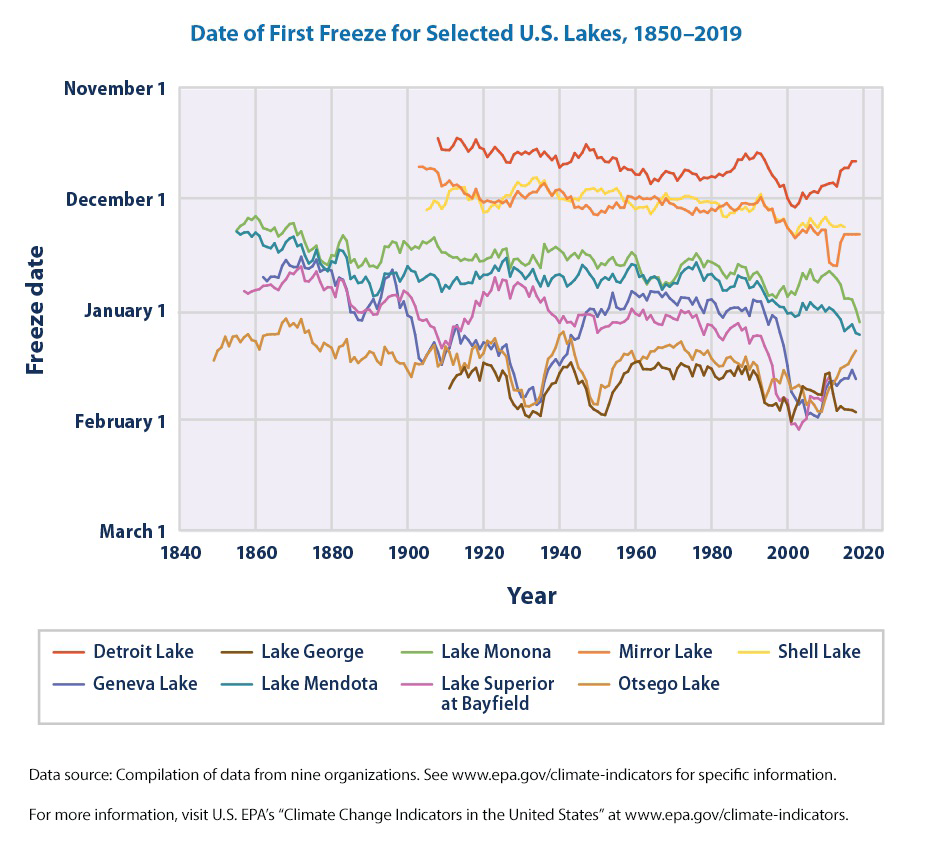
The lakes covered by this indicator are generally freezing later than they did in the past. Freeze dates have shifted later at a rate of roughly half a day to one-and-a-half days per decade (see Figure 1).
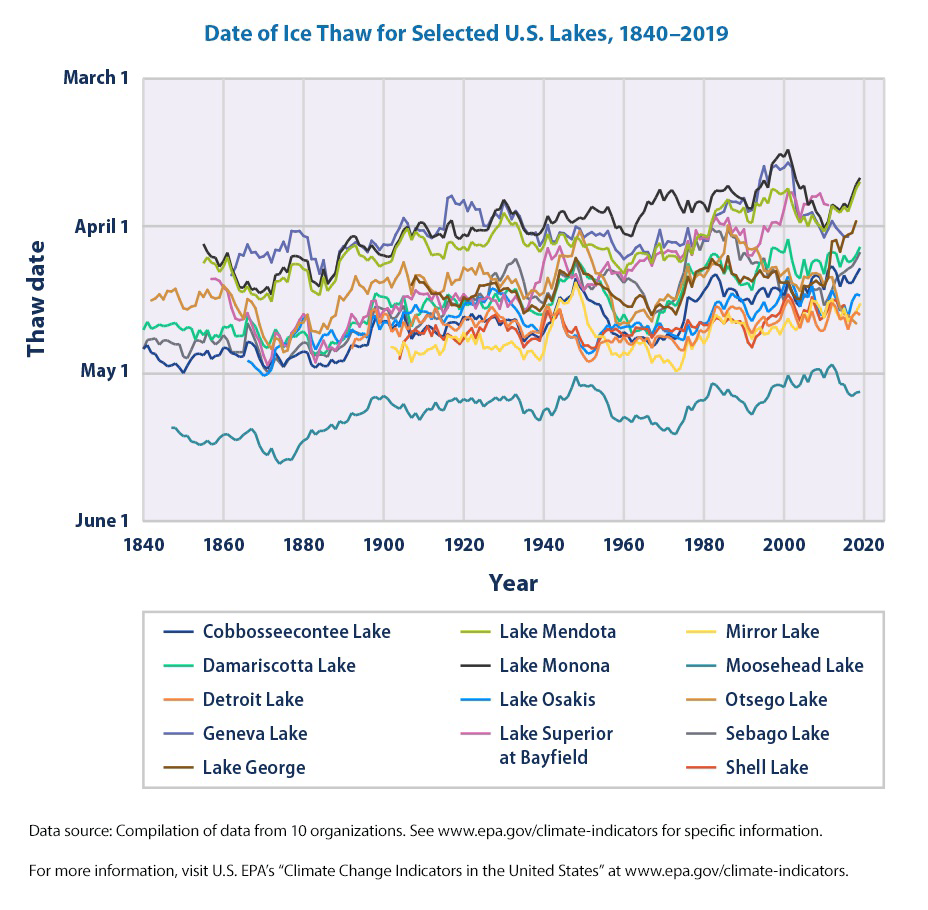
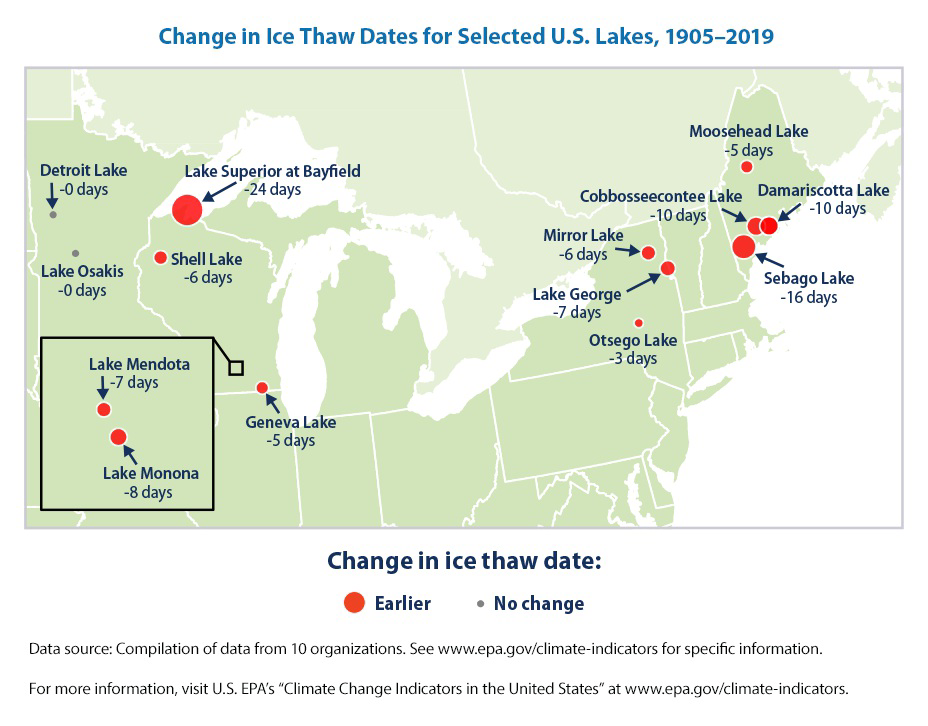
Thaw dates for most of these lakes show a trend toward earlier ice breakup in the spring (see Figure 2). Spring thaw dates have grown earlier by up to 24 days since 1905 (see Figure 3). Nearly all of these lakes were found to be thawing earlier in the year.
The changes in lake freeze and thaw dates shown here are consistent with other studies. For example, long-term ice data from lakes and rivers throughout the Northern Hemisphere reveal that since the mid-1800s, freeze dates have occurred later and thaw dates have occurred earlier, both shifting at an average rate of 0.8 days to one day per decade.
Background
The formation of ice cover on lakes in the winter and its disappearance the following spring depends on climate factors such as air temperature, cloud cover, and wind. Conditions such as heavy rains or snowmelt in locations upstream or elsewhere in the watershed also affect the length of time a lake is frozen. Thus, ice formation and breakup dates are key indicators of climate change. If lakes remain frozen for longer periods, it can signify that the climate is cooling. Conversely, shorter periods of ice cover suggest a warming climate.
Changes in ice cover can affect the physical, chemical, and biological characteristics of a body of water. For example, ice influences heat and moisture transfers between a lake and the atmosphere. Reduced lake ice cover leads to increased evaporation and lower water levels, as well as an increase in water temperature and sunlight penetration. These changes, in turn, can affect plant and animal life cycles and the availability of suitable habitat. Additionally, ice cover affects the amount of heat that is reflected from the Earth’s surface. Exposed water will absorb and retain heat, making the Earth’s surface warmer, whereas an ice- and snow-covered lake will reflect more of the sun’s energy and absorb less.
The timing and duration of ice cover on lakes and other bodies of water can also affect society - particularly in relation to shipping and transportation, hydroelectric power generation, and fishing. The impacts can be positive or negative. For example, reduced ice cover on a large lake could extend the open-water shipping season but require vessels to reduce their cargo capacity, as increased evaporation leads to lower water levels.
Graph of Information - Figure 1.
This figure shows the “ice-on” date, or date of first freeze, for nine U.S. lakes. The data are available from as early as 1850 to 2019, depending on the lake, and have been smoothed using a nine-year moving average.
Graph of Information - Figure 2.
This figure shows the “ice-off” date, or date of ice thawing and breakup, for 14 U.S. lakes. The data are available from as early as 1840 to 2019, depending on the lake, and have been smoothed using a nine-year moving average.
Graph of Information - Figure 3.
This figure shows the change in the “ice-off” date, or date of ice thawing and breakup, for 14 U.S. lakes during the period from 1905 to 2019. Twelve of the lakes have red circles with negative numbers, which represent earlier thaw dates. Larger circles indicate larger changes. Two of the lakes had no change in thaw dates.
Change in ice thaw date:
Earlier (red circle) • No change (blue circle)