Directions: Use the information provided and your knowledge of Earth and Space Sciences to answer the following questions. Show all work where necessary.
Graph of Information - Figure 1.
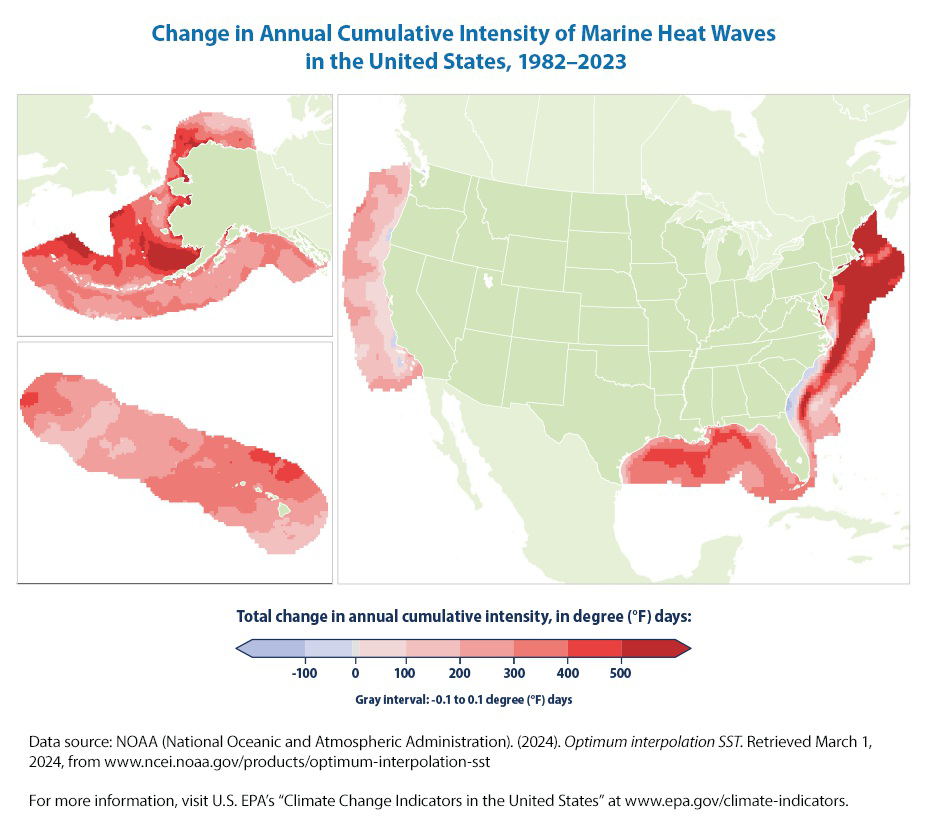
This map shows the change in annual cumulative intensity of marine heat waves along U.S. coasts from 1982 to 2023. Cumulative intensity is measured in degree days - marine heat wave intensity multiplied by duration. Areas with increases are shown in red, with darker colors indicating greater change. The map shows total change, which is the annual rate of change (trend slope) multiplied by the number of years analyzed. The boundaries include the area within the U.S. exclusive economic zone.

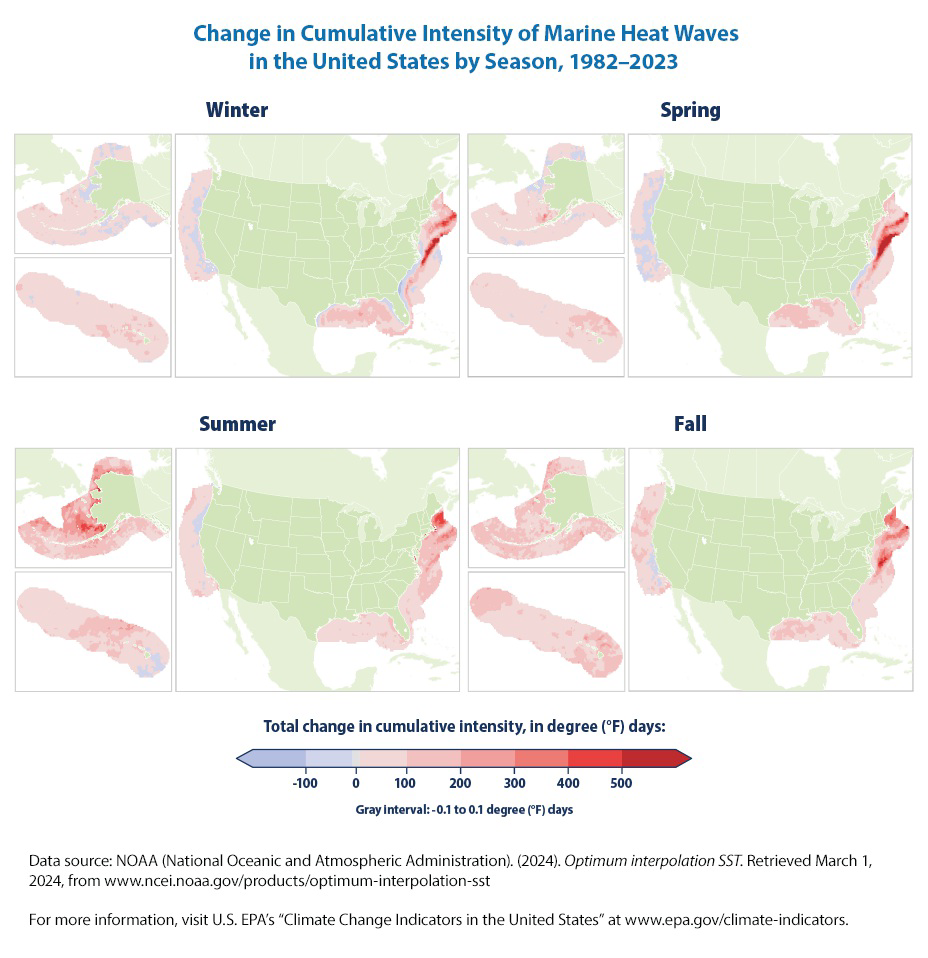
Over the period shown (1982–2023), the annual cumulative intensity of marine heat waves has increased in most coastal U.S. waters, with the largest changes in waters off the northeastern U.S. and Alaskan coasts (Figure 1). Changes were particularly pronounced in the spring in the Northeast and the summer in Alaska (Figure 2).
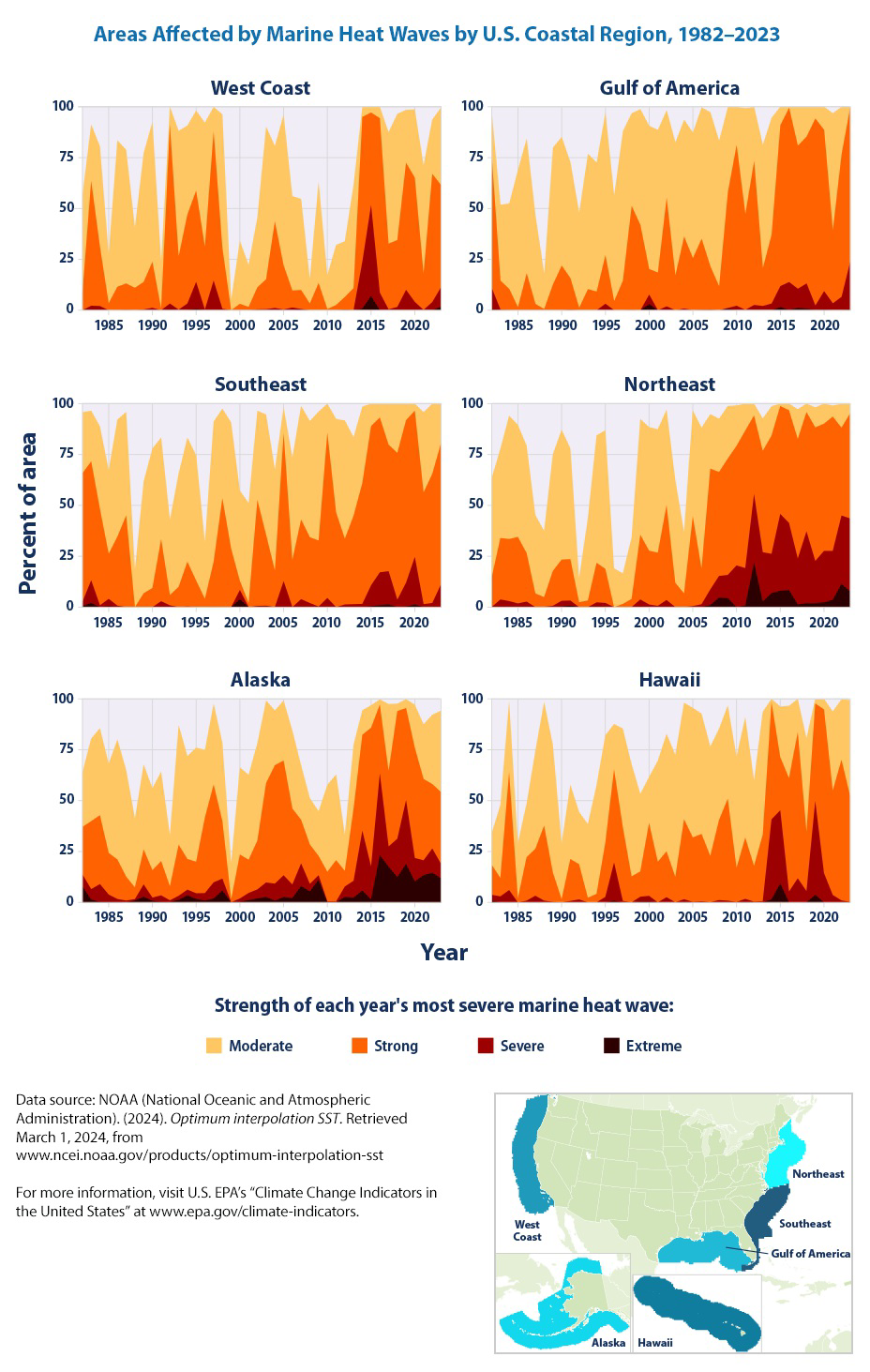
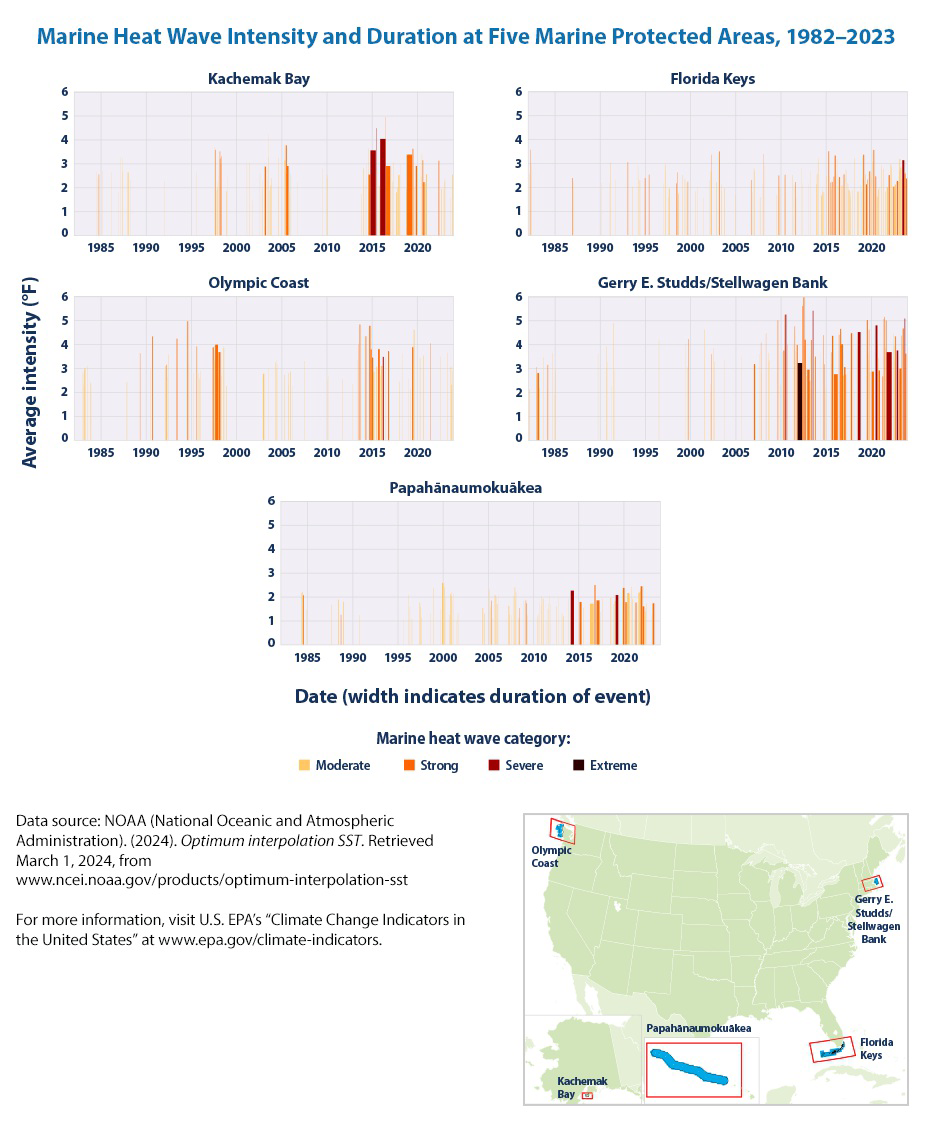
Marine heat wave events have become more widespread and more severe in most U.S. coastal regions in recent years (Figure 3). Region-wide changes in the Northeast and Alaska are particularly evident, as are the location-specific changes in frequency, duration, and intensity at marine protected areas in the Northeast, Alaska, and Hawaii (Figure 4).
Temperature is an important physical characteristic of ocean water. As the Sea Surface Temperature indicator explains, the range of temperature conditions plays an important role in determining what species of plants, animals, and microbes can survive or thrive in a particular area. Long-term changes in these temperature ranges can affect ecological communities by shifting species’ geographic distribution, influencing migration and breeding patterns, and ultimately altering habitat and the movement of nutrients.
Short-term spikes in temperature also pose a concern. Just like heat waves based on air temperature, marine heat waves are an extreme condition that can severely disrupt marine life. This disruption can cause harm as ocean creatures - particularly those that are stationary, like corals - are not able to escape waters that become too warm to tolerate for an extended period. Marine heat waves are associated with some of the largest disruptions to marine life in recent years. For example, persistent marine heat wave conditions in the northern Pacific have fed harmful algal blooms that then led to closures in the Dungeness crab fishery and deaths of sea lions.
Daily, weekly, and seasonal variation in sea surface temperature is natural. Ocean temperatures can also vary year to year, due to multi-year cycles such as the El Niño–Southern Oscillation. As ocean waters become warmer overall, though, marine heat waves will become more common and more extreme.
Explain one ecological impact and one human impact of marine heat waves. Connect both to the role of rising ocean temperatures.
According to Figure 1, which U.S. coastal region experienced the greatest change in annual cumulative intensity of marine heat waves (1982–2023)?
Graph of Information - Figure 2.
This set of maps shows the change in cumulative intensity of marine heat waves along U.S. coasts from 1982 to 2023 by season. The calculation approach and geographic area are the same as in Figure 1. Seasons are defined as follows: December, January, and February for winter; March, April, and May for spring; June, July, and August for summer; and September, October, and November for fall.

Using Figure 2, explain how seasonal marine heat wave intensity varies between the Northeast and Alaska. Provide one specific difference.
Graph of Information - Figure 3.
These graphs show the percentage of each coastal region’s area that experienced at least one marine heat wave in a given year. The stacked segments show severity levels for the most severe heat wave at a location, while the total height of the stack represents the total area that experienced a marine heat wave of any severity. For example, in 2023, 100 percent of the Northeast region experienced at least one heat wave of moderate severity or higher, while 35 percent of the region’s area experienced at least one severe heat wave and 8 percent experienced an extreme heat wave. Data are broken into six regions whose boundaries include the area within the U.S. exclusive economic zone.

According to Figure 3, which coastal region has had years where 100% of its area experienced at least one marine heat wave?
Graph of Information - Figure 4.
These graphs show a timeline of marine heat wave events for five marine protected areas selected from different parts of the U.S. coastline. The columns in each graph show each individual event’s duration (width of the column), intensity (height), and severity level (color; see definitions in the technical documentation). The distribution of vertical columns reflects the frequency of heat waves. The small map to the right shows the areas analyzed (blue).

Using Figure 4, describe which marine protected area shows the most severe and frequent marine heat wave events. Why might this be especially concerning for marine ecosystems?
Which ecological impact is directly associated with marine heat waves?