Snow Cover
Key Points
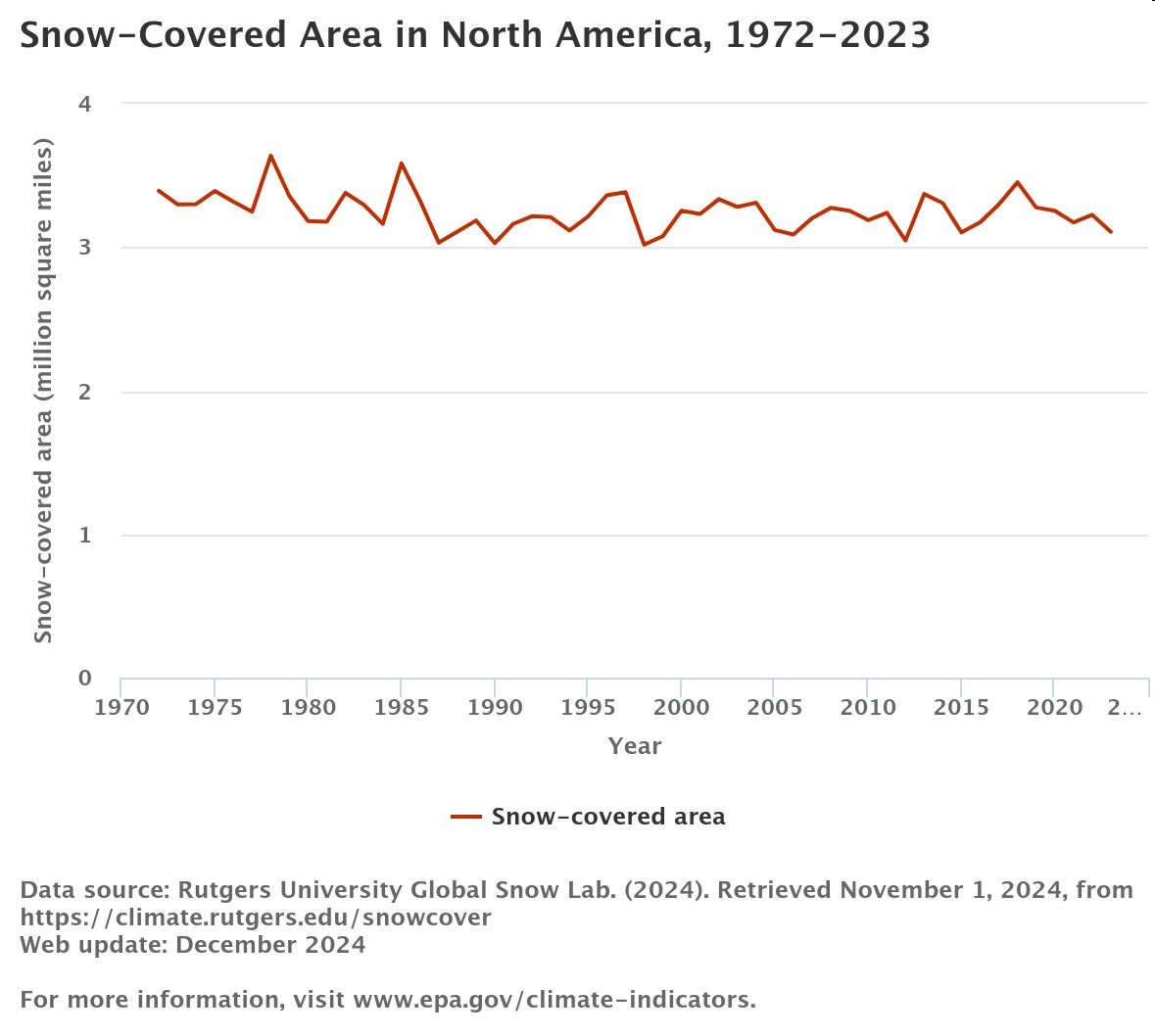
When averaged over the entire year, snow covered an average of 3.25 million square miles of North America during the period from 1972 to 2023 (see Figure 1).
The extent of snow cover has varied from year to year. The average area covered by snow has ranged from 3.0 million to 3.6 million square miles, with the minimum value occurring in 1998 and the maximum in 1978 (see Figure 1).
Between 1972 and 2023, the average extent of North American snow cover decreased at a rate of about 2,083 square miles per year. The annual average area covered by snow during the most recent decade (2014–2023) was 3.25 million square miles, which is about 3 percent smaller than the annual average extent during the first 10 years of measurement (1972–1981) - a difference of 92,925 square miles, or an area slightly smaller than the size of Michigan (see Figure 1).
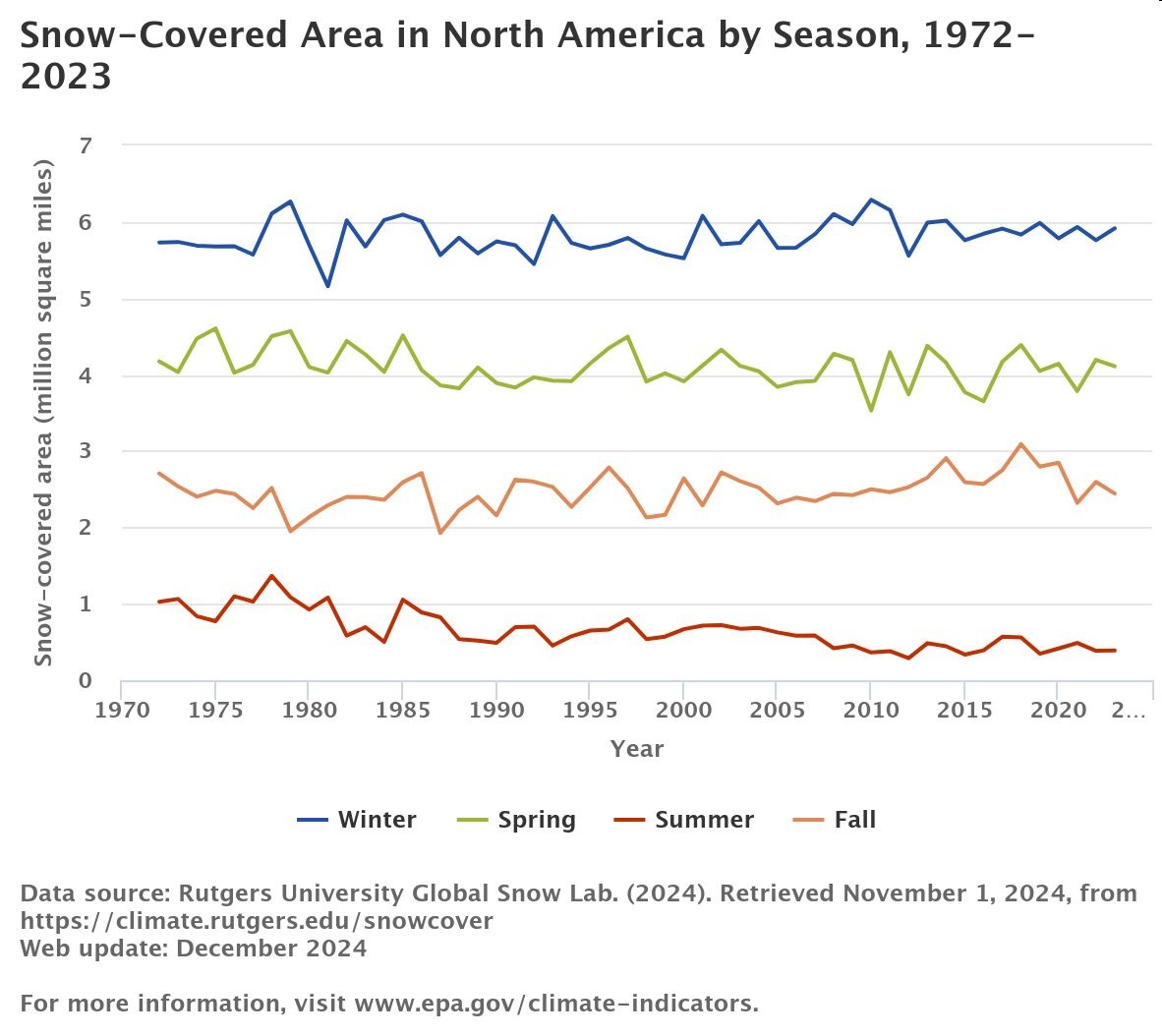
Decreases in snow cover have largely occurred in spring and summer, whereas winter snow cover has remained fairly steady over the time period studied and fall snow cover has increased (see Figure 2).
Spring and summer snow cover can have a particularly important influence on water supplies.
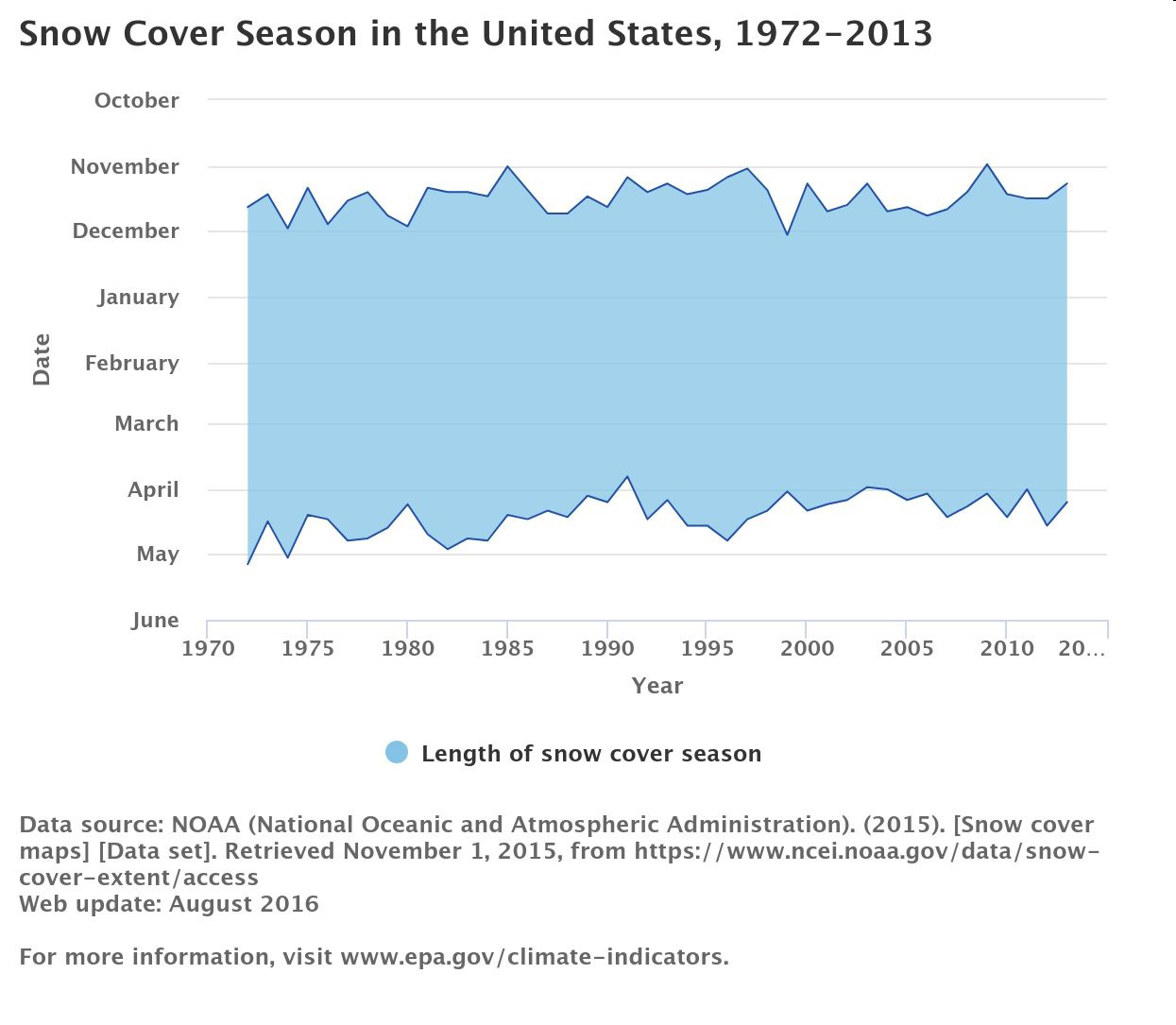
Between 1972 and 2013, the U.S. snow cover season became shorter by nearly two weeks, on average (see Figure 3). By far the largest change has taken place in the spring, with the last day of snow shifting earlier by 19 days since 1972. In contrast, the first date of snow cover in the fall has remained relatively unchanged.
Background
“Snow cover” refers to the amount of land covered by snow at any given time. Naturally, it is influenced by the amount of precipitation that falls as snow. Air temperature also plays a role because it determines whether precipitation falls as snow or rain, and it affects the rate at which snow on the ground melts. As temperature and precipitation patterns change, so can the overall area covered by snow.
Snow cover is not just something that is affected by climate change; it also exerts an influence on climate. Because snow is white, it absorbs only a small portion of the sunlight that hits it (10 to 20 percent in the case of fresh snow) and reflects the rest back to space. In contrast, darker surfaces such as bare ground and open water absorb the majority of the energy they receive and heat up more quickly. In this way, the overall amount of snow cover affects patterns of heating and cooling over the Earth’s surface. More snow means more energy reflects back to space, resulting in cooling, while less snow cover means more energy is absorbed at the Earth’s surface, resulting in warming.
On a more local scale, snow cover is important for many plants and animals. For example, some plants and animals rely on a protective blanket of snow to insulate them from sub-freezing winter temperatures. Humans and ecosystems also rely on snowmelt to replenish streams and groundwater. Snow cover also keeps the soil moist, so if the snow melts away earlier in the spring, the soil may dry out sooner, which can stress plants and increase the risk of wildfire.
Graph of Information - Figure 1.
This graph shows the average area covered by snow in a given calendar year, based on an analysis of weekly maps. The area is measured in square miles. These data cover all of North America (not including Greenland).
Graph of Information - Figure 2.
This graph shows the average area covered by snow during spring (March–May), summer (June–August), fall (September–November), and winter (December–February), based on an analysis of weekly maps. The area is measured in square miles. These data cover all of North America (not including Greenland).
Graph of Information - Figure 3.
This figure shows the timing of each year’s snow cover season in the contiguous 48 states and Alaska, based on an average of all parts of the country that receive snow every year. The shaded band spans from the first date of snow cover until the last date of snow cover.