Ice Breakup on Three Alaskan Rivers
Key Points
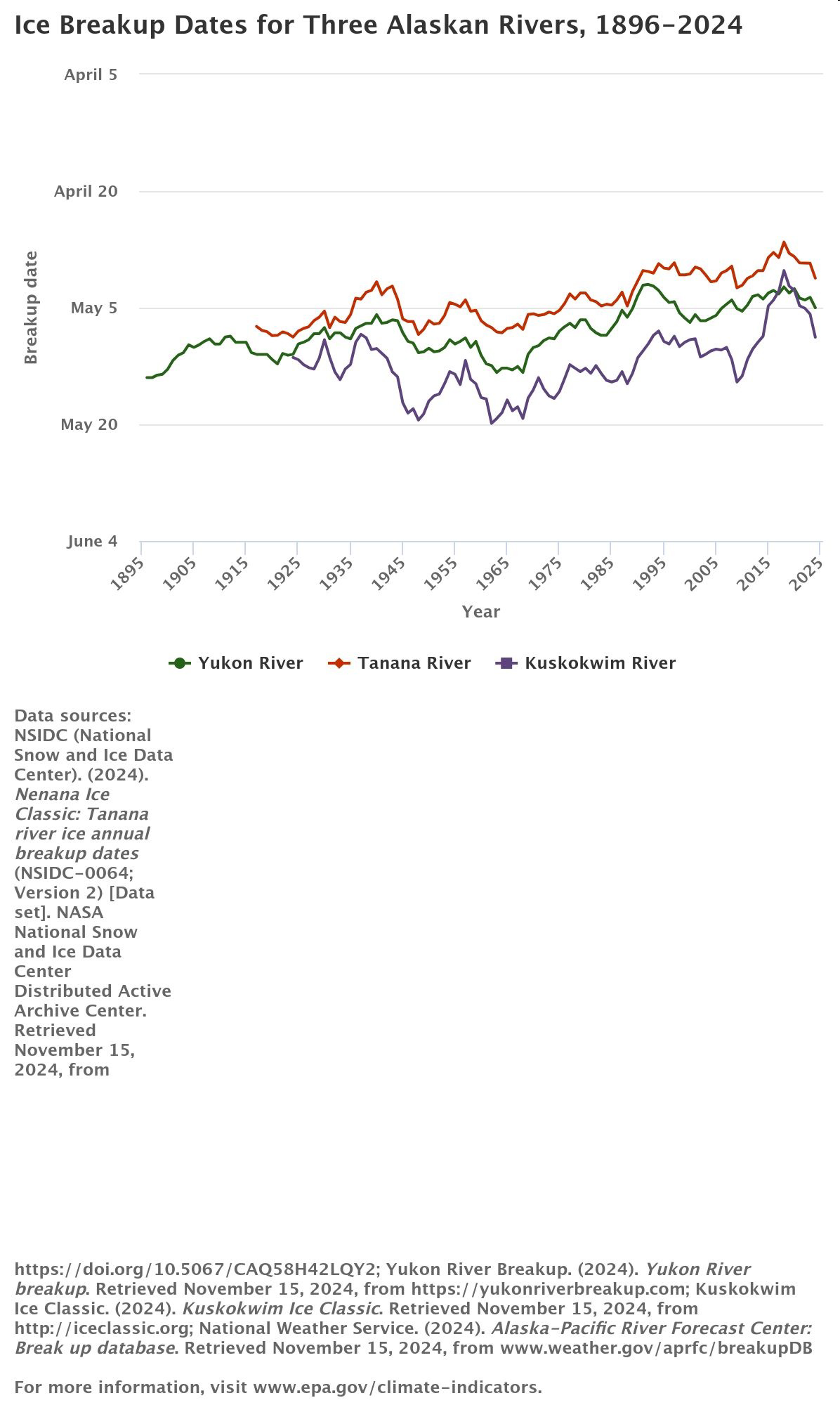
The Tanana, Yukon, and Kuskokwim rivers all demonstrate long-term trends toward earlier ice breakup in the spring. The ice breakup dates for all three rivers have shifted earlier by seven to nine days over their respective periods of record.
At all three locations, the earliest breakup dates on record have occurred within the past six years.
Despite the overall trend toward earlier breakup, most of the recent breakup dates for the rivers are within the range of historical variation.
Background
Regions in the far north such as Alaska are warming more quickly than other parts of the world, and this pattern is expected to continue. The Tanana, Yukon, and Kuskokwim rivers in Alaska provide a particularly noteworthy record of northern climate. For a century or more, local citizens have recorded the date when the ice on these rivers starts to move or break up each spring. In fact, some towns have annual competitions to guess when ice breakup will occur.
Since 1917, the Nenana Ice Classic competition on the Tanana River in central Alaska has paid several million dollars in winnings to the people who come closest to guessing the exact date and time of day when the river ice will break up. Similar traditions exist on the Kuskokwim River in Bethel, where breakup dates have been recorded since 1924, and in Dawson City on the Yukon River, just across the border in Canada, where breakup dates have been recorded since 1896.
River ice breakup is more than just a friendly competition, though. Ice breakup is an important time of transition for communities that rely on these relatively remote and free-flowing wild rivers for transportation, subsistence hunting and fishing, and other needs. In addition, early thawing can lead to severe ice movement, jamming, damage to infrastructure, and destructive floods.
The data collected by these communities highlight how the river ice breakup dates in Nenana, Dawson City, and Bethel have changed over time. The towns all use the same method to measure the date and time of river ice breakup. Residents place a tripod on the ice in the center of the river. This tripod is attached by a cable to a clock on the shore. When the ice under the tripod breaks or starts to move, the tripod moves, pulling the cable and stopping the clock.
Graph of Information - Figure 1.
This figure shows the date each year when ice breaks up at three locations: the town of Nenana on the Tanana River, Dawson City on the Yukon River, and Bethel on the Kuskokwim River. The annual data for each river have been plotted using a nine-year moving average.