Ocean Acidity
Key Points
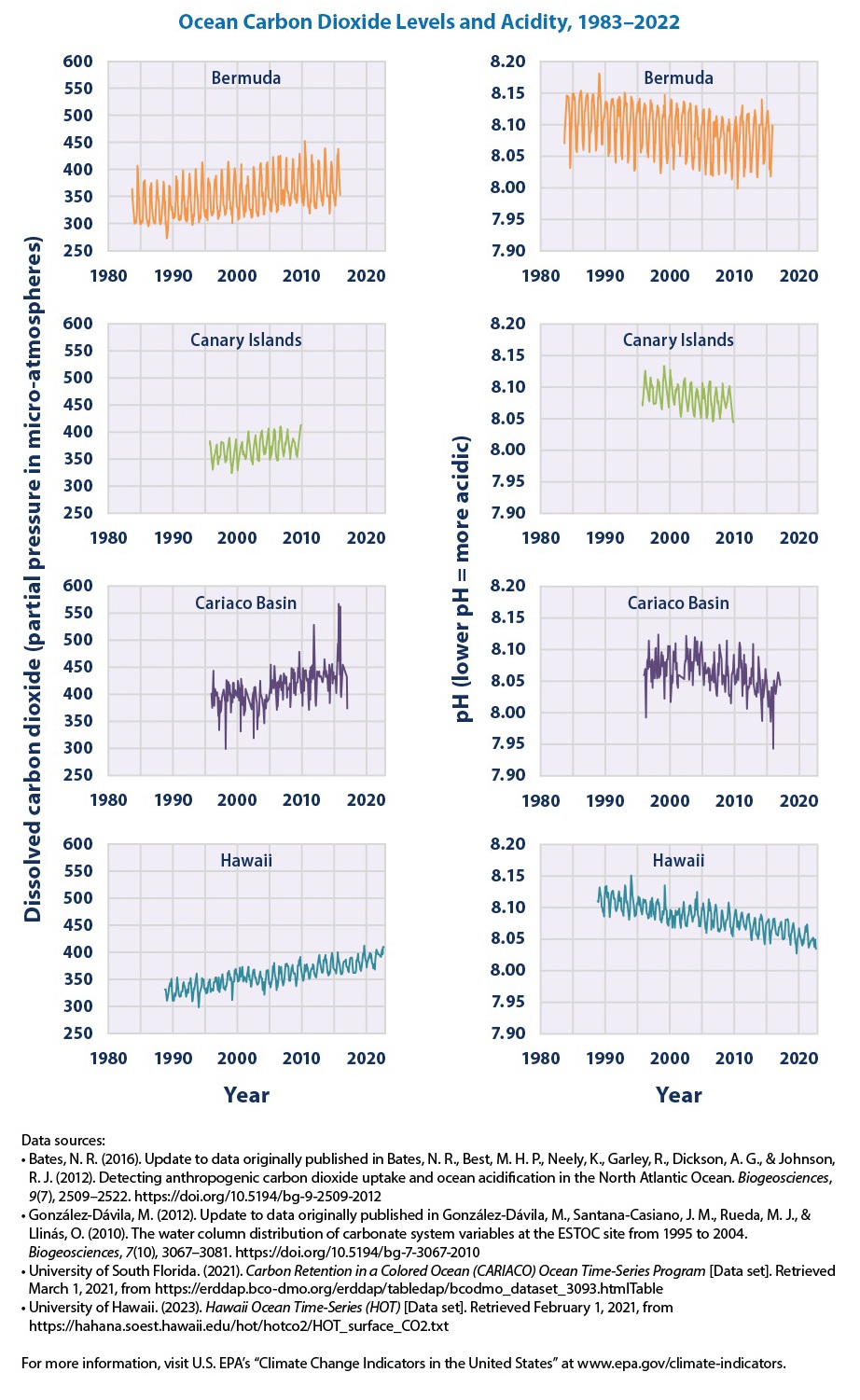
Measurements made over the last few decades have demonstrated that ocean carbon dioxide levels have risen in response to increased carbon dioxide in the atmosphere, leading to an increase in acidity (that is, a decrease in pH) (Figure 1).
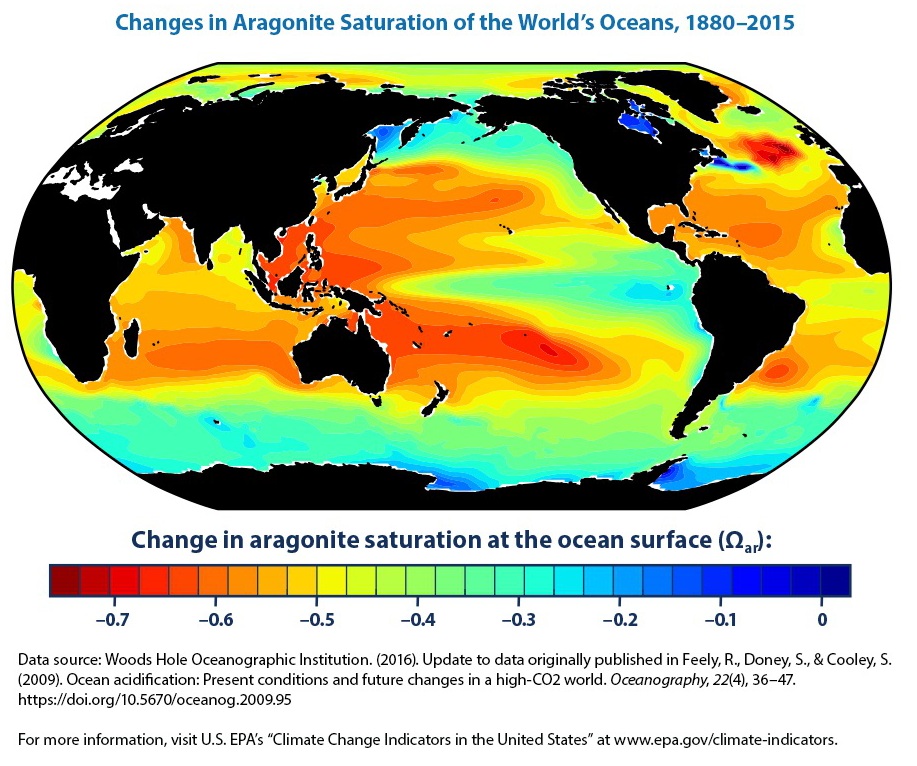
Historical modeling suggests that since the 1880s, increased carbon dioxide has led to lower aragonite saturation levels in the oceans around the world, which makes it more difficult for certain organisms to build and maintain their skeletons and shells (Figure 2).
The largest decreases in aragonite saturation have occurred in tropical waters (Figure 2); however, decreases in cold areas may be of greater concern because colder waters typically have lower aragonite saturation levels to begin with.
Background
The ocean plays an important role in regulating the amount of carbon dioxide in the atmosphere. As atmospheric concentrations of carbon dioxide rise, the ocean absorbs more carbon dioxide. Because of the slow mixing time between surface waters and deeper waters, it can take hundreds to thousands of years to establish this balance. From 1750 to 2019, oceans absorbed about 25 percent of the carbon dioxide emitted into the atmosphere by human activities, according to data in the IPCC Sixth Assessment Report (total human emissions of $685 \pm 75$ PgC and ocean uptake of $170 \pm 20$ PgC).
Although the ocean’s ability to take up carbon dioxide prevents atmospheric levels from climbing even higher, rising levels of carbon dioxide dissolved in the ocean can have a negative effect on some marine life. Carbon dioxide reacts with sea water to produce carbonic acid. The resulting increase in acidity (measured by lower pH values) changes the balance of minerals in the water. This makes it more difficult for corals, some types of plankton, and other creatures to produce a mineral called calcium carbonate, which is the main ingredient in their hard skeletons or shells. Thus, declining pH can make it more difficult for these animals to thrive. This can lead to broader changes in the overall structure of ocean and coastal ecosystems, and can ultimately affect fish and shellfish populations and the people, communities, or Tribes who depend on them for jobs or subsistence.
While changes in ocean pH and mineral saturation caused by the uptake of atmospheric carbon dioxide generally occur over many decades, these properties can fluctuate over shorter periods, especially in coastal and surface waters. For example, increased photosynthesis during the day and during the summer leads to natural fluctuations in pH. Acidity also varies with water temperature.
Graph of Information - Figure 1.
This figure shows the relationship between changes in ocean carbon dioxide levels (measured in the left column as a partial pressure - a common way of measuring the amount of a gas) and acidity (measured as pH in the right column). The data come from two observation stations in the North Atlantic Ocean (Bermuda and Canary Islands), one in the Caribbean Sea (Cariaco), and one in the Pacific (Hawaii). The up-and-down pattern shows the influence of seasonal variations.
Graph of Information - Figure 2.
This map shows changes in the aragonite saturation level of ocean surface waters between the 1880s and the most recent decade (2006–2015). Aragonite is a form of calcium carbonate that many marine animals use to build their skeletons and shells. The lower the saturation level, the more difficult it is for organisms to build and maintain their skeletons and shells. A negative change represents a decrease in saturation.
Graph of Information - Figure 3.
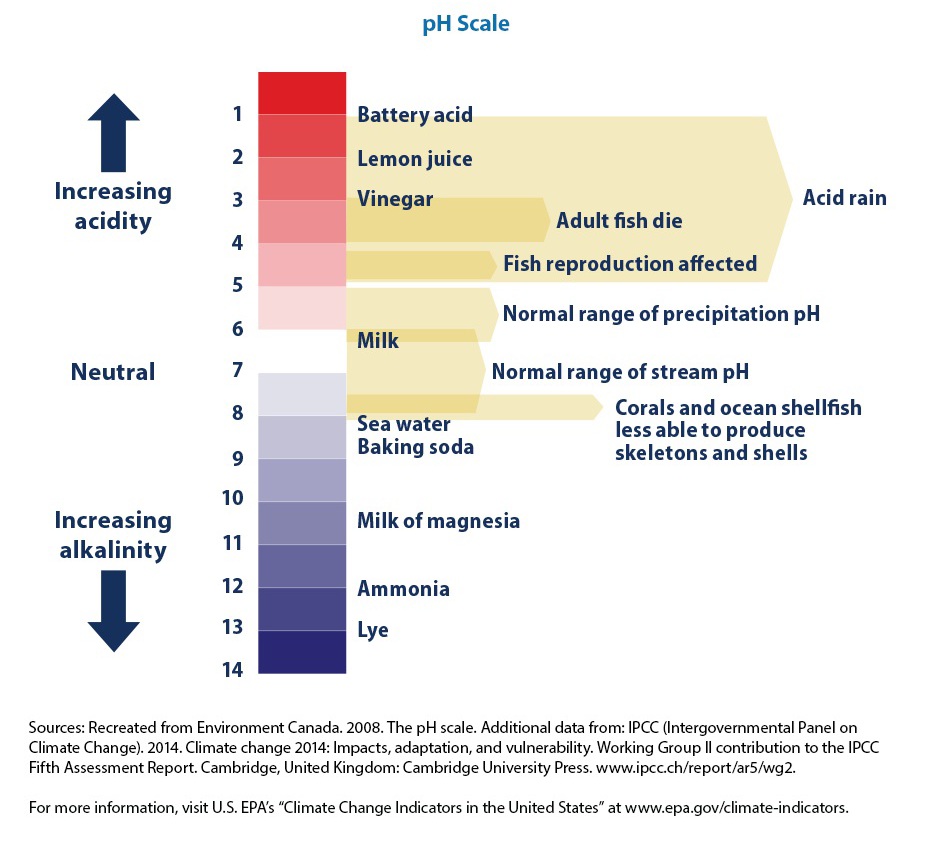
Acidity is commonly measured using the pH scale. Pure water has a pH of about 7, which is considered neutral. A substance with a pH less than 7 is considered to be acidic, while a substance with a pH greater than 7 is considered to be basic or alkaline. The lower the pH, the more acidic the substance. Like the well-known Richter scale for measuring earthquakes, the pH scale is based on powers of 10, which means a substance with a pH of 3 is 10 times more acidic than a substance with a pH of 4.