Ocean Heat
Key Points
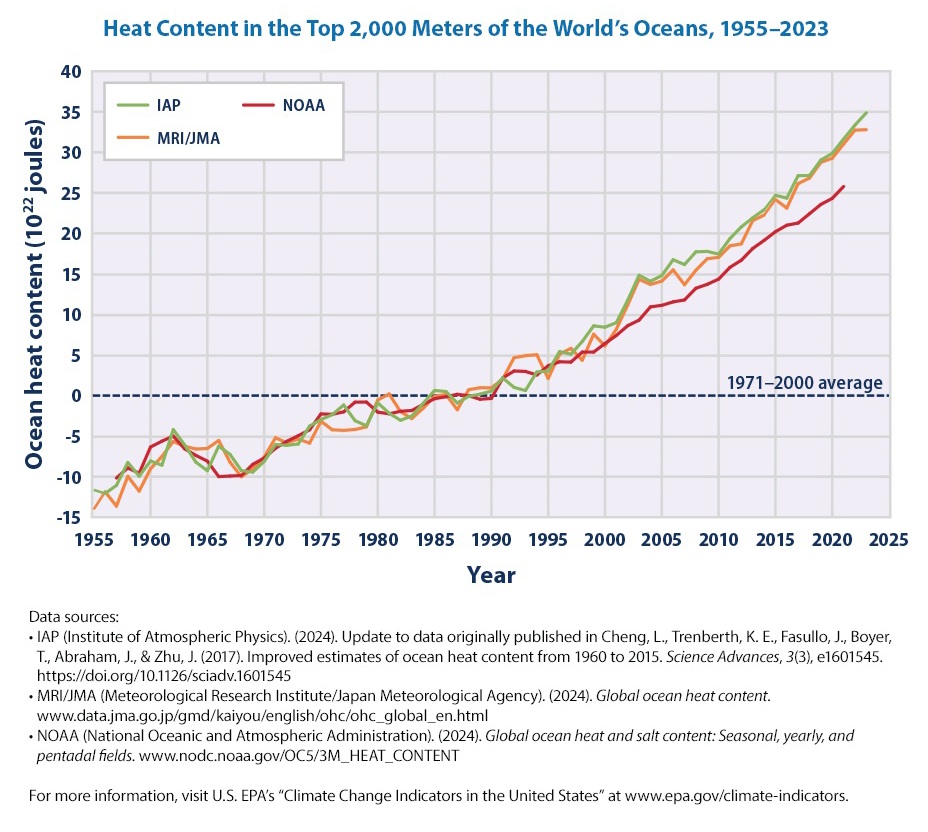
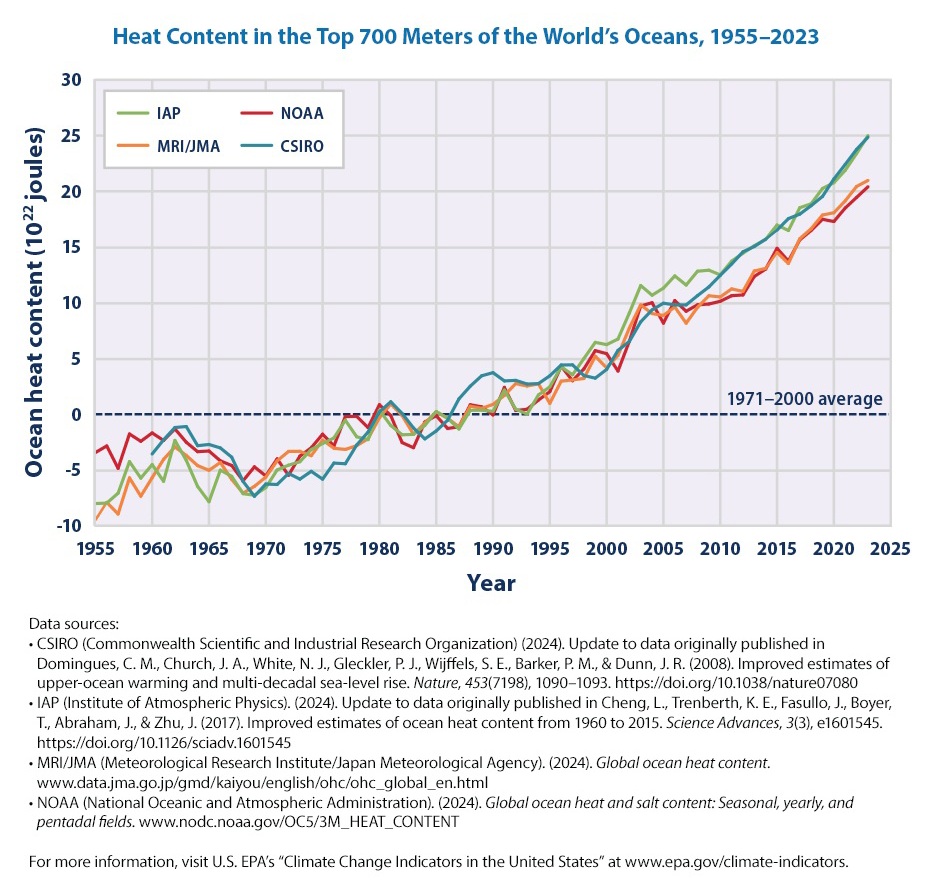
In four different data analyses, the long-term trend shows that the top 700 meters of the oceans have become warmer since 1955 (see Figure 1). All three analyses in Figure 2 show additional warming when the top 2,000 meters of the oceans are included. These results indicate that the heat absorbed by surface waters extends to much lower depths over time.
Although concentrations of greenhouse gases have risen at a relatively steady rate over the past few decades, the rate of change in ocean heat content can vary from year to year (see Figures 1 and 2). Year-to-year changes are influenced by events such as volcanic eruptions and recurring ocean-atmosphere patterns such as El Niño.
Background
When sunlight and energy trapped by greenhouse gases reach the Earth’s surface, the world’s oceans absorb some of this energy and store it as heat. This heat is initially absorbed at the surface, but some of it eventually spreads to deeper waters. Currents also move this heat around the world. Water has a much higher heat capacity than air, meaning the oceans can absorb larger amounts of heat energy with only a slight increase in temperature.
The total amount of heat stored by the oceans is called “ocean heat content,” and measurements of water temperature reflect the amount of heat in the water at a particular time and location. Ocean temperature plays an important role in the Earth’s climate system - particularly sea surface temperature - because heat from ocean surface waters provides energy for storms and thereby influences weather patterns.
Increasing greenhouse gas concentrations are trapping more energy from the sun. Because changes in ocean systems occur over centuries, the oceans have not yet warmed as much as the atmosphere, even though they have absorbed more than 90 percent of the Earth’s extra heat over the last half-century, and even as the rate of ocean heat uptake has doubled since 1993. If not for the large heat-storage capacity provided by the oceans, the atmosphere would warm more rapidly. Increased heat absorption also changes ocean currents because many currents are driven by differences in temperature, which cause differences in density. These currents influence climate patterns and sustain ecosystems that depend on certain temperature ranges.
Because water expands slightly as it gets warmer, an increase in ocean heat content will also increase the volume of water in the ocean, which is one of the major causes of the observed increases in sea level. For all these reasons, ocean heat content is one of the most important indicators tracking the causes and responses of a changing climate.
Graph of Information - Figure 1.
This figure shows changes in heat content of the top 700 meters of the world’s oceans between 1955 and 2023. Ocean heat content is measured in joules, a unit of energy, and compared against the 1971–2000 average, which is set at zero for reference.
For reference, an increase of 1 unit on this graph (1 × 10²² joules) is equal to approximately 17 times the total amount of energy used by all the people on Earth in a year (based on a total global energy supply of 606 exajoules in the year 2019, which equates to 6.06 × 10²⁰ joules).
Graph of Information - Figure 2.
This figure shows changes in heat content of the top 2,000 meters of the world’s oceans between 1955 and 2023. Ocean heat content is measured in joules, a unit of energy, and compared against the 1971–2000 average, which is set at zero for reference.
For reference, an increase of 1 unit on this graph (1 × 10²² joules) is equal to
approximately 17 times the total amount of energy used by all the people on Earth in a year (based on a total global energy supply of 606 exajoules in the year 2019, which equates to 6.06 × 10²⁰ joules)