Snowfall
Key Points
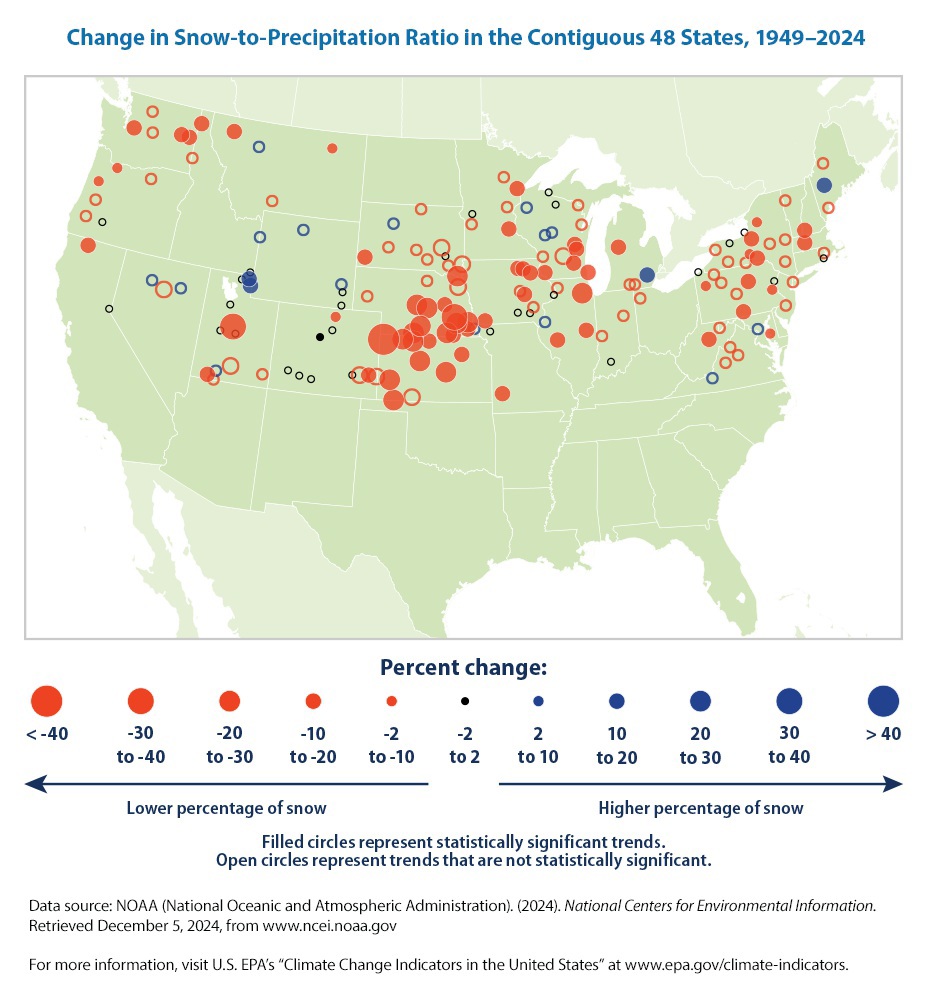
Total snowfall has decreased in many parts of the country since widespread observations became available in 1930, with 57 percent of stations showing a decline (see Figure 1). Among all of the stations shown, the average change is a decrease of 0.19 percent per year.
In addition to changing the overall rate of precipitation, climate change can lead to changes in the type of precipitation. One reason for the decline in total snowfall is because more winter precipitation is falling in the form of rain instead of snow. More than 80 percent of the stations across the contiguous 48 states have experienced a decrease in the proportion of precipitation falling as snow (see Figure 2).
Snowfall trends vary by region. The Pacific Northwest has seen a decline in both total snowfall and the proportion of precipitation falling as snow. Parts of the Midwest have also experienced a decrease, particularly in terms of the snow-to-precipitation ratio. A few regions have seen modest increases, including some areas near the Great Lakes that now receive more snow than in the past (see Figures 1 and 2).
Background
Snowfall is an important aspect of winter in much of the United States. Many people depend on spring snowmelt to provide their drinking water and support other uses such as irrigation, especially in the western United States, where snowmelt provides 75 percent of the water supply. Many communities also rely on snow for winter recreation. Some plants and animals also depend on snow and snowmelt for survival. The amount of snow that falls in a particular area directly influences both snow cover and snowpack, which refer to snow that accumulates on the ground.
Warmer temperatures cause more water to evaporate from the land and oceans, which leads to more precipitation, larger storms, and more variation in precipitation in some areas. In general, a warmer climate causes more of this precipitation to fall in the form of rain instead of snow. Some places, however, could see more snowfall if temperatures rise but still remain below the freezing point, or if storm tracks change. Areas near large lakes might also experience more snowfall as lakes remain unfrozen for longer periods, allowing more water to evaporate. In contrast, other areas might experience less snowfall as a result of wintertime droughts.
Changes in the amount and timing of snowfall could affect the spawning of fish in the spring and the amount of water available for people to use in the spring and summer. Changes in snowfall could also affect winter recreation activities, like skiing, and the communities that rely on these activities.
Graph of Information - Figure 1.
This figure shows the average rate of change in total snowfall from 1930 to 2007 at 419 weather stations in the contiguous 48 states. Blue circles
represent increased snowfall; red circles represent a decrease.
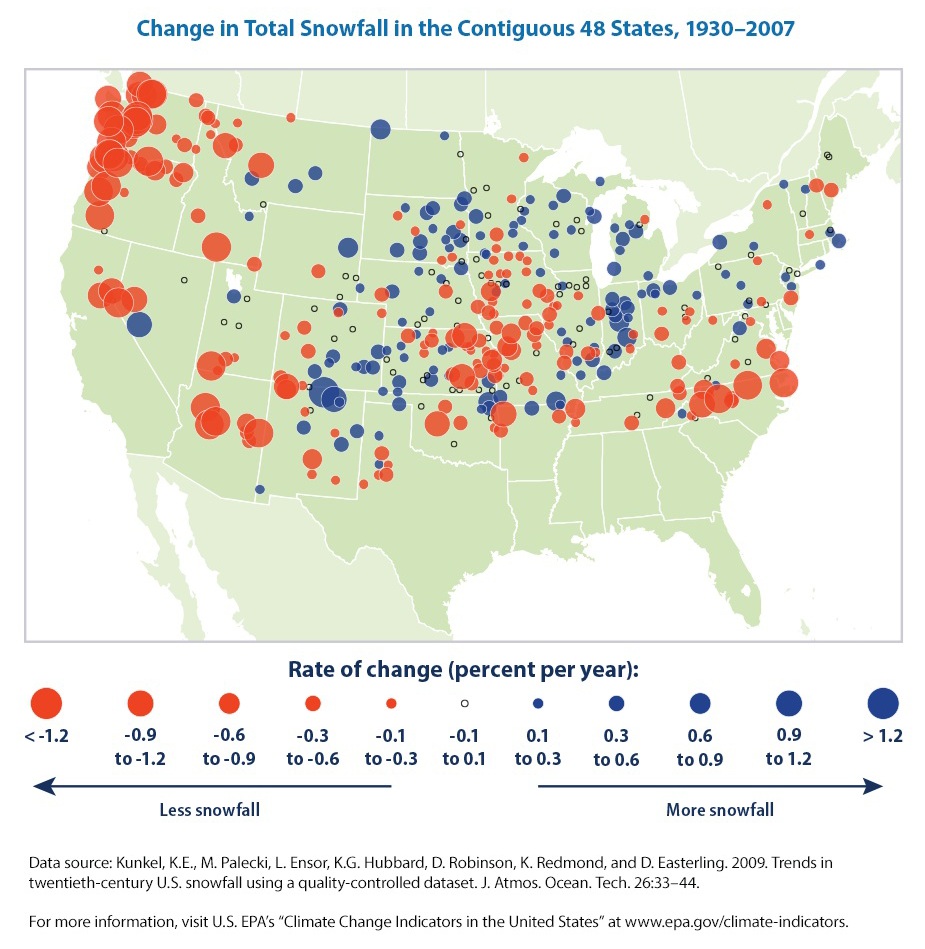
Graph of Information - Figure 2.
This figure shows the percentage change in winter snow-to-precipitation ratio from 1949 to 2024 at 170 weather stations in the contiguous 48 states. This ratio measures what percentage of total winter precipitation falls in the form of snow. A decrease (red circle) indicates that more precipitation is falling in the form of rain instead of snow. Solid-color circles represent stations where the trend was statistically significant.