Direct and Indirect Sunlight
Source: https://science8sc.weebly.com/direct-vs-indirect-rays.html
The tilt of Earth's axis causes the angle sunlight reaches Earth to change throughout the year as Earth revolves around the Sun.
Direct vs. Indirect Rays From the Sun
If you were at the beach and wanted to get a tan wouldn't you angle yourself directly toward the Sun? When you do doesn't it get hotter? The same is true with how the Sun's rays strike the Earth. When one hemisphere of Earth is tilted toward the Sun (North or South) it gets more direct rays from the Sun causing an increase in temperature.
Figure 1.
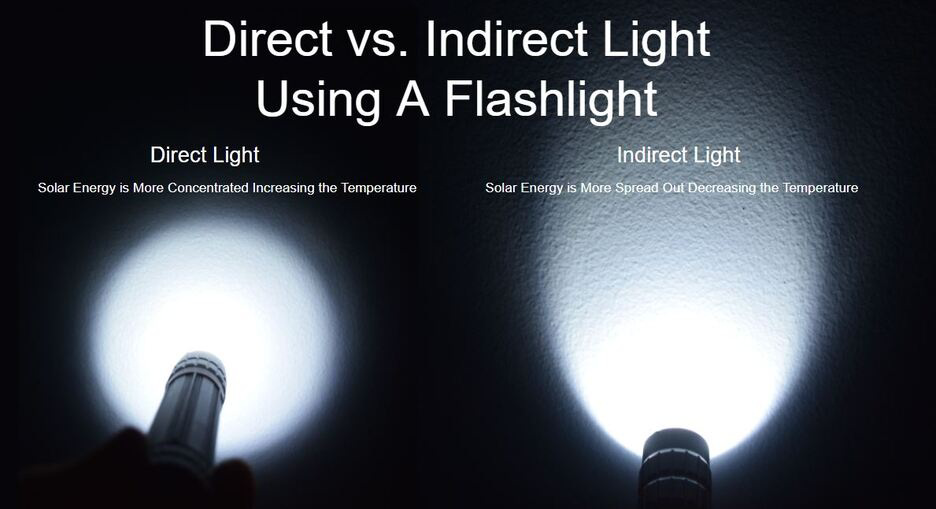
When one hemisphere is tilted toward the Sun it experiences more direct rays from the Sun that strike Earth at higher angles (closer to 90o) causes warmer temperatures. When one hemisphere is tilted away from the Sun it experiences indirect rays from the Sun that strike Earth at lower angles cause cooler temperatures.
Figure 2.
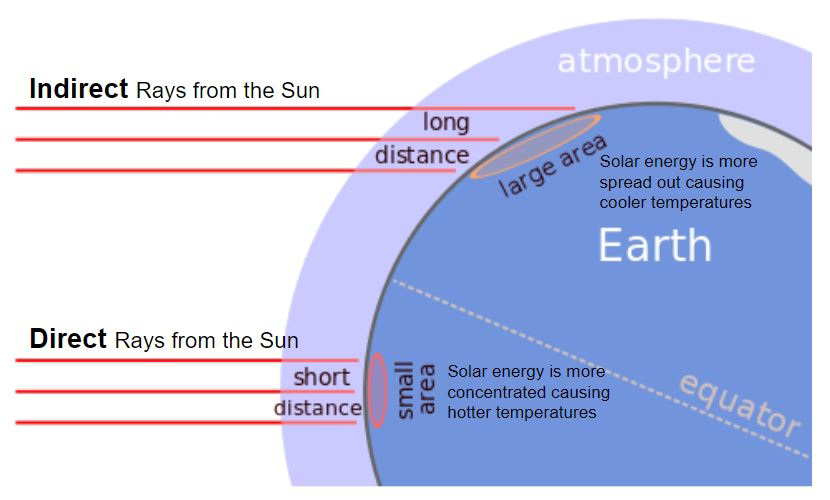
Notice in Figure 2 the farther you are from the equator the Sun's rays are less direct and spread out over a larger area. This makes it colder.
Figure 3.
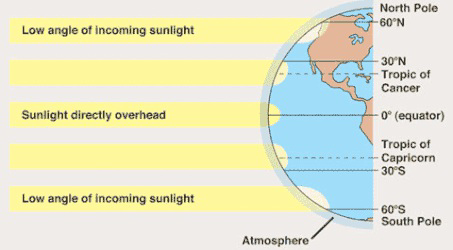
Notice in Figure 3 the closer you are to the equator the Sun's rays are more direct and concentrated over a smaller area. This makes it hotter.
Seasonal Shadows?!
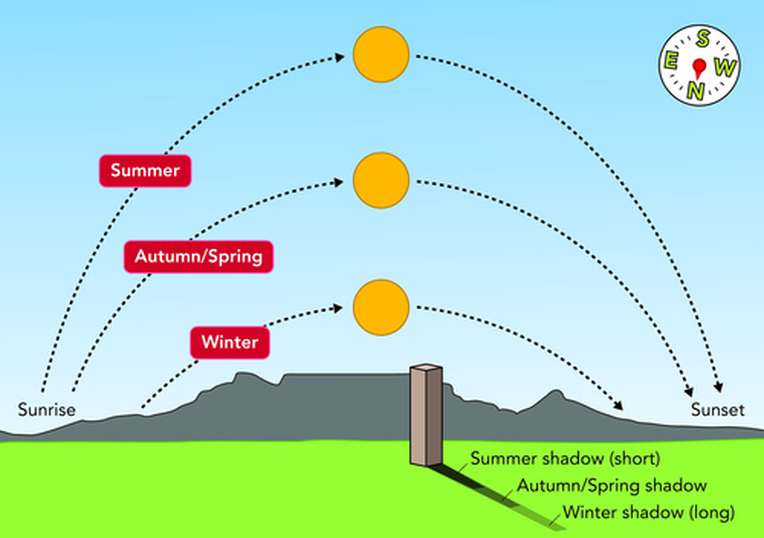
Shadows are formed when an object blocks light. For example, when sunlight hits the metal piece on this sundial, it forms a shadow. The shadow can be used to tell the time of day. That is because shadows change shape during the day. When the Sun first rises, it sits at a very low angle on the horizon creating a long shadow. In the middle of the day, the Sun sits at a higher angle more directly above creating a smaller shadow. As the Sun sets near the horizon, it creates longer shadows again. Because the Sun rises in the east and sets in the west shadows point in different directions throughout the day, making a sundial very useful for telling time.
Figure 4.

Shadows can be used to tell time and determine the seasons.
The shape of shadows also depends on which season it is. During our summer, the northern half of Earth is tilted toward the Sun. So, the Sun’s light hits the northern half of Earth at a more direct angle. Because the Sun is more directly overhead, shadows are smaller in the summer than in the winter. In the winter, the northern part of Earth is tilted away from the Sun. That means the sunlight is not coming in as directly. So, shadows during the winter are longer.
Figure 5.