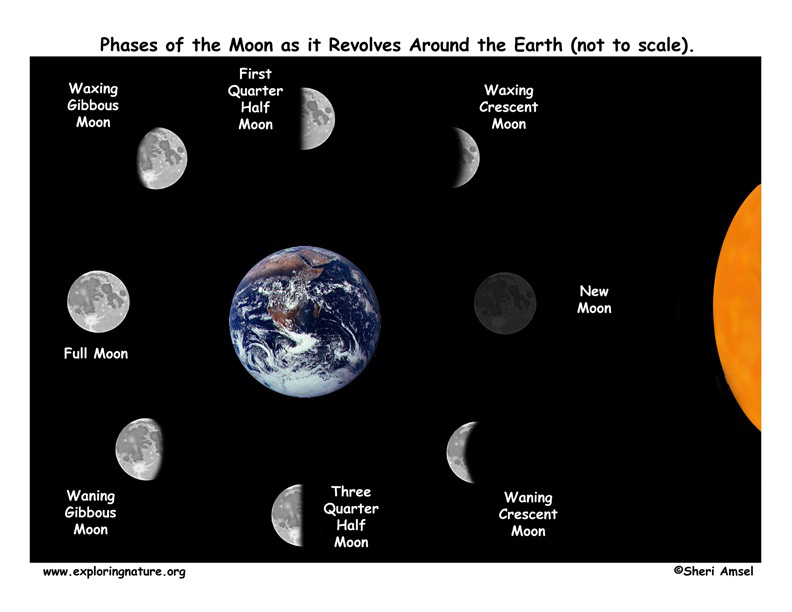
Patterns of Moon Phases
Source: https://www.exploringnature.org/db/view/1841
In the sky at night, we can see the moon’s size change throughout the month at regular intervals. This is called moon phases. Yet, in reality, the moon never changes size. This is how it works.
First it's important to remember two key facts:
The moon revolves around the Earth every 27 days, but from Earth it appears to be 29.5 days because the Earth’s motion extends its full revolution.
The moon takes the same amount of time to rotate once around on its axis as it does to revolve around the Earth - so the same side of the moon always faces the Earth.
The moon looks different during its revolution around the Earth, because, at each position it is being seen from a different angle, despite having the same amount of sunlight on its surface.
When the moon is positioned between the Earth and the sun, we face the dark side, so we cannot see the moon at all. This is called a new moon.
As each day passes and the moon moves at an angle out from between the Earth and the sun, we begin the see a sliver of the moon getting sunlight. By day 4, it reaches 45°. This is called a waxing crescent.
When the moon has revolved to a 90° angle from the Earth and sun, on about day 7, it has reached its first quarter. We can now see half the moon, while the other half sits in invisible shadows.
The next phase, at about day 10, it reaches 135° and we can see roughly three quarters of the moon. This is called the waxing gibbous phase.
After roughly 2 weeks, the moon is now in position with the Earth sitting between it and the sun at 180°, so we see its fully lit side as a full moon. Most months it is not in an exact alignment or the Earth would block the sun from the moon causing a lunar eclipse. This happens only a couple of times a year.
As it continues on in its revolution around the Earth, the moon begins to move into shadow as the waning gibbous moon by day 18 (225°), then the third quarter half moon at day 22 (270°), then waning crescent at day 26 (315°) and finally the invisible new moon again on day 29.
Like the full moon, the new moon does not block the sun from reaching the Earth because it is not an exact alignment. On the months where the alignment is exact, we experience a solar eclipse.