Twa kɔ nsɛm atitiriw so
Log in
Sign up for FREE
arrow_back
Laabri

Seasons Series - MS - ESS - Space Systems

star
star
star
star
star
Last updated 4 months ago
6 Nsɛmmisa
Hyɛ no nsow a efi ɔkyerɛwfo no hɔ:

Directions: Use the information provided and your knowledge of Earth and Space Sciences to answer the following questions. Show all work where necessary.

Directions: Use the information provided and your knowledge of Earth and Space Sciences to answer the following questions. Show all work where necessary.

The seasons are opposite in the Northern half of the world (Northern Hemisphere) than in the Southern half of the world (Southern Hemisphere). When we are swimming at the beach in the summer, the Southern half of the world (Southern Hemisphere) is sledding! The equator, shown as an imaginary red line around the middle of the Earth, divides the Northern Hemisphere from the Southern Hemisphere. North America is in the Northern Hemisphere. Each changing season in our Northern Hemisphere has different weather. Let’s look at seasonal things.

Fall (Autumn)
Fall starts on September 22 every year. In the fall, the air starts to get colder every day. The noon sun starts to shine lower in the sky. Days grow shorter. Plants begin to lose their bright green color. Animals move south or get ready for winter sleep. Some animals grow warmer fur or feathers. Some animals change color to blend in with coming snow. The leaves of some trees change color and fall off.

Winter
Winter begins on December 21. The Northern half of the Earth (the Northern Hemisphere) is tilted away from the sun. This is our coldest season. The air can be freezing. It can snow. The wind is cold. The ground, roads and sidewalks can be icy. Many animals sleep (hibernate) to save energy. After December 21st the sun is already beginning to climb higher in the sky. During the winter, the days are already slowly growing longer.

Spring
Spring begins on March 20. The days are longer. The sun is higher in the sky. The Northern half of the Earth (the Northern Hemisphere) is tilted toward the sun again. As the days grow longer, it gets warmer. Plants begin to bud and grow. Migrating animals move north and those who spent the winter in the north begin to shed their winter coats.

Summer


Summer begins on June 21. Summer is the warmest season in the Northern half of the Earth (Northern Hemisphere). Plants grow. Plants are food for plant eating animals. Animals gain weight and are food for meat eating animals. Summer is when all animals eat and gain weight. For humans, summer is the time to grow fresh food that we can eat all year.

Ɛhia
4
DOK 2
MS-ESS1-1

Seasons

Source: https://www.exploringnature.org/db/view/1888

Our weather changes all year long – this is called the seasons. The seasons cycle from fall to winter to spring to summer every year. The seasons change because of two things:

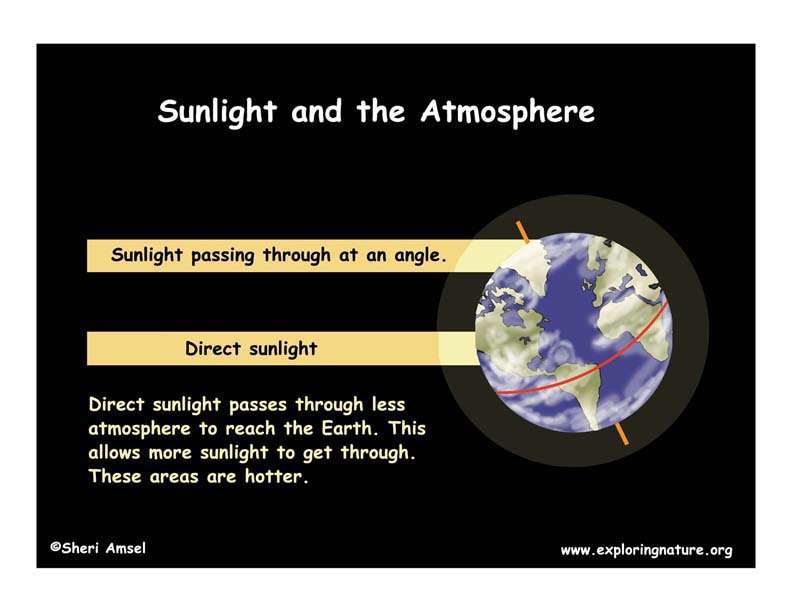
  1. How much direct sunlight a place gets during the year: When the sun is right over our heads, high up in the sky – that is called direct sunlight. That is the most sun an area can get. Direct sunlight is warmer than sunlight hitting the Earth at an angle. Here in the Northern half of the Earth (the Northern Hemisphere), we get the most direct sunlight on June 21st every year. This is the first day of summer.

  2. How long the sun shines on one place during a day (day length): Longer days get more sunshine. The longer the day, the more time the sun has to warm us up. On June 21st – the first day of summer– we get more sun for the longest time than any other day all year.

The longest day length is called the summer solstice and is considered the first day of summer. In the Southern Hemisphere, it is the exact opposite! They experience the winter solstice on that day – the shortest day length of the year.

Figure 1.
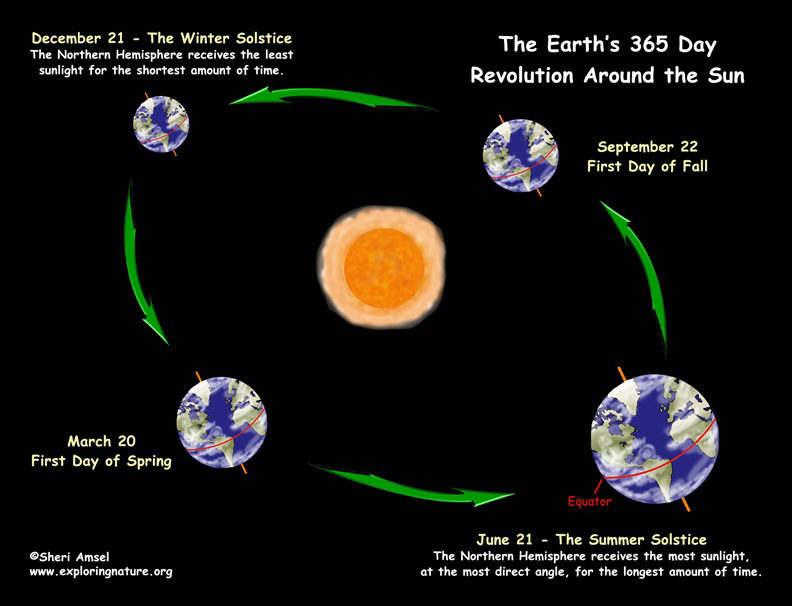
Diagram of the Earth's 365-day revolution around the Sun showing positions and dates of solstices and equinoxes.

Ɛhia
4
DOK 2
MS-ESS1-1
Ɛhia
6
Asemmisa {{asɛmmisaAhyɛnsode}}
2.

How does the Sun affect the seasons? Use both direct sunlight and day length in your explanation.
DOK 3
MS-ESS1-1
Ɛhia
6
Asemmisa {{asɛmmisaAhyɛnsode}}
3.

What pattern allows scientists to predict the seasons year after year? Provide an example.

DOK 3
MS-ESS1-1
Asemmisa {{asɛmmisaAhyɛnsode}}
4.

Why are the seasons opposite in the Northern and Southern Hemispheres?

How Does This Work?

The length of day changes all year. That is because the Earth is tipped 25o on its axis (see picture). If the Earth stood straight up and down, we would have 12 hours of day and 12 hours of night all year round, everywhere on Earth. Because of the Earth’s tilt, the Arctic in the far north, in the summer is tipped toward the sun. So from March 20th to September 22nd the sun never stops shining in the Arctic. Yet even though it gets sunlight for six months of the year, it is still not as hot as places nearer the equator. This is because the sun does not shine on the Arctic directly overhead, but at an angle.

You would think that the hottest day in the Northern half of the Earth (Northern Hemisphere) would be on June 21st, but it really takes several weeks to warm the Earth. So it is usually July before we feel the warmest days. It also gets hotter all day as the sun “rises” in the sky. As with the seasons, even though the most direct sunlight is at noon, the day gets warmer and warmer until early in the afternoon.

The hottest place on record in North America is Death Valley, California, where it often reaches over 100oF and once reached 134oF on July 10, 1913. The coldest place on record in North America is Prospect Creek, Alaska where it reached -80oFon January 23, 1971.

Figure 2.

Diagram titled 'Sunlight and the Atmosphere' showing sunlight passing through at an angle versus direct sunlight to Earth.

Ɛhia
4
DOK 2
MS-ESS1-1
Ɛhia
8
Asemmisa {{asɛmmisaAhyɛnsode}}
6.

How does the angle of Earth’s tilt affect seasonal temperatures? Use an example from summer and winter.

DOK 4
MS-ESS1-1
Asemmisa {{asɛmmisaAhyɛnsode}}
1.

Why is June 21st considered the first day of summer in the Northern Hemisphere?

Asemmisa {{asɛmmisaAhyɛnsode}}
5.

Why does the Arctic get six months of daylight but still remain colder than the equator?