Hurricanes
Key Points
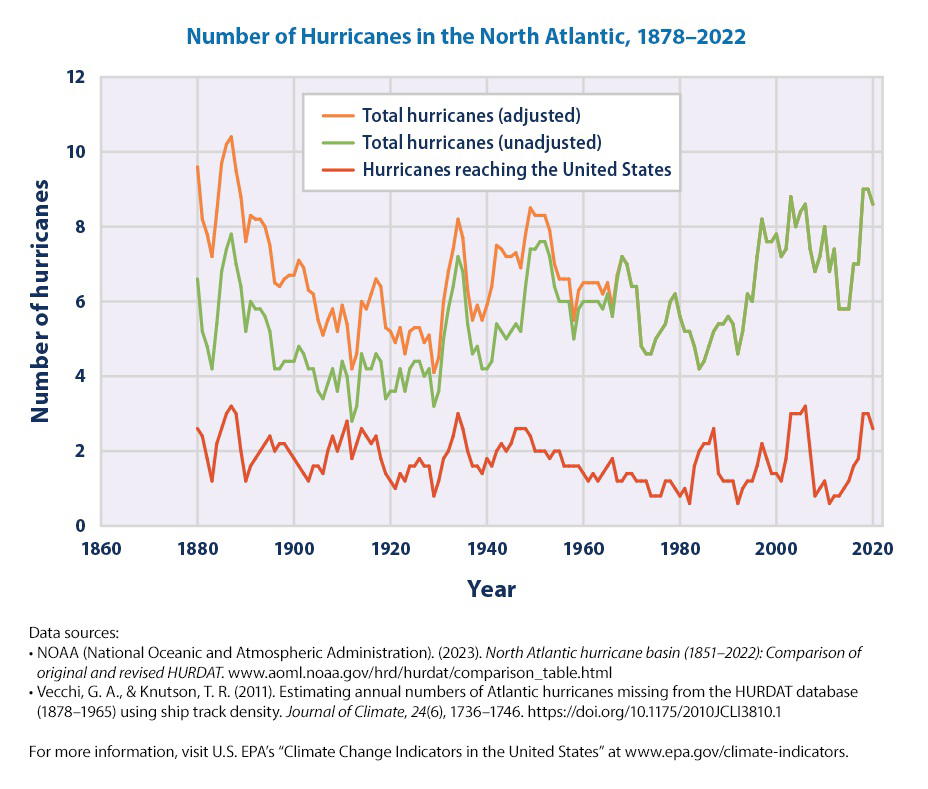
Since 1878, about six to seven hurricanes have formed in the North Atlantic every year. Roughly two per year make landfall in the United States. The total number of hurricanes (particularly after being adjusted for improvements in observation methods) and the number reaching the United States do not indicate a clear overall trend since 1878 (see Figure 1).
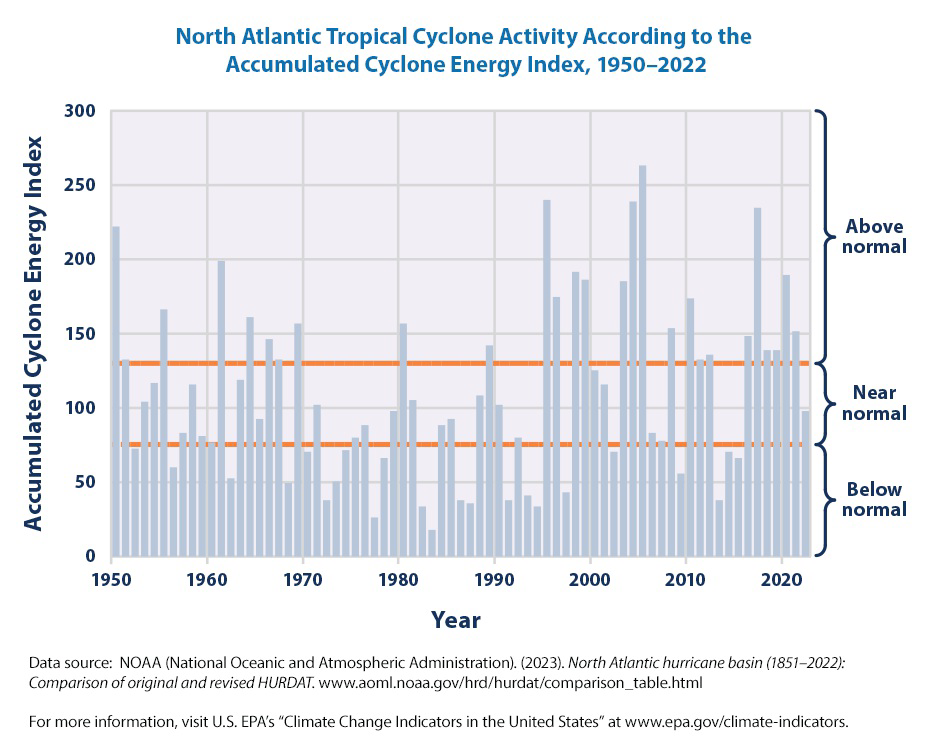
According to the total annual ACE Index, cyclone intensity has risen noticeably over the past 30 years, and eight of the 10 most active years since 1950 have occurred since the mid-1990s (see Figure 2). Relatively high levels of cyclone activity were also seen during the 1950s and 1960s.
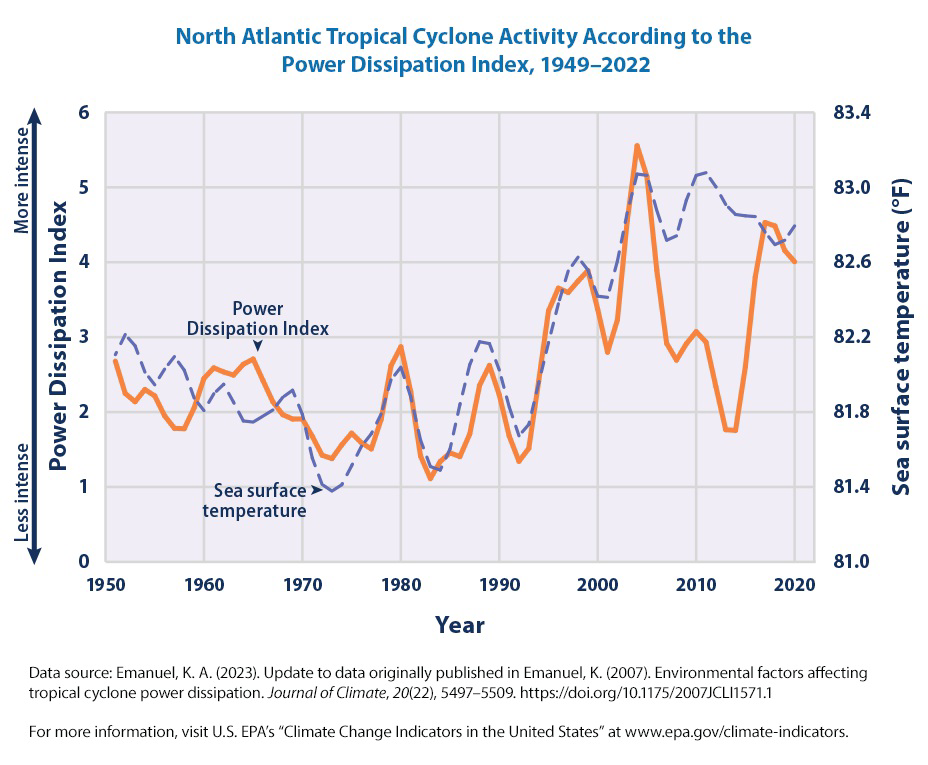
The PDI (see Figure 3) shows fluctuating cyclone intensity for most of the mid- to late 20th century, followed by a noticeable increase since 1995 (similar to the ACE Index). These trends are shown with associated variations in sea surface temperature in the tropical North Atlantic for comparison (see Figure 3).
The results described above generally align with global trends reported in the most recent assessment by the Intergovernmental Panel on Climate Change. Studies generally agree that tropical cyclone intensity has increased around the world over approximately the past 40 years, but changes in observation methods over time make it difficult to know whether intensity or frequency have increased over the full period with available data.
Background
Hurricanes, tropical storms, and other intense rotating storms fall into a general category called cyclones. There are two main types of cyclones: tropical and extratropical (those that form outside the tropics). Tropical cyclones get their energy from warm tropical oceans. Extratropical cyclones get their energy from the jet stream and from temperature differences between cold, dry air masses from higher latitudes and warm, moist air masses from lower latitudes.
This indicator focuses on tropical cyclones in the Atlantic Ocean, Caribbean, and Gulf of America. Tropical cyclones are most common during the “hurricane season,” which runs from June through November. The effects of tropical cyclones are numerous and well known. At sea, storms disrupt and endanger shipping traffic. When cyclones encounter land, their intense rains and high winds can cause severe property and infrastructure damage, loss of life, soil erosion, and flooding. The associated storm surge - the large volume of ocean water pushed toward shore by the cyclone’s strong winds - can cause severe flooding, erosion, and destruction.
Climate change is expected to affect tropical cyclones by increasing sea surface temperatures, a key factor that influences cyclone formation and behavior. The U.S. Global Change Research Program and the Intergovernmental Panel on Climate Change project that tropical cyclones will become more intense over the 21st century, with higher wind speeds and heavier rains.
Graph of Information - Figure 1.
This graph shows the number of hurricanes that formed in the North Atlantic Ocean each year from 1878 to 2022, along with the number that made landfall in the United States. The orange curve shows how the total count in the green curve can be adjusted to attempt to account for the lack of aircraft and satellite observations in early years. All three curves have been smoothed using a five-year average, plotted at the middle year. The most recent average (2018–2022) is plotted at 2020.
Graph of Information - Figure 2.
This figure shows total annual Accumulated Cyclone Energy (ACE) Index values, which account for cyclone strength, duration, and frequency, from 1950 through 2022. The National Oceanic and Atmospheric Administration has defined “near normal,” “above normal,” and “below normal” ranges based on the distribution of ACE Index values over the 70 years from 1951 to 2020.
Graph of Information - Figure 3.
This figure presents annual values of the Power Dissipation Index (PDI), which accounts for cyclone strength, duration, and frequency. Tropical North Atlantic sea surface temperature trends are provided for reference. Note that sea surface temperature is measured in different units, but the values have been plotted alongside the PDI to show how they compare. The lines have been smoothed using a five-year weighted average, plotted at the middle year. The most recent average (2018–2022) is plotted at 2020.