Drought Cluster
Key Points
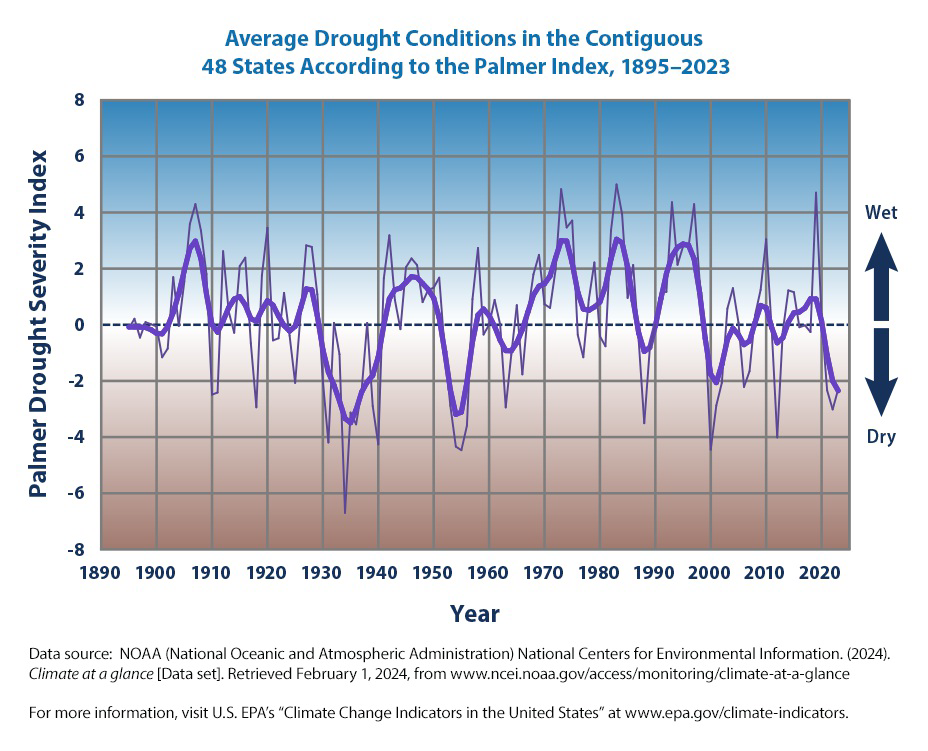
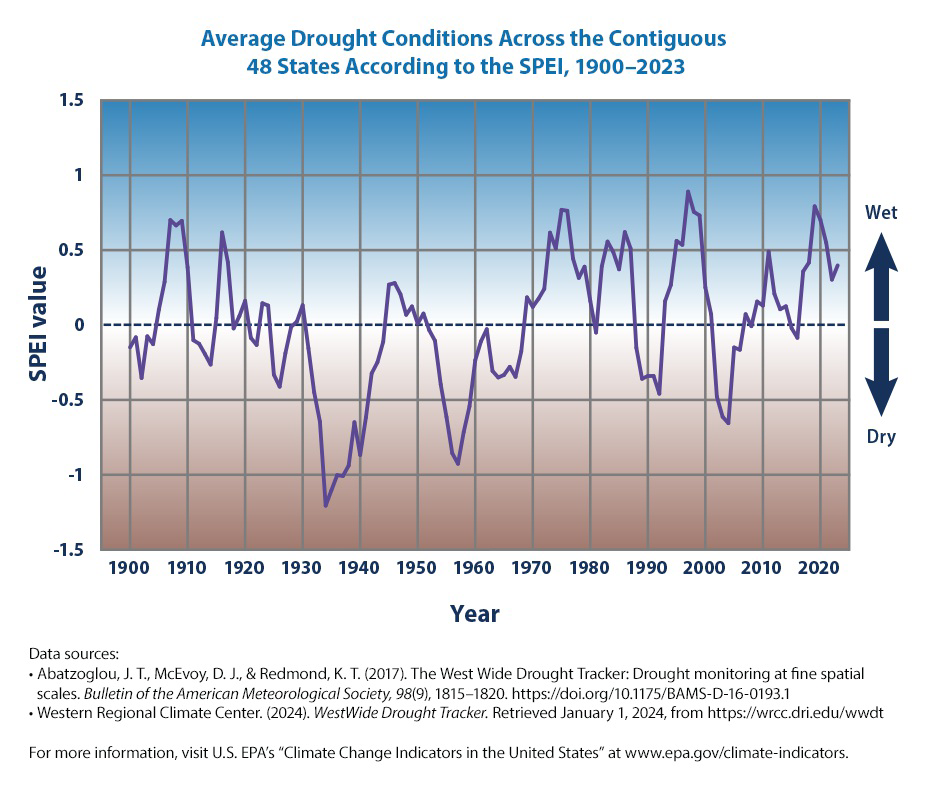
Average drought conditions across the nation have varied over time. The 1930s and 1950s saw the most widespread droughts, while the last 50 years have generally been wetter than average (see Figures 1 and 2). Over the entire period shown in Figures 1 and 2, the overall trend has been toward wetter conditions, with the SPEI increasing at a rate of about 0.03units per decade (see Figure 2).
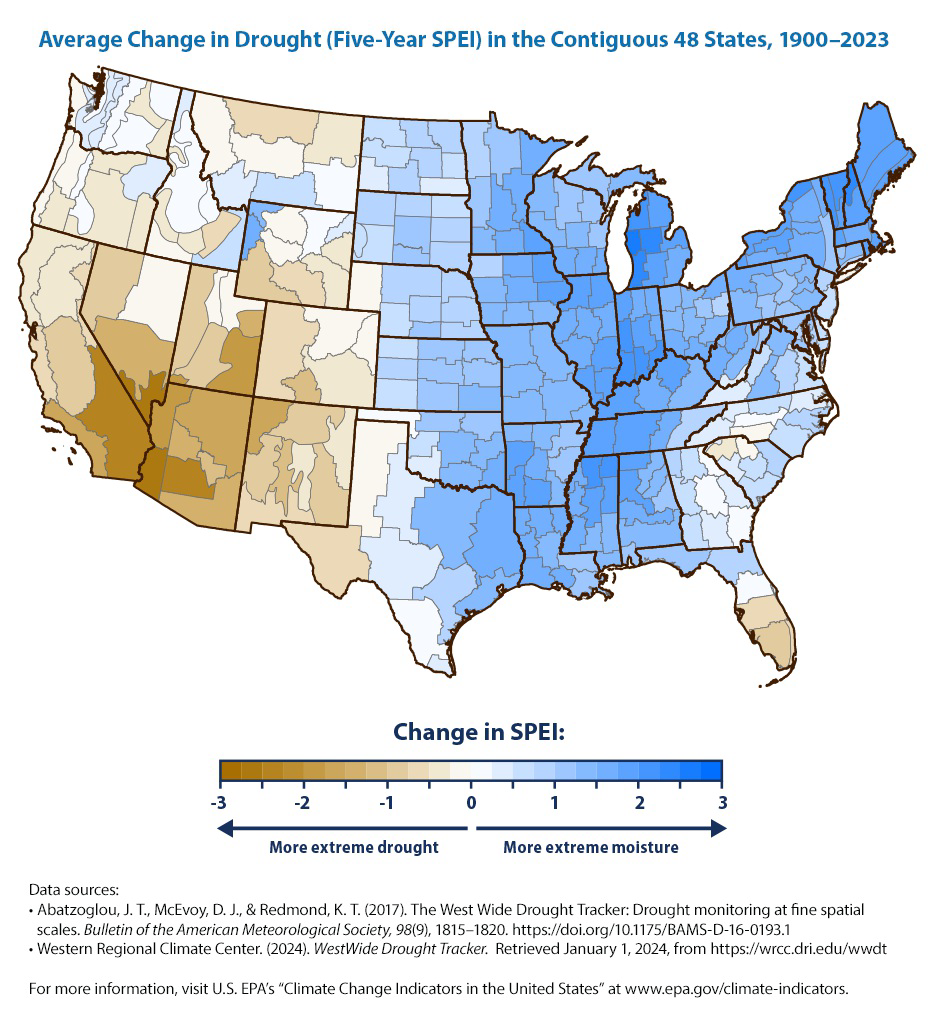
Large and consistent decreases in the SPEI have been observed throughout the western United States. Decreases have been especially prominent in southwestern states such as California, Arizona, and New Mexico. The eastern United States - in particular the Midwest and Northeast - has experienced generally wetter conditions (see Figure 3).
In terms of scale and duration, the droughts of the 1930s Dust Bowl era remain the most extreme in the historical record (see Figures 1 and 2).
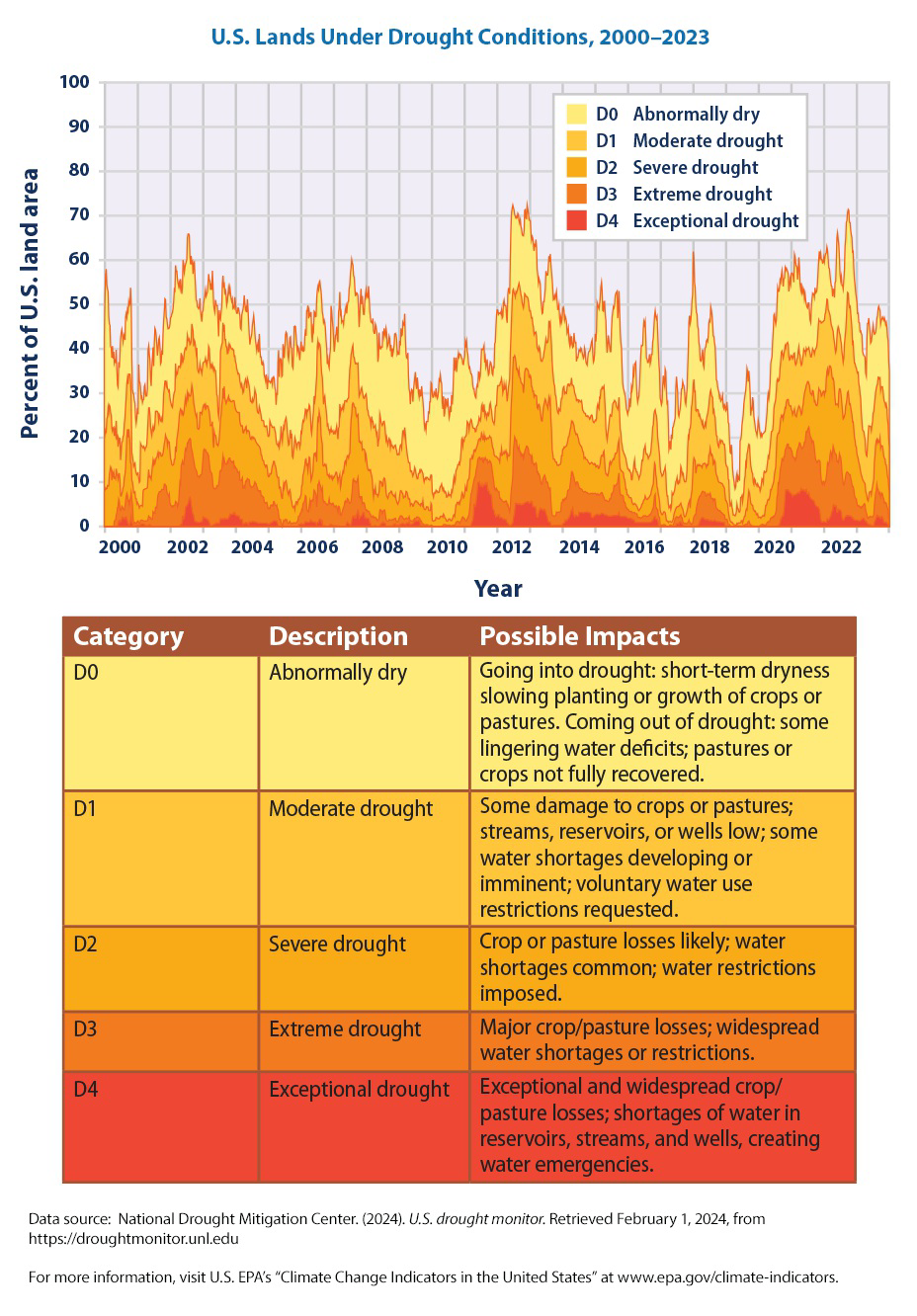
Over the period from 2000 through 2023, roughly 10 to 70 percent of the U.S. land area experienced conditions that were at least abnormally dry at any given time (see Figure 4). The years 2002–2003 and 2012–2013 had a relatively large area with at least abnormally dry conditions, while 2009–2011, 2016–2017, and 2019 had substantially less area experiencing drought.
During the latter half of 2012, more than half of the U.S. land area was covered by moderate or greater drought (see Figure 4). In several states, 2012 was among the driest years on record.
Background
There are many definitions and types of drought. Meteorologists generally define drought as a prolonged period of dry weather caused by a lack of precipitation that results in a serious water shortage for some activity, population, or ecological system. Drought can also be thought of as an extended imbalance between precipitation and evaporation.
As average temperatures have risen because of climate change, the Earth’s water cycle has sped up through an increase in the rate of evaporation from the Earth’s surface (including soil, lakes, and reservoirs) and transpiration from plants. An increase in evapotranspiration makes more water available in the air for precipitation, but contributes to drying over some land areas, leaving less moisture in the soil. As the climate continues to change, many historically wet areas are likely to experience increased precipitation and increased risk of flooding, while historically dry areas are likely to experience less precipitation and increased risk of drought. As a result, since the 1950s, some regions of the world have experienced an increase in some types of drought, including western North America, southern Europe, and much of Africa.
Drought conditions can negatively affect agriculture, water supplies, energy production, human health, and many other aspects of society. The impacts vary depending on the type, location, intensity, and duration of the drought. For example, effects on agriculture can range from slowed plant growth to severe crop losses, while water supply impacts can range from lowered reservoir levels and dried-up streams to major water shortages. Prolonged droughts pose a particular threat to indigenous populations because of their economic and cultural dependence on land and water supplies. Warming and drought can threaten medicinal and culturally important plants and animals and can reduce water quality and availability, making tribal populations particularly vulnerable to waterborne illnesses. Lower streamflow and groundwater levels can also harm ecosystems more broadly, by harming plants and animals and increasing the risk of wildfires.
Graph of Information - Figure 1.
This chart shows annual values of the Palmer Drought Severity Index, averaged over the entire area of the contiguous 48 states. Positive values represent wetter-than-average conditions, while negative values represent drier-than-average conditions. A value between -2 and -3 indicates moderate drought, -3 to -4 is severe drought, and -4 or below indicates extreme drought. The thicker line is a nine-year weighted average.
Graph of Information - Figure 2.
This graph shows annual values of the SPEI, averaged over the entire area of the contiguous 48 states. The line in this graph represents an average SPEI value for each year, based on conditions over the preceding five years (five-year SPEI). Positive values represent wetter-than-average conditions, while negative values represent drier-than-average conditions.
Graph of Information - Figure 3.
This map shows the total change in drought conditions across the contiguous 48 states, based on the long-term average rate of change in the five-year SPEI from 1900 to 2023. Data are displayed for small regions called climate divisions. Blue areas represent increased moisture; brown areas represent decreased moisture or drier conditions.
Graph of Information - Figure 4.
This chart shows the percentage of U.S. lands classified under drought conditions from 2000 through 2023. This figure uses the U.S. Drought Monitor classification system, which is described in the table below. The data cover all 50 states plus Puerto Rico.