Land Loss Along the Atlantic Coast
Key Points
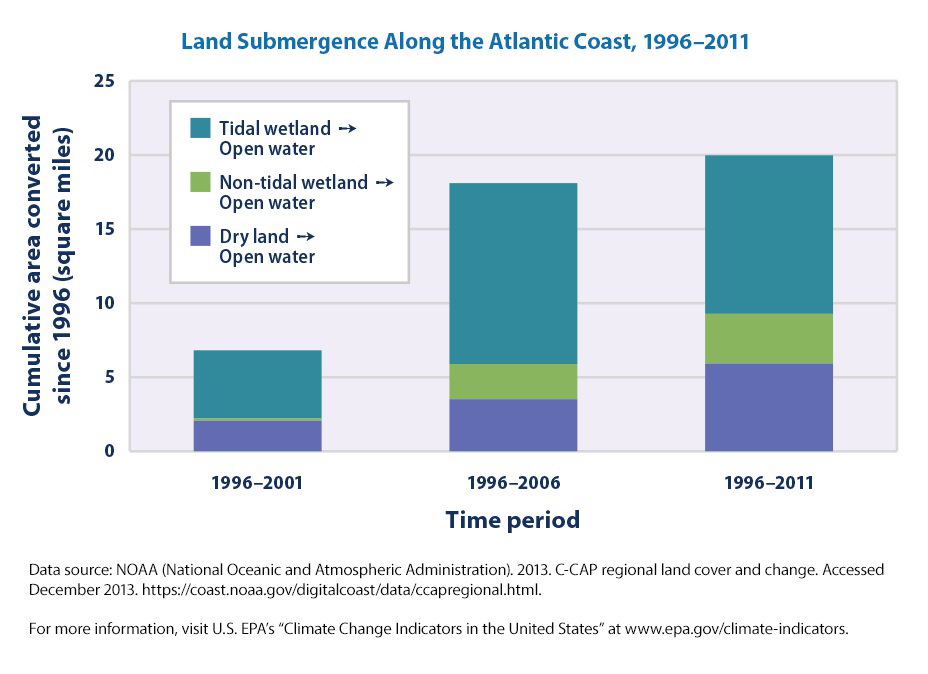
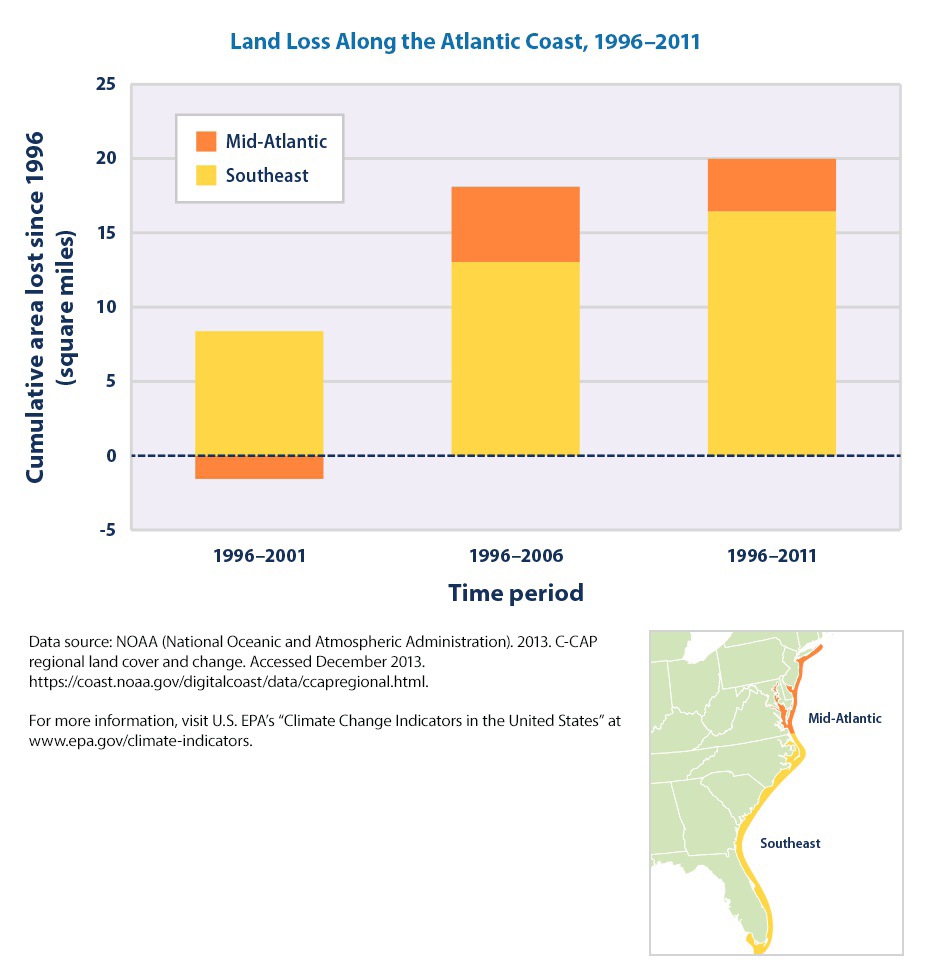
Roughly 20 square miles of dry land and wetland were converted to open water along the Atlantic coast between 1996 and 2011. (For reference, Manhattan is 33 square miles.) More of this loss occurred in the Southeast than in the Mid-Atlantic (see Figure 1).
The data suggest that at least half of the land lost since 1996 has been tidal wetland. The loss of dry land appears to be larger than the loss of non-tidal wetland (see Figure 2).
Background
Why is the Atlantic coast particularly vulnerable to sea level rise?
Much of the land along the Atlantic coast is flat and close to sea level - including thousands of square miles of marshes and other productive wetlands, plus many low-lying cities. In addition, much of the land along the Atlantic coast is sinking, which magnifies the local effect of sea level rise. The land in North America is actually still adjusting to the loss of ice after the last ice age, which peaked about 20,000 years ago. Back then, thick sheets of ice covered areas of what is now Canada and the northern United States. The weight of all that ice depressed the land beneath it, but caused the land farther south (particularly the Mid-Atlantic region from North Carolina to New York) to bulge upward. After the ice melted and the extra weight was lifted, northern areas began to rise, and the Mid-Atlantic region started to sink. This very slow process continues today.
Rising sea level tends to make headlines during extreme events, like the storm surge that caused billions of dollars in damage during Hurricane Sandy in 2012. Yet rising sea level can also cause permanent changes in the landscape when it inundates (submerges) low-lying land. The Atlantic coast is particularly vulnerable because of low elevations and sinking shorelines.
The loss of coastal land can affect a large number of people, as nearly 10 million Americans live in a coastal floodplain. Coastal ecosystems are also at risk. These environments provide habitat for many kinds of plants and animals, as well as services that ensure people’s well-being, ranging from food production to recreation. Coastal wetlands provide valuable nursery, feeding, breeding, staging, and resting areas for many fish, shellfish, mammals, and birds, and they can buffer coastal areas against storm and wave damage.
As sea level rises, dry land can turn into wetland or open water. Existing wetlands can be threatened, too, as salt marshes, mangrove forests, and other coastal wetlands are at risk of being converted to open water.
The Sea Level indicator shows that sea level is rising overall in connection with climate change, but the rate of change varies by region, as do the effects. To provide a useful regional perspective, this feature examines the amount of land lost to sea level rise along the Atlantic coast from Florida to New York. It is based on satellite data that have been collected and analyzed at five-year intervals since 1996. Figure 1 divides the Atlantic coast into two regions for comparison, while Figure 2 shows the different types of land that have been lost.
Graph of Information - Figure 1.
This graph shows the net amount of land converted to open water along the Atlantic coast during three time periods: 1996–2001, 1996–2006, and 1996–2011. The results are divided into two regions: the Southeast and the Mid-Atlantic (see locator map). Negative numbers show where land loss is outpaced by the accumulation of new land.
Graph of Information - Figure 2.
This graph shows the net amount of land converted to open water along the Atlantic coast during three time periods: 1996–2001, 1996–2006, and 1996–2011. The results are divided into categories to show the type of land that has been converted to open water.