Glaciers in Glacier National Park
Key Points
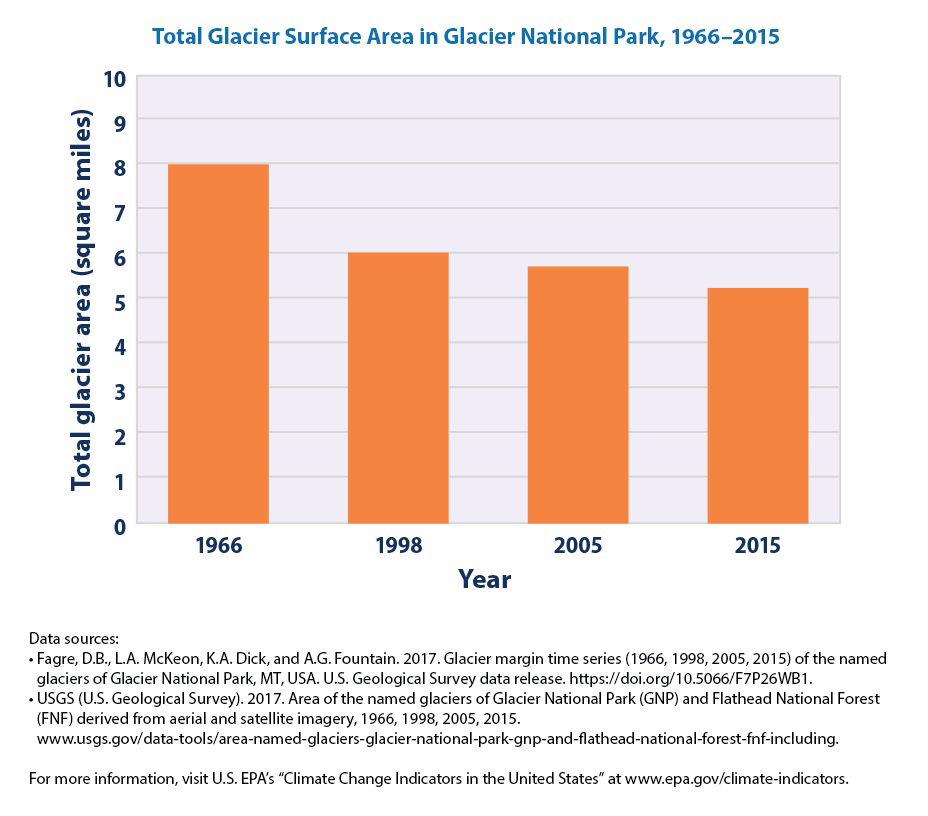
The total surface area of the 37 named glaciers in Glacier National Park decreased by about 34 percent between 1966 and 2015 (see Figure 1).
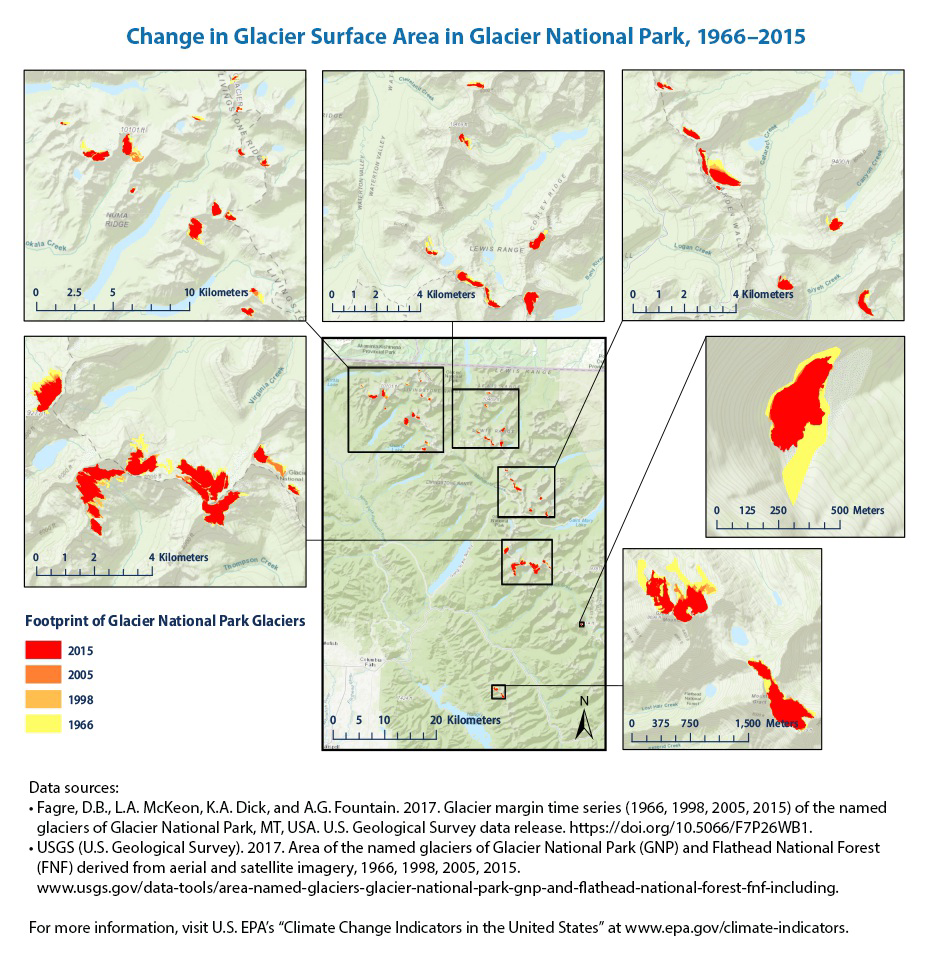
Every glacier’s surface area was smaller in 2015 than it was in 1966 (see Figure 2). Three glaciers temporarily gained some area during part of the overall time period.
The overall trend of shrinking surface area of glaciers in Glacier National Park is consistent with the retreat of glaciers observed in the United States and worldwide.
Background
Visitors from far and wide are drawn to Glacier National Park in Montana for its dramatic beauty and its glaciers. Established in 1910, Glacier is one of the most visited national parks in the United States. Warming temperatures and other changes are melting the park’s alpine glaciers. Such changes have implications not only for tourism, but also for the ecosystems, animals, and people that depend on glacier-fed streamflow. Shrinking glaciers represent a clear and compelling indicator of climate change.
In 2017, the U.S. Geological Survey (USGS) published a study where they analyzed aerial images from 1966, 1998, 2005, and 2015 to assess changes over time in the surface area of Glacier National Park’s 37 named glaciers. Scientists are studying the Park’s alpine glaciers to better understand how they have changed, what that means for the local environment, and how they may inform land management decisions in the park.
Graph of Information - Figure 1.
This figure shows the change in total glacier surface area (in square miles) for all 37 named glaciers in Glacier National Park for four discrete points in time from 1966 to 2015.
Graph of Information - Figure 2.
Footprint of Glacier National Park Glaciers
2015
2005
1998
1966