Ice Sheets
Key Points
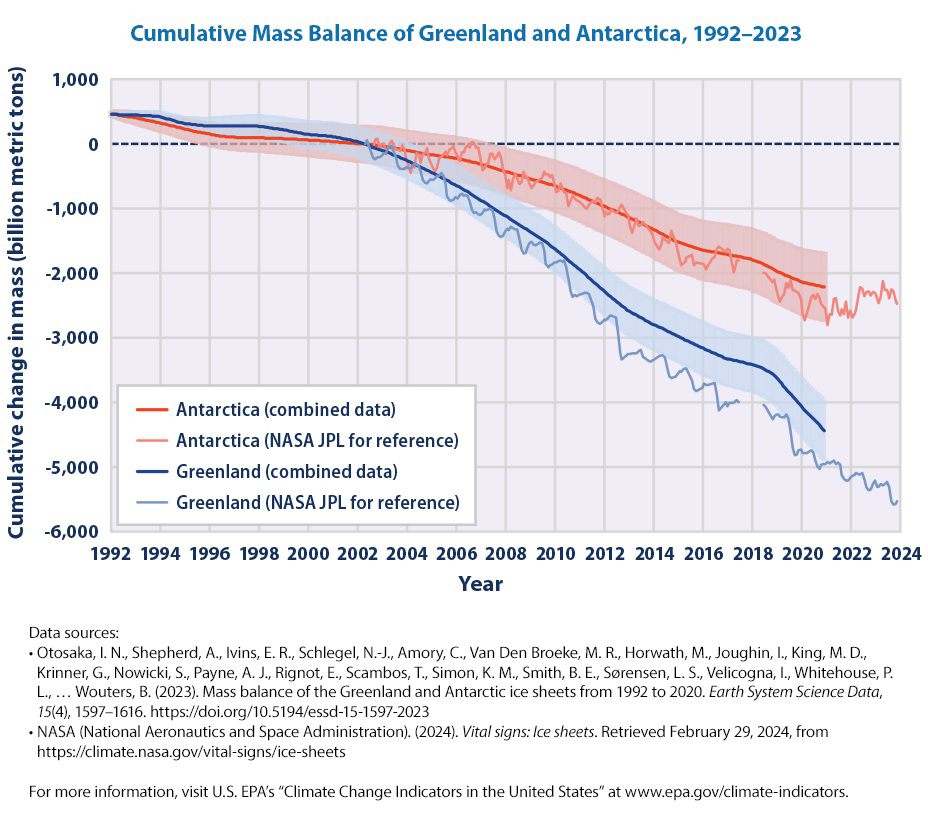
Since 1992, Greenland and Antarctica have both lost ice overall (see Figure 1), with Greenland losing an average of about 175 billion metric tons of ice per year and Antarctica losing more than 90 billion per year.
The total amount of ice lost by Greenland and Antarctica from 1992 to 2020 was enough to raise sea level worldwide by an average of three-quarters of an inch or more. By comparison, global average sea level increased by about 3 inches overall during this period.
Ice sheets naturally fluctuate with seasonal variations in temperature, precipitation, and other factors. The NASA JPL data points in Figure 1 show these types of seasonal patterns, particularly for Greenland. With nearly three decades of data, though, Figure 1 shows that the overall shrinking of the ice sheets far exceeds seasonal and year-to-year variations.
Observations of ice sheets losing mass are consistent with trends in small glaciers as well as warming trends in global temperatures during this period.
Background
Ice sheets are large bodies of ice on land that cover hundreds of thousands of square miles on Greenland and Antarctica. Greenland’s ice sheet reaches more than 1 mile thick on average in the interior and contains an estimated 700,000 cubic miles of ice, while Antarctica’s ice is nearly 3 miles thick in some places, with a volume of about 7 million cubic miles. Together, these ice sheets hold nearly 70 percent of the world’s fresh water. Some of this ice has been in place for more than 1 million years.
Ice sheets accumulate snowfall - just like small glaciers but at a larger scale. Over time, this snow becomes compacted into layers of ice, and the weight of this ice causes it to flow downhill and outward toward the ocean. When an ice sheet is in equilibrium, new snow accumulation is balanced by melting at the surface, runoff, and calving (ice breaking off to form icebergs) at the ocean.
A warmer climate affects ice sheets in several ways. The most evident impact observed to date is a loss of ice due to warmer air and ocean waters. Warmer air causes the ice to melt more quickly and flow more rapidly to the sea, especially in low-elevation regions near the edges of the ice sheets. Warmer ocean waters melt the edge and base of the ice sheet and accelerate the process of calving. In addition, warmer ocean waters weaken the floating ice shelves that form in key places along the coast, especially in Antarctica. These ice shelves help to hold back the flow of ice on land, so as ice shelves shrink or disappear, ice from the ice sheet can flow into the ocean more quickly. Some of the losses are offset, because warmer air allows very cold interior regions in Greenland and Antarctica to receive more snowfall. Overall, though, both ice sheets are experiencing a net loss of ice. Ultimately, as the ice sheets shrink, the water they add to the ocean raises sea level around the world (see the Sea Level indicator). Melting of Greenland and Antarctica’s ice sheets accounted for about one-third of observed global sea level rise between 2006 and 2015. Thus, ice sheets are important indicators not only because of their sensitivity to changes in climate, but also for their role in global sea level rise.
Graph of Information - Figure 1.
This figure shows the cumulative change in mass in the ice sheets of Greenland and Antarctica since 1992. The dark “combined” lines are based on more than 20 different studies that have been combined for each region. Shading shows the uncertainty estimates from the various data sets that feed into the combined average. The two
“NASA JPL” lines have been added to show results from one commonly cited analysis, including seasonal variations. All estimates are centered at zero in 2002 to provide a consistent point of reference. Thus, a
downward slope indicates a net loss of ice and snow. For reference, 1,000 billion metric tons is equal to about 260 cubic miles of ice - enough to raise sea level by about 3 millimeters.