Permafrost
Key Points
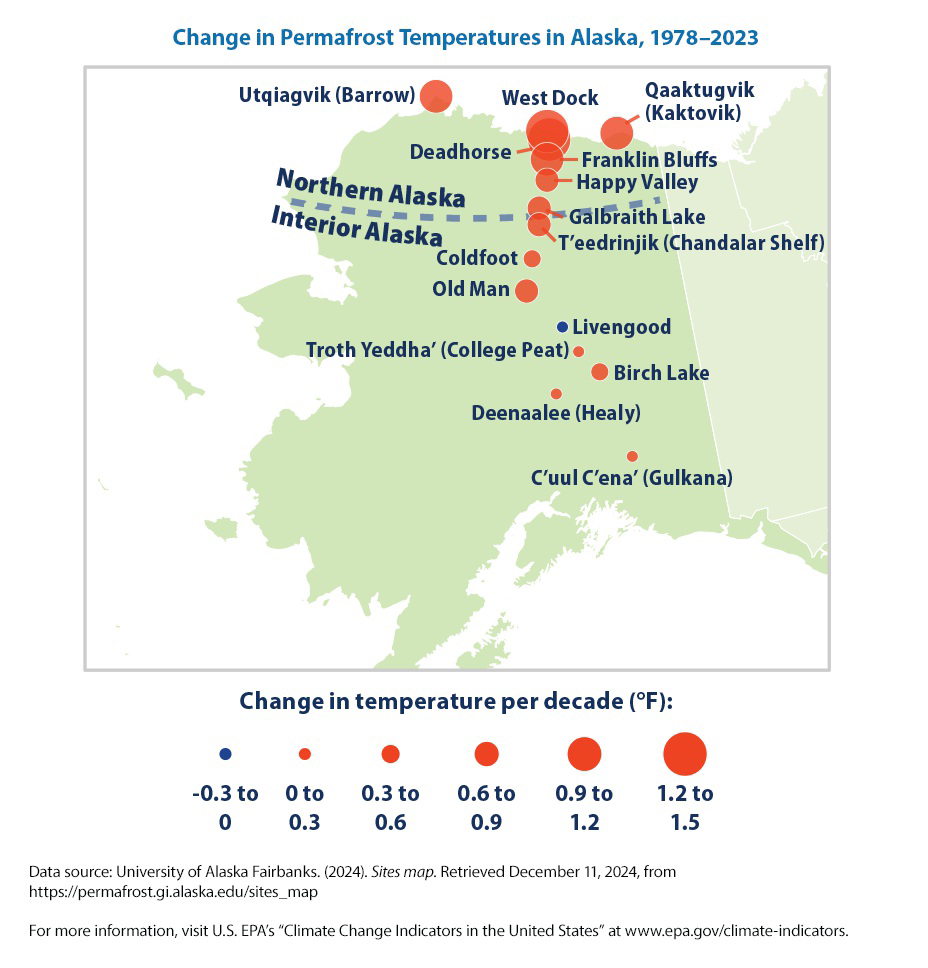
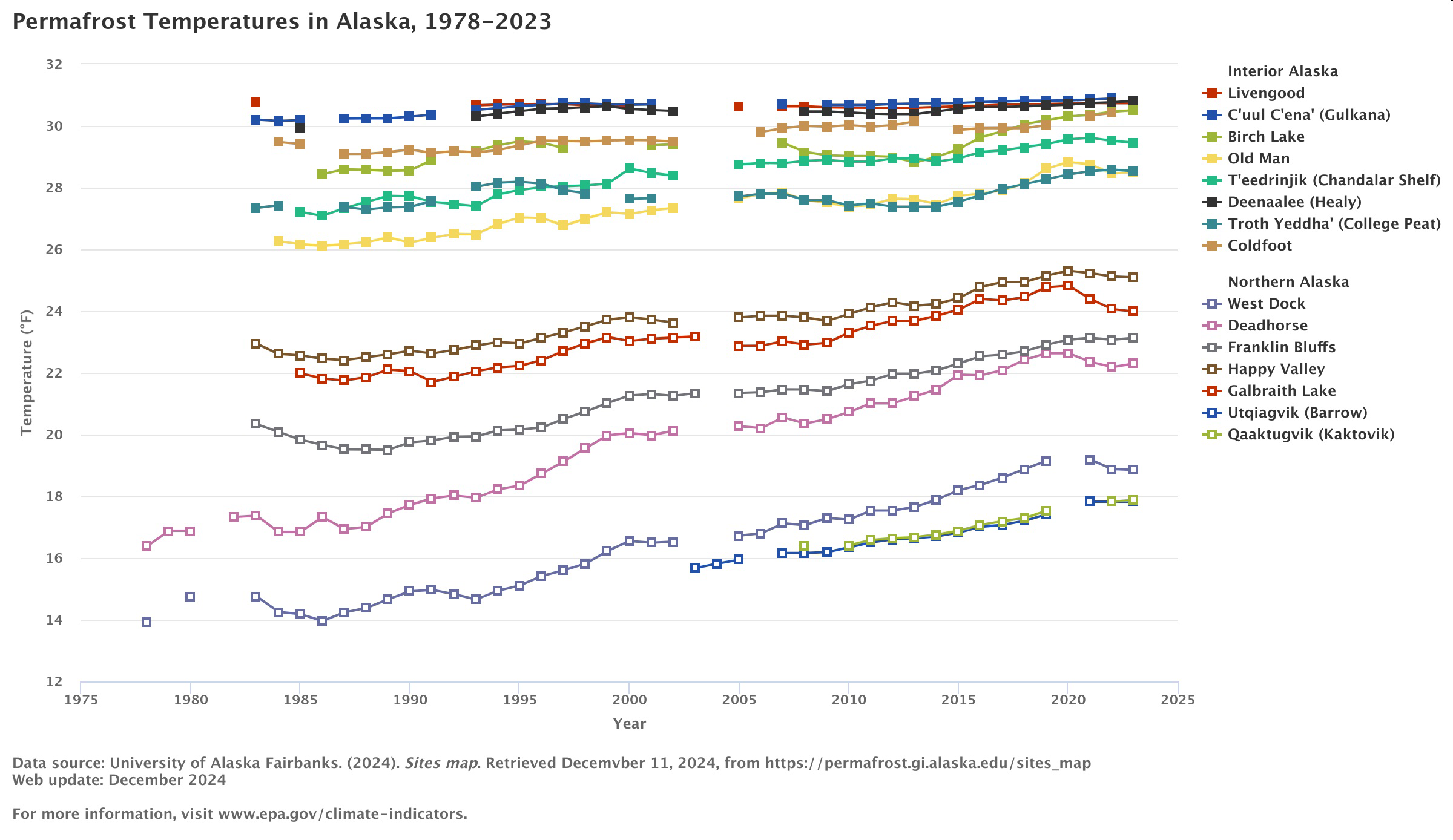
Between 1978 and 2023, permafrost temperatures increased at 14 of the 15 borehole sites shown in this indicator (see Figures 1 and 2). Warming was statistically significant at all 14 of the boreholes that had increases.
In general, permafrost has warmed more quickly in northern Alaska than interior Alaska (see Figure 2). The increasing rate of change in the north is consistent with changes in air temperatures, which have increased more quickly in northern Alaska than in other parts of the state.
The Deadhorse site in northern Alaska had the highest rate of temperature change, at +1.5oF per decade. The Livengood site in interior Alaska was the only site to get cooler over the period of record, though only slightly. Overall, permafrost temperatures have increased at an average rate of 0.6oF per decade.
Changes in permafrost temperature shown in this indicator are consistent with changes observed in Russia, Canada, and other parts of the Arctic.
Background
Permafrost is defined as rock or soil that remains at or below the freezing point of 32oF for two or more years. Permafrost usually lies below an “active layer” of ground that freezes and thaws every year with seasonal changes in temperature. Permafrost occurs in many different forms with various amounts of ice (continuous and discontinuous) and is mainly found in areas near the Arctic. In Alaska, about 80 percent of the ground has permafrost underneath it. A key characteristic affecting the state of permafrost is the temperature at the ground surface and shallow depths. The seasonal timing, amount, and extent of snow cover also affect permafrost. A warming climate has brought higher temperatures to Alaska and other areas with permafrost, causing some permafrost to thaw. While the impacts of climate change on permafrost vary at regional and local scales, permafrost thawing has been observed in many locations around the world.
A thawing permafrost layer can lead to severe impacts on people and the environment. For instance, as ice-filled permafrost thaws, it can turn into a muddy slurry that cannot support the weight of the soil and vegetation above it. Infrastructure such as roads, buildings, and pipes could be damaged as permafrost thaws. Infrastructure damage and erosion, due in part to permafrost thaw, has already caused some communities in western and southern Alaska to have to relocate. Additionally, organic matter (like the remains of plants) currently frozen in the permafrost will start to decompose when the ground thaws, resulting in the emission of methane and carbon dioxide into the atmosphere. This contributes to further global climate change.
Graph of Information - Figure 1.
This figure shows permafrost temperature at borehole sites in interior and northern Alaska, measured at the end of summer (approximately September of each year). Measurements at these sites were taken at depths between 49 and 85 feet.
Graph of Information - Figure 2.
This map shows the change in permafrost temperature per decade for long-term borehole sites in Alaska. Larger circles correspond to greater rates of warming per decade. The blue circle represents a cooling trend. Borehole measurement depths range from 49 to 85 feet.