Plate Tectonics - Fast or Slow?
Source:
https://www.gsi.ie/en-ie/education/our-planet-earth/Pages/The-Earth-through-time.aspx
Plate Tectonics
The Earth's crust and upper mantle is broken into many plates called tectonic plates that are like pieces of a jigsaw puzzle. There are seven major plates that make up 94% of the Earth's surface and many smaller plates making up the other 6%.
Figure 1.
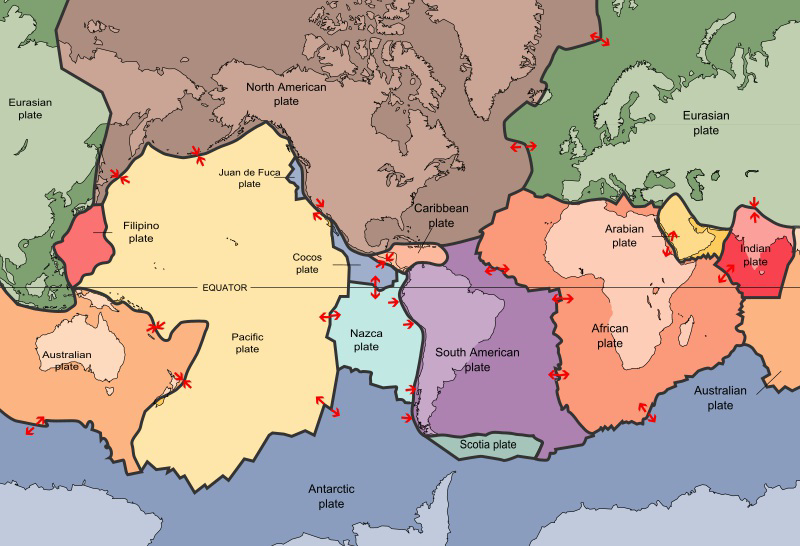
The tectonic plates are in motion and it is thought that they have been in motion since early in earth's history. The word tectonic refers to the structure of the earth and the processes happening on it. Ireland has a long and interesting tectonic history and therefore, we have a great diversity of rock-types in a relatively small area.
Earth's Tectonic History
In the last section we looked at plate tectonics and the movement of the large plates that make up the Earth's crust. Here we will look at how plate tectonics has changed the face of the earth over the last few billion years and how it is continuing to change.
By looking at the globe, we can see that the east coast of South America seems to fit perfectly, almost like a puzzle, into the west coast of Africa. We can also see that North America can be rotated slightly and made to fit comfortably next to Europe, and Asia.
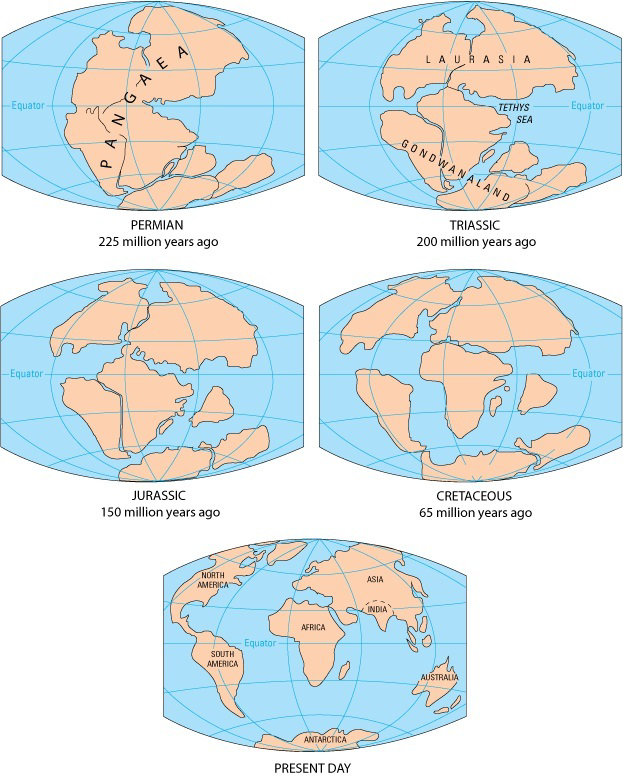
This is evidence that at one point all of these continents were once joined up. This giant landmass known as a supercontinent was called Pangea. The word Pangaea means "All Lands", this describes the way all the continents were joined up together. Pangea existed 240 million years ago and about 200 millions years ago it began to break apart. Over millions of years these pieces came to be the continents as we know them today.
Pangaea was not the first supercontinent and it will not be the last. It is best known because it possible to reconstruct it from the current continents.
Figure 2.