Sea Level
Key Points
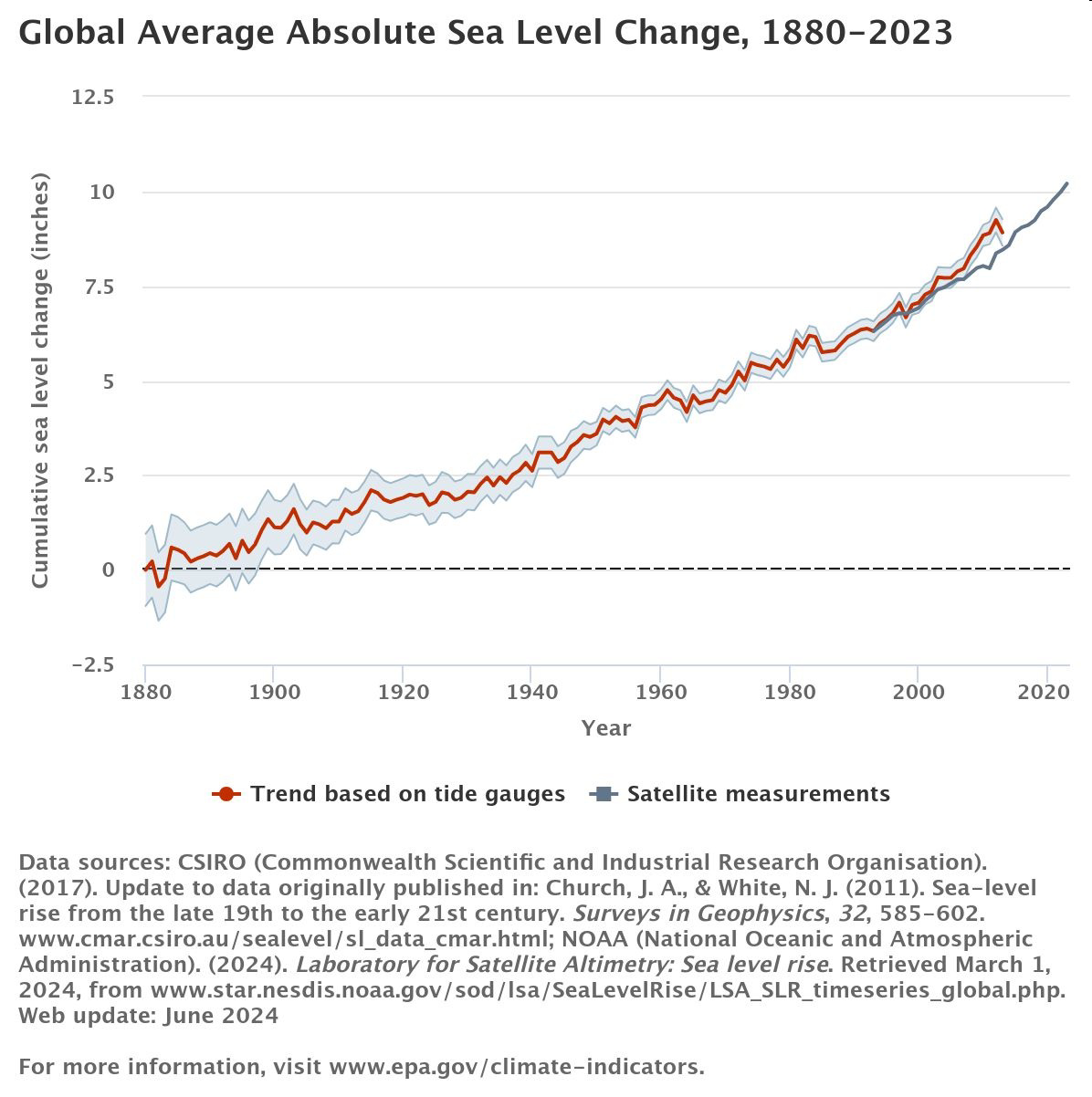
After a period of approximately 2,000 years of little change (not shown here), global average sea level rose throughout the 20th century, and the rate of change has accelerated in recent years. When averaged over all of the world’s oceans, absolute sea level rose at an average rate of 0.06 inches per year from 1880 to 2013 (Figure 1). Since 1993, however, average sea level rose at a rate of 0.12 inches per year - roughly twice as fast as the long-term trend.
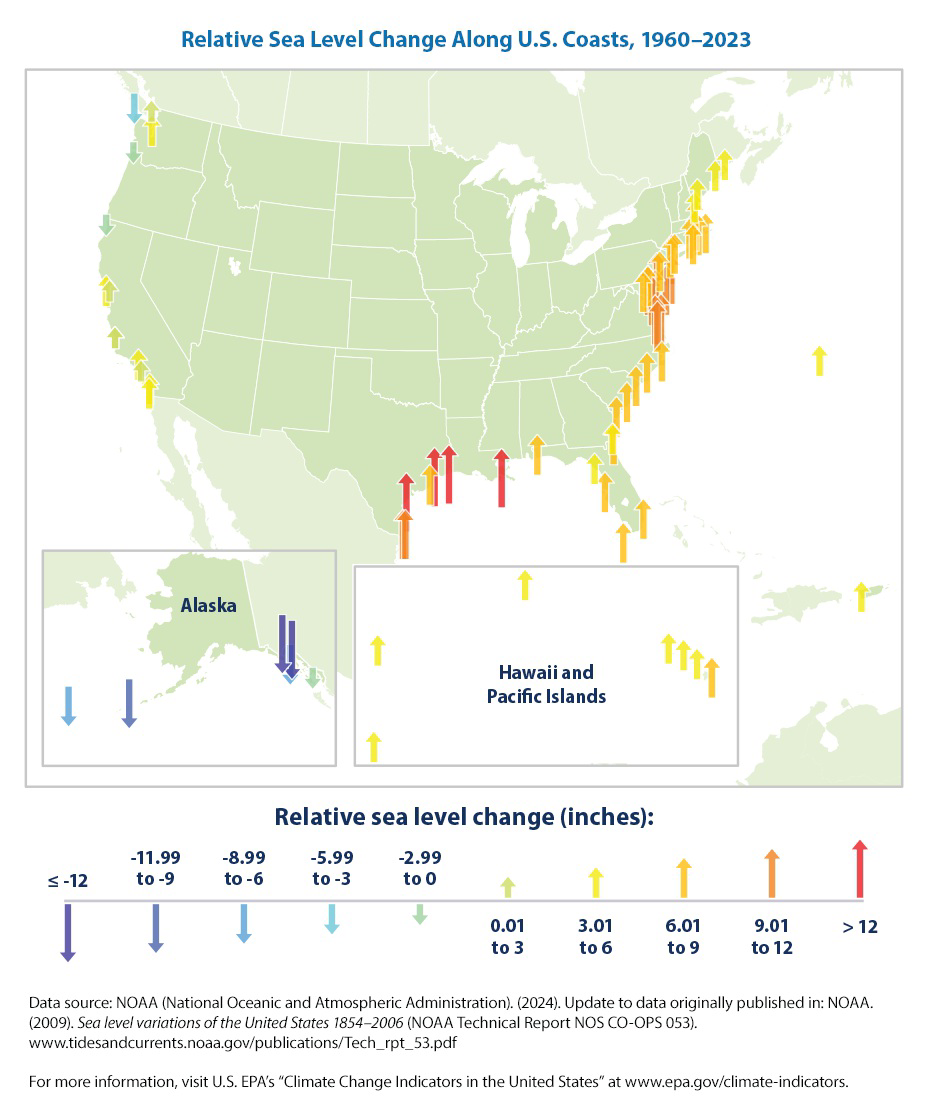
Relative sea level rose along much of the U.S. coastline between 1960 and 2023, particularly the Mid-Atlantic coast and parts of the Gulf coast, where some stations recorded increases of more than 8 inches (Figure 2). Meanwhile, relative sea level fell at some locations in Alaska and the Pacific Northwest. At those sites, even though absolute sea level has risen, land elevation has risen more rapidly.
While absolute sea level has increased steadily overall, particularly in recent decades, regional trends vary, and absolute sea level has decreased in some places. Relative sea level also has not risen uniformly because of regional and local changes in land movement and long-term changes in coastal circulation patterns.
Background
As the temperature of the Earth changes, so does sea level. Temperature and sea level are linked for two main reasons:
Changes in the volume of water and ice on land (namely glaciers and ice sheets) can increase or decrease the volume of water in the ocean.
As water warms, it expands slightly—an effect that is cumulative over the entire depth of the oceans.
Changing sea levels can affect human activities in coastal areas. Rising sea level inundates low-lying wetlands and dry land, erodes shorelines, contributes to coastal flooding, and increases the flow of salt water into estuaries and nearby groundwater aquifers. Higher sea level also makes coastal infrastructure more vulnerable to damage from storms.
The sea level changes that affect coastal systems involve more than just expanding oceans, however, because the Earth’s continents can also rise and fall relative to the oceans. Land can rise through processes such as sediment accumulation (the process that built the Mississippi River delta) and geological uplift (for example, as glaciers melt and the land below is no longer weighed down by heavy ice). In other areas, land can sink because of erosion, sediment compaction, natural subsidence (sinking due to geologic changes), groundwater withdrawal, or engineering projects that prevent rivers from naturally depositing sediments along their banks. Changes in ocean currents such as the Gulf Stream can also affect sea levels by pushing more water against some coastlines and pulling it away from others, raising or lowering sea levels accordingly.
Scientists account for these types of changes by measuring sea level change in two different ways. Relative sea level change refers to how the height of the ocean rises or falls relative to the land at a particular location. In contrast, absolute sea level change refers to the height of the ocean surface above the center of the earth, without regard to whether nearby land is rising or falling. Evidence suggests sea level along the U.S. coastline will rise 10 to 12 inches by 2050 - as much as the rise measured from 1920 to 2020. (The 10 to 12 inches are an average: differences in both land and ocean height mean the rise will vary regionally along U.S. coasts.)
Graph of Information - Figure 1.
This graph shows cumulative changes in sea level for the world’s oceans since 1880, based on a combination of long-term tide gauge measurements and recent satellite measurements. This figure shows average absolute sea level change, which refers to the height of the ocean surface, regardless of whether nearby land is rising or falling. Satellite data are based solely on measured sea level, while the long-term tide gauge data include a small correction factor
because the size and shape of the oceans are changing slowly over time. (On average, the ocean floor has been gradually sinking since the last Ice Age peak, 20,000 years ago.) The shaded band shows the likely range of values, based on the number of measurements collected and the
precision of the methods used.
Graph of Information - Figure 2.
This map shows cumulative changes in relative sea level from 1960 to 2023 at tide gauge stations along U.S. coasts. Relative sea level reflects changes in sea level as well as land elevation.