Glaciers
Key Points
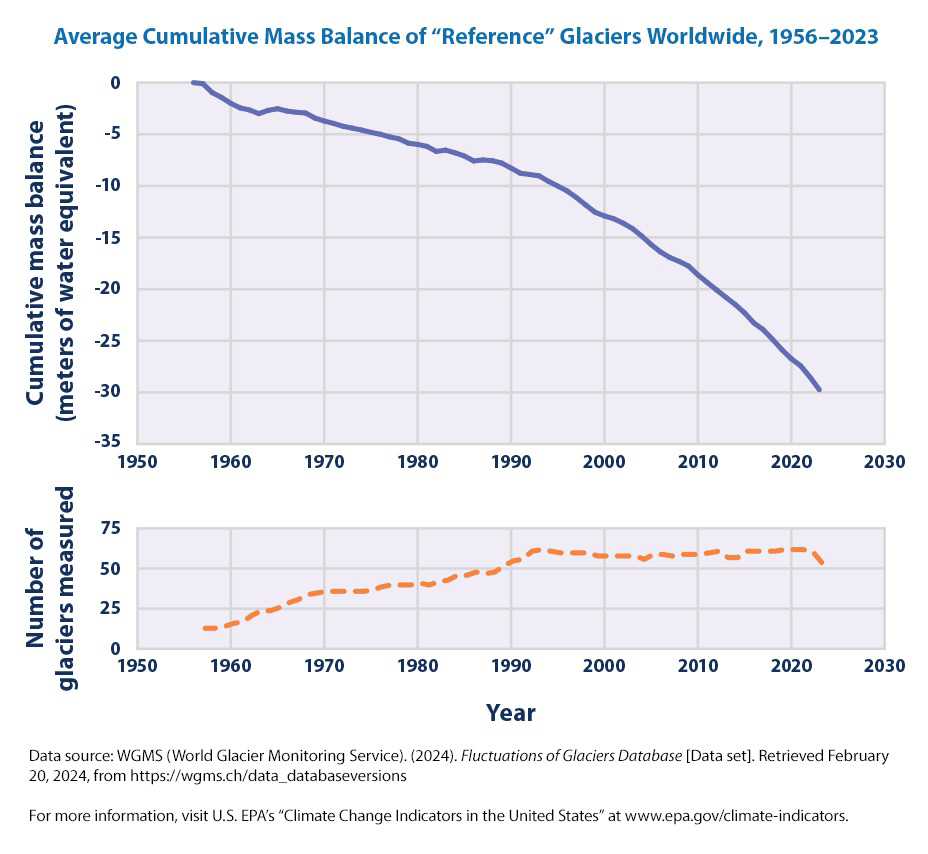
On average, glaciers worldwide have been losing mass since at least the 1970s (see Figure 1), which in turn has contributed to observed changes in sea level. A longer measurement record from a smaller number of glaciers suggests that they have been shrinking since the 1950s. The rate at which glaciers are losing mass appears to have accelerated over roughly the last decade.
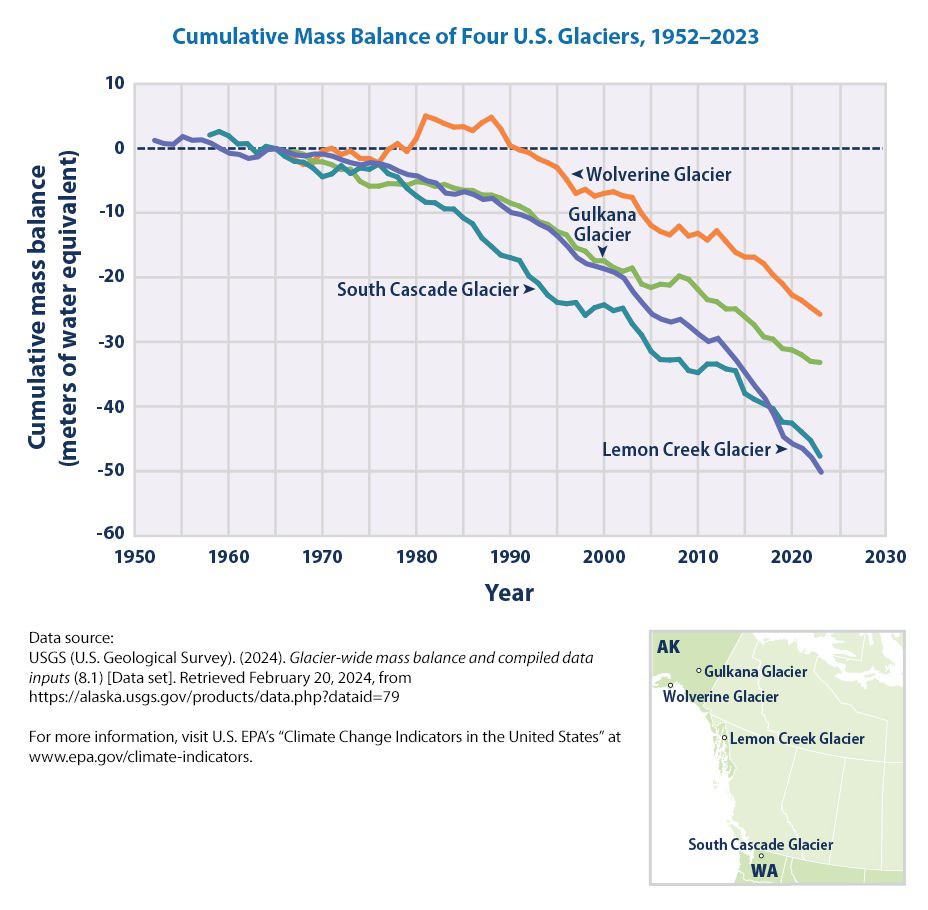
The four U.S. reference glaciers have shown an overall decline in mass balance since the 1950s and 1960s and an accelerated rate of decline in recent years (see Figure 2). Year-to-year trends vary, with some glaciers gaining mass in certain years (for example, Wolverine Glacier during the 1980s), but the measurements clearly indicate a loss of glacier mass over time.
Trends for the four U.S. reference glaciers are consistent with the retreat of glaciers observed throughout the western United States, Alaska, and other parts of the world. Observations of glaciers losing mass are also consistent with warming trends in U.S. and global temperatures during this time period.
Background
A glacier is a large mass of snow and ice that has accumulated over many years and is present year-round. In the United States, glaciers can be found in the Rocky Mountains, the Sierra Nevada, the Cascades, and throughout Alaska. A glacier flows naturally like a river, only much more slowly. At higher elevations, glaciers accumulate snow, which eventually becomes compressed into ice. At lower elevations, the “river” of ice naturally loses mass because of melting and ice breaking off and floating away (iceberg calving) if the glacier ends in a lake or the ocean. When melting and calving are exactly balanced by new snow accumulation, a glacier is in equilibrium and its mass will neither increase nor decrease.
In many areas, glaciers provide communities and ecosystems with a reliable source of streamflow and drinking water, particularly in times of extended drought and late in the summer, when seasonal snowpack has melted away. Freshwater runoff from glaciers also influences ocean ecosystems. Glaciers are important as an indicator of climate change because physical changes in glaciers - whether they are growing or shrinking, advancing or receding - provide visible evidence of changes in temperature and precipitation. If glaciers lose more ice than they can accumulate through new snowfall, they ultimately add more water to the oceans, leading to a rise in sea level. The same kinds of changes occur on a much larger scale within the giant ice sheets that cover Greenland and Antarctica, potentially leading to even bigger implications for sea level. Small glaciers tend to respond more quickly to climate change than the giant ice sheets. Altogether, the world’s small glaciers are adding roughly the same amount of water to the oceans per year as the ice sheets of Greenland and Antarctica combined. Between 1971 and 2018, they added more water overall to the oceans than the ice sheets did.
Graph of Information - Figure 1.
This figure shows the cumulative change in mass balance of a set of “reference” glaciers worldwide beginning in 1956. The line on the upper graph represents the average of all the glaciers that were measured. Negative values indicate a net loss of ice and snow compared with the base year of 1956. For consistency, measurements are in meters of water equivalent, which represent changes in the average thickness of a glacier. The small chart below shows how many glaciers were measured in each year. Some glacier measurements have not yet been
finalized for the last few years, hence the smaller number of sites.
Graph of Information - Figure 2.
This figure shows the cumulative mass balance of four U.S. reference glaciers since measurements began in the
1950s or 1960s. For each glacier, the mass balance is set at zero for the base year of 1965. Negative values indicate a net loss of ice and snow compared with the base year. For consistency, measurements are in meters of water equivalent, which represent changes in the average thickness of a glacier.